3. Reproductive Health
Objectives
What you will learn
- Identify the socio-demographic factors driving population explosion and assess measures taken under RCH programmes.
- Differentiate contraceptive modalities (barrier, copper-releasing vs. hormone-releasing IUDs, oral pills, implants, vasectomy/tubectomy).
- State the statutory criteria, gestation windows, and medical provisions governing the Medical Termination of Pregnancy (MTP) Act.
- Classify major Sexually Transmitted Infections (STIs), distinguishing curable bacterial infections from incurable viral conditions.
- Evaluate Assisted Reproductive Technologies (ART), selecting appropriate interventions (IVF-ET, ZIFT, GIFT, ICSI, IUI) for specific clinical causes of infertility.
Introduction
Chapter 3
Reproductive Health
Big idea: reproductive health means being well in body, mind and relationships. It needs knowledge, safe care and the freedom to make informed choices.
In Chapter 2 you studied how the human reproductive system works. You traced sperm and ova from the organs where they form to the zygote they create. This chapter asks a different question: what does it take to keep that system, and the person who has it, healthy?
The World Health Organisation (WHO) defines reproductive health as total well-being in all aspects of reproduction. Total means more than the absence of disease. Well-being covers the body and also the mind. It covers how a person behaves and how the community treats them. A person is reproductively healthy when their organs work normally, when they feel no fear or shame about their body, when their habits are safe, and when they can reach medical help without difficulty.
This matters to you directly. Between the ages of 16 and 18 the body finishes many changes that began at puberty. Questions arise about growth, relationships and the future. Wrong information spreads fast among friends and on screens. Correct information protects health. It also protects the ability to plan a family later in life.
A society is reproductively healthy when its people know the facts, when clinics and trained staff are within reach, and when families can decide freely about the number and timing of children. Health programmes, fair laws and research all play a part. You will meet each of them in this chapter.
Read the road map from top to bottom. Section 3.1 explains awareness and care. Section 3.2 turns to planning families and slowing population growth. Section 3.3 covers safe medical care when a pregnancy must end. Section 3.4 deals with infections and how to prevent them. Section 3.5 shows how medicine helps couples who cannot conceive. Five stops, one story: knowledge leading to safer choices.
- Explain what reproductive health is and why awareness and health care both matter.
- Describe how population grows and why population stabilisation is a health goal.
- Classify contraceptive methods and explain how each one works in the body.
- Explain medical termination of pregnancy (MTP) and why it should be done only by qualified doctors.
- Name common sexually transmitted infections (STIs) and list ways to prevent them.
- Describe infertility and the main assisted reproductive technologies (IVF, ET, ZIFT, GIFT, ICSI, AI).
3.1 Reproductive health: problems and strategies
Imagine a health camp at a school. A doctor explains the changes of adolescence. A nurse answers quiet questions afterwards. A poster on the wall lists the address of the nearest clinic. Small actions, but together they change how a whole community cares for health. This section explains the system behind such camps.
Many countries set up national programmes to improve reproductive health. Early programmes focused on family planning. Family planning means helping families decide the number of children and the gap between them. It respects the choice of the couple. It does not force any decision.
Over time these programmes widened. Today they are called Reproductive and Child Health (RCH) programmes. The name says what they cover. They care for pregnancy, safe delivery and the newborn child. They provide contraception and treat infections. They look after menstrual health and help couples with infertility. One programme, many doors: a pregnant woman, a teenager with questions and a couple planning a child all enter through it.
Return to the WHO definition from the chapter opening. Reproductive health has four sides. Physical health means organs that work normally and pregnancies that proceed safely. Emotional health means freedom from fear, shame and pressure. Behavioural health means safe personal habits. Social health means a community that supports care instead of hiding problems. A programme that ignores any one side leaves people unprotected.
Read the figure from top to bottom. Each box is one pillar, and each pillar carries its plain meaning. Awareness gives correct information to everyone. Care puts trained staff, clinics and medicines within reach. Rules and protection make laws fair and enforce them. Research keeps testing safer methods and better treatments. The arrows run one way on paper, but in real life the pillars support each other. Information without clinics helps little. Clinics without fair rules reach few people.
People need correct information about the body, adolescence, safe habits, infections and family planning. Parents, teachers, doctors, friends, books, radio, television and reliable websites all carry it. School-based health education matters most, because it reaches young people before myths settle in their minds. A student who understands ovulation, for example, can make sense of every contraceptive method in section 3.2. Knowledge first, decisions later: that is the order that protects health.
Information alone cannot treat anyone. Clinics and hospitals need trained staff, working equipment and a steady supply of medicines. They must handle pregnancy check-ups, safe delivery, contraception services, infections, menstrual problems and infertility advice. Care must be near and affordable. A clinic that is far away or feared is almost the same as no clinic. Privacy matters too: young people seek help sooner when they trust that their questions stay confidential.
Laws protect people when custom or carelessness would harm them. For example, tests such as amniocentesis can reveal the sex of an unborn baby. Using that knowledge to end a pregnancy only because of the sex is banned by law in India. The ban protects mothers from pressure and protects society from a distorted ratio of girls to boys. You will study this misuse in detail in section 3.3. Other rules set a minimum age for marriage and control the quality of medicines. Fair rules turn good intentions into safe practice.
Scientists keep testing new contraceptives with fewer side effects and better treatments for infections and infertility. The once-a-week pill and the hormone-releasing IUD both came out of such research. Every method in section 3.2 passed through trials before reaching clinics. Research is the quiet pillar: patients never see it, but every safe method rests on it.
Programmes need measures of success. Health workers watch several signs. Each sign below shows one side of the system working.
- Fewer mothers and infants die around pregnancy and birth. This shows that delivery care and newborn care are reaching families.
- More deliveries are attended by trained health workers. Skilled hands handle emergencies that home remedies cannot.
- More couples choose to plan the size of their family. Planning shows that contraception and counselling are available.
- STIs are found and treated earlier. Early treatment stops both suffering and further spread.
- More people know where to get medical help. Knowledge of where to go is itself a measure of awareness.
Notice the pattern: the first two signs speak of care, the third of planning, the fourth of treatment and the fifth of awareness. The four pillars appear again in the results.
In the early 1950s India started a national family planning programme, among the earliest such programmes in the world. The aim was to slow rapid population growth by helping couples plan their families. Over the following decades the scope widened. Child immunisation, safe delivery and newborn care joined the effort. Today the work continues under the name Reproductive and Child Health. The lesson of that history is simple: planning births was the starting point, but caring for mothers and children at every stage became the full goal.
Four actions take place in a town. (a) A teacher explains the changes of puberty in class. (b) A clinic appoints a trained nurse for pregnancy check-ups. (c) Officers stop a laboratory that reveals the sex of unborn babies. (d) Scientists test a new contraceptive with fewer side effects. Match each action to one pillar of the programme.
Step 1: list the four pillars: awareness, care, rules and protection, research.
Step 2: action (a) gives correct information, so it belongs to awareness.
Step 3: action (b) puts trained staff within reach, so it belongs to care.
Step 4: action (c) enforces a fair law, so it belongs to rules and protection.
Step 5: action (d) builds a safer method, so it belongs to research.
Check: all four actions are placed, and each pillar appears exactly once.
Result: Action (a) is awareness, (b) is care, (c) is rules and protection, and (d) is research.
Work through these before moving on.
3.2a Population Explosion
A town builds a new school every ten years, yet every new classroom fills up again. More children survive, adults live longer, and the town keeps growing. This is the story of the last hundred years in much of the world. Better food, hygiene, medicines and vaccines let people live longer, and fewer children die. That is good news, but it also means population can grow quickly.
When the number of people grows faster than food, housing, schools, clinics and jobs, the quality of life of everyone is under pressure. Population stabilisation means bringing the growth rate down so that resources and services can keep up. It does not mean forcing families. It means giving every couple the knowledge and means to plan.
Growth by doubling is hard to picture, because the additions keep getting bigger. A town that adds one million people in its first doubling adds two million in its next. Same rate, twice the crowd. A picture makes this clearer than words.
Schematic growth curve of an imagined town that doubles every 35 years. The population rises from 1 million to 2 million after 35 years, 4 million after 70 years and 8 million after 105 years. The curve bends upwards because each doubling adds more people than the last.
Read the curve from left to right. At year zero the imagined town holds 1 million people. After one doubling time of 35 years it holds 2 million. After 70 years it holds 4 million. After 105 years it holds 8 million. Notice the bend: the curve climbs ever more steeply, because each doubling adds more people than the one before. Real towns rarely double so neatly, but the shape of the lesson is true.
An imagined town has 1,000,000 people and its population doubles every 35 years. How many people will it have after 35, 70 and 105 years?
After one doubling time (35 years): .
After two doubling times (70 years): .
After three doubling times (105 years): .
Check: each answer doubles the one before, and 8,000,000 equals , which matches three doublings.
Result: The town grows to 2,000,000, then 4,000,000, then 8,000,000. The numbers added grow bigger each period, so growth speeds up.
To slow such growth, governments encourage smaller families, set a legal minimum age for marriage (18 years for women and 21 for men in India), and give information and services for contraception. Later marriage shortens the reproductive span and keeps young people in education longer. Contraception (also called birth control) means methods that prevent pregnancy. The rest of this section meets all seven groups.
3.2b Contraceptive Methods
Doctors judge a method by four tests. A good method passes all four, but real users weigh them differently. A couple who want a child next year needs reversibility most. A couple who travel far to a clinic need a long-acting method most.
- Easy to use and easy to get. A method that needs daily attention fails when life gets busy.
- Effective, with few or no side effects. Protection matters, but so does comfort and health.
- Reversible, so the user can plan a future pregnancy. Most methods allow a return to fertility after stopping.
- Does not interfere with normal sexual activity or desire. A method that spoils intimacy is soon abandoned.
No method is perfect for everyone. The right choice should always be made with a qualified doctor or health worker. Before the details, study the map below. It shows where each method acts between ovulation and implantation.
Read the pipeline from top to bottom. The pill, injection and implant act first: they stop ovulation, so no egg is released at all. The condom and diaphragm act next: they block sperm travel, so sperm never reach the egg. The copper IUD acts in the uterus: its ions weaken sperm, and it also prevents implantation. Sterilisation cuts the gamete path itself. Five steps, five block points: keep this map in mind as each method now gets its own section.
They work by avoiding the meeting of egg and sperm. They need no devices and cost nothing. Their weakness is timing: the fertile period shifts from month to month, and sperm outlive expectations. So they fail more often than other methods.
Periodic abstinence means the couple avoids intercourse during the fertile period. Recall from Chapter 2 why that period is wide. The ovum stays alive for about a day after ovulation, but sperm can survive for several days inside the female body. So danger days surround ovulation on both sides. In a 28-day cycle with ovulation near day 14, textbooks mark roughly day 10 to day 17 as fertile.
In a 28-day cycle, ovulation happens near day 14 and the fertile period runs from day 10 to day 17. How many fertile days is that, and how many other days does the cycle hold?
Count the fertile days inclusively: .
The rest of the cycle is .
Check: , the full cycle.
Result: There are 8 fertile days and 20 other days. Abstinence must cover all 8 days.
Read the strip of squares from left to right. The first five dark squares are menstruation, days 1 to 5. The eight middle squares, days 10 to 17, glow as the fertile period around ovulation near day 14. The remaining squares are other days. Two warnings sit inside this picture. First, the fertile block is only an estimate: real cycles vary from person to person and from month to month. Second, sperm deposited just before day 10 can still be alive when the ovum arrives. Both facts explain why this method fails more often.
Withdrawal (coitus interruptus) means the male withdraws before ejaculation, so semen is not released in the vagina. Small amounts of fluid can leak before ejaculation, and that fluid can carry sperm. The method also depends on perfect control every time. Both reasons make it unreliable.
Lactational amenorrhoea works after childbirth. Amenorrhoea means the absence of menstruation. While a mother feeds her baby fully and frequently, the hormones of breast-feeding suppress ovulation, so periods stop and pregnancy is unlikely for about six months. Three conditions must all hold: the baby is below six months old, feeding is full with little other food, and periods have not returned. When any one condition breaks, another method must take over at once.
A physical barrier keeps sperm from reaching the egg. Nothing in the body chemistry changes. That simplicity is the strength of this group.
Condoms are thin sheaths of latex or similar material. A male condom covers the penis. A female condom lines the vagina with a flexible ring that holds it in place. Each condom is used once and then thrown away safely. Condoms also reduce the risk of STIs, which no other contraceptive does as well. They block both sperm and direct contact with infected fluids and sores. That double duty is why health workers call the condom a dual-protection method. Correct use every time matters: a torn, expired or wrongly worn condom protects poorly.
Diaphragms, cervical caps and vaults are soft rubber domes that cover the cervix inside the female body. A trained worker fits the right size. They are reusable and are placed before intercourse, with spermicidal cream or jelly that slows and kills sperm. The health worker advises how many hours they must stay in place afterwards. Fitting plus spermicide plus timing: all three decide how well they work.
A doctor or trained nurse places a small device in the uterus through the vagina. A thin thread hangs through the cervix so the position can be checked and the device later removed. Only a trained worker should place or remove it. There are three types: non-medicated (for example the Lippes loop), copper-releasing (for example CuT, Cu7 and Multiload 375) and hormone-releasing (for example LNG-20).
An IUD makes the uterus unfriendly to sperm in three ways. Copper ions released in the uterus slow sperm down and lower their fertilising power. The device also raises phagocytosis of sperm: white blood cells engulf and digest the sperm. Phagocytosis means eating by cells. Hormone-releasing IUDs add two more effects: they thicken the cervical mucus so sperm cannot pass easily, and they keep the uterine lining unsuitable for implantation. IUDs work for years, yet fertility returns after removal. That long, reversible protection explains their popularity.
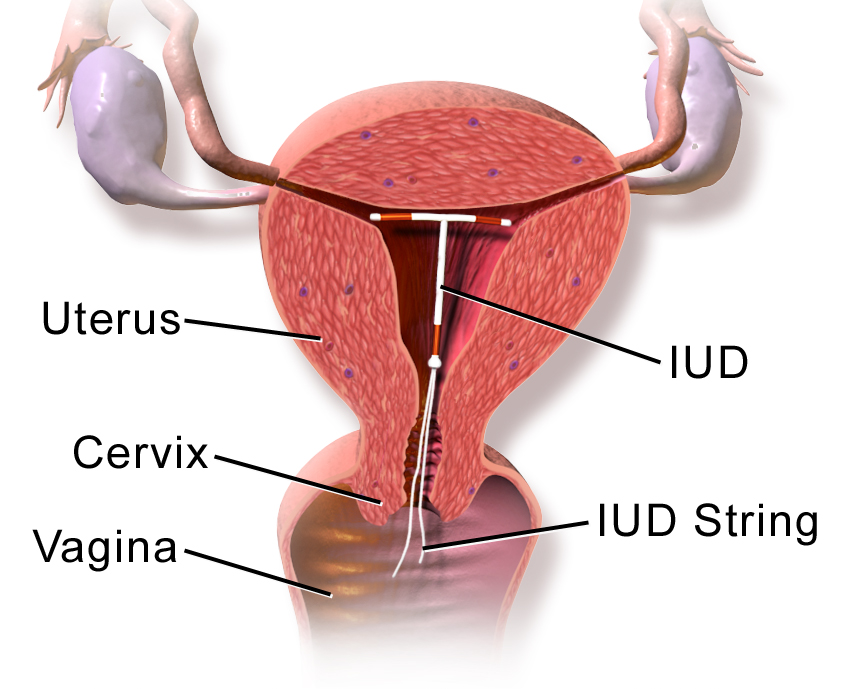

Read the figure from the outside in. The uterus is the large muscular organ in the centre, with a tube leaving each top corner towards the ovaries. Inside the cavity sits the T-shaped device: a white stem with copper-coloured arms. Its stem points down towards the cervix, and a thin string hangs through the cervix into the vagina. Follow that string with your eye: it is the line a health worker checks at follow-up visits. The device fills the cavity where sperm would swim, which is exactly why it works. Placement and removal belong to trained hands only. Never attempt either alone.
The pill holds small doses of progestogen, or progestogen with oestrogen, taken as tablets. These are synthetic versions of the ovarian hormones you met in Chapter 2. A steady daily dose suppresses the release of FSH and LH from the pituitary. Without the LH surge, the follicle never bursts and no ovum is released. The same tablets also thicken the cervical mucus and keep the uterine lining thin, so even a released egg would face two more barriers. Three locks on one door: that is why the pill is so effective when taken correctly.
The usual pack holds 21 active tablets, taken daily starting in the first five days of the cycle. A gap with no active tablets follows. How many days is the gap in a 28-day cycle, and what is the full pack length?
Full pack length: days, one full cycle.
Gap days: .
Check: , the cycle length.
Result: The gap lasts 7 days, and the full pack covers 28 days. Bleeding in the gap follows the hormone fall; it is not a natural period.
Starting within the first five days matters. At that stage no follicle has grown far, so suppression begins in time. Some users feel nausea, headache or weight change at first; a doctor chooses the brand and dose that suits the person. Scientists in India also developed a non-hormonal, once-a-week pill (Saheli), which avoids daily tablets. Missing tablets weakens protection, so the pack instructions must be followed exactly and the doctor asked about any missed dose.
The same hormones as the pill can be given as an injection (effective for weeks to months) or as a small implant placed under the skin (effective for years). A health worker gives the injection or places the matchstick-sized implant in the arm. They work like the pill but need no daily action, which suits users who forget tablets. Fertility returns after the injections stop or the implant is removed, though return may take some months.
After unprotected intercourse, a broken condom or missed pills, a progestogen-based tablet or a copper IUD can still reduce the chance of pregnancy if used within 72 hours (3 days). It works mainly by delaying or blocking ovulation and hindering fertilisation. Sooner is better: each passing day lowers the protection. It is for emergencies only and is not a regular method. The dose is higher than a daily tablet, side effects are stronger, and it cannot end a pregnancy that has already implanted.
These are permanent methods for people who are sure they want no more children. In vasectomy a small part of the vas deferens is cut and tied through a small cut in the scrotum. In tubectomy a small part of the fallopian tube is cut and tied through a small cut in the abdomen or through the vagina. Both operations block the gametes on their road. Reversal is difficult and often fails, so counselling before surgery is essential.
Read the figure as two mirror stories. On the left, sperm leave the testis and climb the vas deferens, but a marked cut blocks the duct before the urethra. On the right, the egg leaves the ovary and enters the fallopian tube, but a marked cut blocks the tube before the uterus. The cuts sit on the roads, never on the factories. The testes still make sperm and androgens. The ovaries still make eggs and hormones. Only transport stops. That is why sexual health, desire and body features stay unchanged after sterilisation.
The table below gathers every method by its mechanism. Read it row by row and ask two questions each time: what does it block, and what must the user remember?
| Method | How pregnancy is prevented | What the user must do | Reversible? |
|---|---|---|---|
| Periodic abstinence | Intercourse is avoided on fertile days | Track the cycle and abstain for 8 days | Yes |
| Withdrawal | Semen is kept out of the vagina | Perfect control every time | Yes |
| Lactational amenorrhoea | Feeding suppresses ovulation | Feed fully; baby below 6 months; no periods yet | Yes, ends by itself |
| Male condom | Sheath blocks sperm in the vagina | New piece, correct use, every time | Yes |
| Female condom | Lining blocks sperm in the vagina | Correct placement every time | Yes |
| Diaphragm, cap or vault | Dome covers the cervix; spermicide slows sperm | Correct size fitted; placed before, kept after | Yes |
| Copper IUD | Ions weaken sperm; phagocytosis rises | Placed and removed by a trained worker | Yes |
| Hormone IUD | Thick mucus blocks sperm; lining resists implantation | Placed and removed by a trained worker | Yes |
| Pill | Hormones stop ovulation; mucus thickens | One tablet daily without missing | Yes |
| Injection or implant | Same hormones, longer action | Clinic visits on schedule | Yes, after stopping |
| Emergency method | Delays ovulation; hinders fertilisation | Used within 72 hours, emergencies only | Yes |
| Vasectomy | Vas deferens is cut and tied | One-time surgery with counselling | No, treat as permanent |
| Tubectomy | Fallopian tube is cut and tied | One-time surgery with counselling | No, treat as permanent |
Three patterns emerge. First, hormonal methods (pill, injection, implant, hormone IUD) all work mainly by stopping ovulation, with mucus and lining as backup. Second, barrier and copper methods never change hormones; they block or weaken sperm. Third, only sterilisation is permanent and only the condom also guards against infections. Examiners often ask for exactly these groupings.
Studies in many countries count how many couples become pregnant in one year of normal (typical) use. Typical means real life, with forgotten tablets and torn condoms included. The numbers below are rounded values often quoted from international studies. Treat them as approximate, because they differ between studies and users. We use them to practise calculation, and to learn one honest lesson: correct and consistent use matters more than the method name.
| Method | Pregnancies per 100 couples in one year (approximate) | Out of 1,000 couples |
|---|---|---|
| No method | 85 | 850 |
| Male condom (typical use) | 13 | 130 |
| Pill (typical use) | 7 | 70 |
| Copper IUD | 1 | 10 |
Read the table from top to bottom as a story of improving protection. Without any method, 85 of every 100 couples conceive within a year. Typical condom use brings that down to 13. Typical pill use brings it to 7. A copper IUD brings it near 1. Correct and consistent use matters more than the method name. No row reaches zero: even the best method used imperfectly can fail, and no method should be chosen without a doctor.
Out of 1,000 couples using no method, about 850 become pregnant in a year. If all of them use male condoms (typical use), how many pregnancies are avoided, and what percent is that?
Pregnancies with condoms: .
Pregnancies avoided: .
Percent avoided: percent.
Check: , the starting total.
Result: About 720 pregnancies are avoided, which is 85% of the pregnancies expected with no method.
Pause here and test the main ideas.
3.3 Medical termination of pregnancy (MTP)
A couple learns that a pregnancy threatens the health of the mother. A doctor confirms that the foetus has a serious disorder. What can medicine do, and what are the limits? This section answers with care, because every option here is a medical decision, never a casual one.
Medical termination of pregnancy (MTP) is the voluntary ending of a pregnancy before it reaches full term. It is also called induced abortion. Induced means brought about by medical action. A pregnancy can also end by itself, which is called a spontaneous abortion or miscarriage. That needs no decision and no procedure. MTP is a medical procedure, so it should be done only by qualified doctors in approved health facilities.
Notice the vocabulary. Termination and abortion describe the ending. Voluntary and induced describe who brings it about. Spontaneous describes nature acting alone. Using the right word keeps discussion respectful and exact.
Doctors consider MTP in three kinds of situations. Each one below is a different reason, and each needs counselling alongside medicine.
- After an unplanned pregnancy, for example when a contraceptive fails or when pregnancy is the result of a crime. The couple did not choose this pregnancy.
- When continuing the pregnancy could seriously harm the health or life of the mother. Here the life and health of the mother come first.
- When the foetus has a serious condition that is found through medical tests. Tests such as ultrasound or amniocentesis can reveal disorders that would make survival impossible or life extremely hard.
In every case the decision belongs to the woman with medical advice, and the procedure belongs to trained hands. Pressure from others has no place in it.
Laws about MTP differ from country to country, and they have been amended in India over time. In India MTP is legal when specific conditions are met, and the permitted stage of pregnancy depends on the rules in force. Check the current rules or ask a doctor. Only qualified doctors may perform it, and only in approved facilities with proper equipment. The general medical rule is the same everywhere: the earlier a pregnancy is ended, the safer it is.
Read the figure as a timeline with a boundary. The left box covers weeks 1 to 12, the first trimester. Trimester means a block of about three months. Here the pregnancy is small and the procedure is simplest, so MTP is considerably safer. The right box covers the weeks after 12, when the foetus is larger and the procedure carries more risk, so the rules are stricter. The dashed line at week 12 marks that change, and the arrow below repeats the message: risk rises as pregnancy advances. Sooner means safer, always with a qualified doctor.
A pregnancy is detected in week 6. How many weeks remain before the end of the first trimester at week 12?
First trimester ends at week . Detection is at week .
Weeks left: .
Check: , the trimester end.
Result: About 6 weeks remain. Early detection leaves time for counselling and safe care.
Amniocentesis is a medical test with a proper purpose. A little fluid is taken from around the foetus and tested for chromosome disorders and some inherited conditions. The fluid carries cells shed by the foetus, and those cells reveal the chromosome set. Used correctly, it prepares parents and doctors for a child with special needs.
The same test can also reveal the sex of the foetus. Using it for that purpose, and then ending the pregnancy only because of the sex, is illegal in India. It harms the mother, who undergoes pressure and procedures, and it is unfair to society. In some places it has distorted the ratio of girls to boys. Counselling, public awareness and strict action against misuse are the correct remedies. The law bans revealing the sex; medicine condemns pressuring the mother; education changes the attitudes behind both.
Make sure these four points are clear.
3.4 Sexually transmitted infections (STIs)
A student notices an unusual discharge but feels no pain, so they wait. Weeks pass, and the infection spreads silently. This section explains why waiting is the most dangerous response, and what the correct response looks like.
Infections that spread mainly through sexual contact are called sexually transmitted infections (STIs). You may also see the older names venereal diseases (VD) and reproductive tract infections (RTI). Common STIs include gonorrhoea, syphilis, chlamydiasis, genital herpes, genital warts, trichomoniasis, hepatitis B and HIV (which can lead to AIDS; see Chapter 7). Learning their names plainly is part of health: a named problem can be treated, while a hidden one grows.
Every STI travels from an infected person to a healthy one through body fluids or close contact. Four routes cover almost all cases.
- Sexual contact with an infected person. This is the main route for all eight diseases above.
- Sharing injection needles or unsterilised surgical instruments. This route matters for hepatitis B and HIV, which survive in blood.
- Transfusion of infected blood or blood products. Tested blood from certified banks has made this route rare, but it caused infections before strict testing.
- From an infected mother to her baby, during pregnancy or birth. Medical care during pregnancy can protect the baby.
Notice what the routes share: each one moves infected fluid into a new body. Every prevention method in this section blocks one of these movements.
Early signs are often mild: itching, unusual discharge, slight pain, or swelling in the genital area. Mild signs are easy to ignore, and that is exactly the trap. Many infected people, especially females, have no symptoms at all. Absence of symptoms never proves absence of infection. Internal anatomy hides the early damage, so the infection goes unnoticed and spreads to others.
If untreated, STIs climb higher and cause lasting damage. They can cause pelvic inflammatory disease (PID), an infection of the uterus and tubes that brings pain and fever. They can block the tubes and cause infertility in both sexes. They can cause ectopic pregnancy, in which the embryo implants outside the uterus, and still birth. Some can lead to cancer of the reproductive tract. HIV is different: it attacks the immune system itself, so the body loses its defence against all diseases.
Bacterial and parasitic STIs such as gonorrhoea, syphilis, chlamydiasis and trichomoniasis can be cured with proper medicines if found early and the full course is taken. Full course matters: stopping tablets when symptoms fade lets the stronger germs survive and return. Viral STIs such as genital herpes, hepatitis B and HIV cannot be fully cured, but doctors can control them with long-term treatment. Vaccines prevent hepatitis B, and vaccination also exists against some types of the virus that cause genital warts and related cancers. Cure, control or prevention: each disease sits in one of these three boxes.
| STI | Caused by | Early signs to notice | Cure, control or prevention |
|---|---|---|---|
| Gonorrhoea | Bacteria | Discharge, pain while passing urine | Curable with antibiotics if treated early |
| Syphilis | Bacteria | Painless sore, then rash and fever | Curable with antibiotics if treated early |
| Chlamydiasis | Bacteria | Often no signs; discharge or pain | Curable with antibiotics if treated early |
| Trichomoniasis | Single-celled parasite | Itching, discharge, irritation | Curable with medicine |
| Genital herpes | Virus | Painful blisters that return | Controlled with medicines, not fully cured |
| Genital warts | Virus | Small growths on the skin | Growths removed; vaccine prevents some types |
| Hepatitis B | Virus | Often silent; tiredness, yellow eyes | Controlled; vaccine prevents it |
| HIV | Virus | Often silent for years | Controlled with long-term treatment |
Read the table in columns. The second column names the enemy: bacteria and parasites can be killed, viruses can only be suppressed. The third column trains your eye: discharge, sores, blisters and growths each point somewhere. The fourth column gives the outcome, and the words curable, controlled and prevents must not be swapped. Genital herpes and HIV are never called curable here.
Each prevention step below blocks one route from the earlier list. Read them as a matched pair: route on the left of your memory, block on the right.
- Use condoms correctly every time. The condom blocks the main route directly.
- Limit the number of partners and avoid sexual contact with partners whose health you do not know. Fewer exposures mean fewer chances.
- Never share needles or razors, and use only sterile instruments in clinics. Sterile means free of all germs.
- Be vaccinated where a vaccine is available, such as for hepatitis B. Vaccination protects before exposure.
- See a qualified doctor early if there is any doubt, and complete the full treatment. Early visits cure more and spread less.
- Share information with partners so they can also be tested. Treating one person while a partner stays infected passes the disease back.
Read the flowchart from top to bottom as the correct response to any suspicion. An unusual sign such as itching, discharge, pain or swelling is the trigger. A doctor visit comes next, without waiting for the sign to pass. The full course of medicine follows, even after feeling better. Finally, partners are tested too, so the infection cannot bounce back. Each box depends on the one above: skip the visit and treatment comes too late; skip the full course and infection returns; skip the partner and it circles back.
Person A notices an unusual discharge with slight pain. Person A feels embarrassed and considers waiting a month. Trace the correct response step by step, and explain what waiting risks.
Step 1: name the trigger. Discharge with pain matches the early signs of an STI, so Person A must act now.
Step 2: see a qualified doctor early. Tests identify the germ, and bacterial causes can still be cured at this stage.
Step 3: complete the full course of medicine. Stopping early lets surviving germs multiply again.
Step 4: inform partners so they are tested and treated too. Otherwise the infection passes back after cure.
Check: waiting a month risks PID, infertility and further spread, while acting now risks only embarrassment. The comparison decides.
Result: Act now: test, treat fully, and cover partners. Waiting trades a small discomfort for lasting damage.
Test the main ideas of this section.
3.5 Infertility
A couple tries for a child for two years without success. Relatives blame the wife. This section corrects that injustice first, and then explains the medicine. Blame has no place in diagnosis.
A couple is called infertile when they cannot conceive after trying for a long time (usually one to two years) with regular unprotected intercourse. Causes may be physical (blocked tubes, low sperm count), congenital (present from birth), related to disease, drugs, immunological (the immune system attacking gametes), or psychological (such as severe stress). Infertility can be caused by problems in the male, in the female, or in both. It is not the fault of one partner alone, and no one should be blamed. Testing both partners is the first medical step, not the last.
Doctors at specialised clinics find the cause and treat it. Hormone treatment, surgery to open blocked tubes, or medicines against infection solve many cases. If treatment cannot fix the problem, assisted reproductive technologies (ART) can help. Assisted means medicine assists a step the body cannot complete.
Seven methods form this group. Each one assists a different failing step. Read the table slowly: the first column names the method, the middle column says what happens, and the last column says when doctors choose it.
| Method | What happens | Used when |
|---|---|---|
| IVF (in vitro fertilisation) | Egg and sperm are joined in a laboratory dish under body-like conditions. In vitro means in glass. | Fertilisation fails inside the body, often with blocked tubes |
| ET (embryo transfer) | The embryo made in the laboratory is placed in the female body. | Always paired with IVF |
| ZIFT (zygote intra-fallopian transfer) | A zygote or an embryo with up to 8 cells is placed in the fallopian tube. | The female tract can still carry an early embryo |
| IUT (intra-uterine transfer) | An embryo with more than 8 cells is placed in the uterus. | The embryo has grown past the tube stage |
| GIFT (gamete intra-fallopian transfer) | An egg from a donor is placed in the fallopian tube of a female who cannot make eggs but can support a pregnancy. | The female makes no eggs but can carry a baby |
| ICSI (intracytoplasmic sperm injection) | A single sperm is injected directly into an egg. Cytoplasm is the living matter inside the cell. | The sperm count is very low |
| AI (artificial insemination) and IUI | Semen from the partner or a donor is placed in the vagina (AI) or directly into the uterus (IUI). | The male cannot inseminate or the sperm count is low |
Two pairs confuse students most. ZIFT and IUT differ only by cell number: up to 8 cells goes to the tube, more than 8 goes to the uterus. GIFT and IVF differ by where fertilisation happens: in GIFT the egg meets sperm inside the tube, while in IVF they meet in the dish. Fix these two pairs and the table is yours.
Read the flowchart from top to bottom. Two collections start the process: ova from the female and sperm from the male. They meet in the laboratory dish, which is fertilisation in vitro. The zygote divides for a short time. Then the path splits by size. An embryo with up to 8 cells is small enough for the tube, so it goes by ZIFT into the fallopian tube, where it would naturally travel. An embryo with more than 8 cells is placed directly in the uterus, which is IUT. The split matches nature: small embryos belong in the tube, larger ones in the womb.
An embryo in the laboratory is checked and found to have 8 cells. How many rounds of division produced it, and should it be transferred by ZIFT or IUT?
Each round doubles the cells: , , , . Three rounds give cells.
The ZIFT limit is up to 8 cells. is within that limit, so transfer goes to the fallopian tube.
Check: one more round would give cells, which would exceed the limit and need IUT instead.
Result: Three rounds produced it, so it goes by ZIFT into the fallopian tube.
Couple A has blocked fallopian tubes, but the female makes healthy eggs and the male has a normal sperm count. A counsellor suggests GIFT. Is that the right method? Trace the correct choice.
Step 1: list the problem. The tubes are blocked, so neither eggs nor embryos can travel them.
Step 2: test GIFT. GIFT places a donor egg into the tube, but the tubes here are blocked, so GIFT cannot work. The suggestion is wrong.
Step 3: test IVF. IVF joins egg and sperm in a dish, bypassing the tubes completely, so blocked tubes do not matter.
Step 4: choose the transfer. The embryo is placed by ZIFT or IUT depending on its cell number.
Check: every step avoids the blocked tubes. The choice fits the problem.
Result: IVF followed by embryo transfer, not GIFT. Match the method to the blocked step.
Read the three pairs as three different broken steps. Blocked tubes break the meeting place, so fertilisation moves to the dish. Missing eggs break the supply, so a donor egg enters the healthy tube. Missing sperm break the numbers, so one sperm is injected or semen is placed directly. One problem, one matching method: that is how doctors read this figure.
IVF followed by embryo transfer is popularly known as the test-tube baby programme. The baby does not grow in a test tube; only the first stage of fertilisation happens outside the body. The embryo grows in the uterus of the mother exactly like any other baby.
These techniques need highly skilled professionals, special equipment and high costs, so access is limited. Counselling matters as much as equipment: success is not certain, and couples need honest numbers before they begin. Some couples decide to adopt a child instead, which is another way to build a family. Adoption gives a waiting child a home, and it deserves the same respect as any medical path.
Review the infertility story before moving on.
Summary
Summary
Reproductive health is total well-being in all aspects of reproduction: physical, emotional, behavioural and social. It rests on four pillars: awareness, care, fair rules and research. Every section of this chapter stands on one of them.
- Programmes: family planning grew into Reproductive and Child Health (RCH) programmes. They cover pregnancy, delivery, newborn care, contraception, STIs, menstrual health and infertility. India started its national effort in the early 1950s, among the earliest in the world.
- Population stabilisation: growth by doubling adds ever bigger crowds: an imagined town of 1,000,000 doubling every 35 years reaches 2,000,000, then 4,000,000, then 8,000,000. Smaller families, later marriage and contraception slow the rate.
- Contraceptive methods: natural methods (periodic abstinence over 8 fertile days, withdrawal, lactational amenorrhoea); barriers (male and female condoms, diaphragm and caps with spermicide); three IUD types; the pill (21 active tablets plus a 7-day gap); injectables and implants; emergency care within 72 hours; permanent sterilisation by vasectomy and tubectomy.
- MTP: voluntary termination of pregnancy by qualified doctors in approved facilities. Safest in the first trimester (weeks 1 to 12); risks rise afterwards. Revealing foetal sex by amniocentesis and sex-selective termination are illegal.
- STIs: gonorrhoea, syphilis, chlamydiasis, trichomoniasis, genital herpes, genital warts, hepatitis B and HIV spread by sexual contact, shared needles, infected blood and mother-to-baby routes. Bacterial and parasitic STIs are curable if treated early with a full course; viral ones are controlled. Condoms, sterile instruments, vaccines and early treatment prevent them.
- Infertility: inability to conceive after one to two years of trying, with causes in either partner. ART matches the broken step: IVF with embryo transfer, ZIFT up to 8 cells, IUT beyond that, GIFT for missing eggs, ICSI or AI for very low sperm counts. Adoption is an equal path to a family.
Revise this chapter in three passes. First, redraw the method pipeline from memory: ovulation, sperm travel, fertilisation, implantation, with the method that blocks each. Second, retell the safety rules aloud: MTP only by doctors, STI treatment as a full course, sterilisation as permanent. Third, explain the two number stories without looking: doubling growth and the typical-use pregnancies avoided. Teaching aloud exposes gaps fast.
Six slips to avoid in the examination hall
- Reproductive health has four sides, not one. Name all four.
- Natural methods fail more often because cycles vary and sperm survive for days.
- The pill stops ovulation. It cannot end an implanted pregnancy and gives no STI protection.
- MTP is safest in the first trimester. Unsafe providers cause bleeding, infection and death.
- Viral STIs are controlled, never cured. Silent infection still spreads.
- Infertility is never one partner’s fault. ZIFT takes up to 8 cells; IUT takes more.
Exercises
Try these questions without looking at the answers. Write your answer in full sentences first, then compare.
3.1 A town reports fewer infant deaths but no rise in planned families. Which pillar of the programme is working, and which is weak? Explain.
3.2 A clinic offers free medicines but turns away teenagers who come with questions. Which sides of reproductive health are served, and which are missing?
3.3 A town of 500,000 people has a doubling time of 40 years. How many people will it have after 80 years? Show the steps.
3.4 A population grows with a fixed doubling time. Explain why the yearly addition still gets bigger every decade.
3.5 Explain two ways a higher minimum age for marriage helps population stabilisation.
3.6 A couple wants a child next year but needs contraception now. Which method property matters most, and name two suitable groups.
3.7 A pill pack holds 21 active tablets in a 28-day cycle. Show that the gap is 7 days, and explain why the pack starts in the first five days.
3.8 A couple relies on withdrawal. Give two biological reasons it can fail.
3.9 Explain how a copper IUD prevents pregnancy at the biological level.
3.10 Before tubectomy, what must counselling cover, and why can reversal not be promised?
3.11 A condom breaks during intercourse. About 48 hours have passed. Can emergency contraception still help? Explain how it works and why it is not a regular method.
3.12 Give three dangers of MTP done by an untrained provider, and state the safe alternative.
3.13 State True or False with a reason: (a) MTP is safest in the first trimester. (b) Amniocentesis may legally reveal the sex of the foetus. (c) Full breast-feeding protects against pregnancy for two years. (d) Sterilisation removes the gonads.
3.14 A person develops a painless sore, and weeks later a rash with fever. Which STI does this suggest, and what are the next three steps?
3.15 Symptoms vanish after three days of tablets. Why must the full course still be finished, and why must partners be treated?
3.16 Infections spread in an area through shared injection needles. Name two targeted actions and say which route each blocks.
3.17 A family blames the wife for childlessness, but tests show a very low sperm count. Correct the blame and name the suitable ART with a reason.
3.18 A laboratory embryo has 16 cells. How many division rounds produced it, and should transfer be ZIFT or IUT?
3.19 Out of 1,000 couples, typical pill use gives about 70 pregnancies in a year and a copper IUD about 10. How many pill users avoid pregnancy, and how many more pregnancies occur with the pill than with the IUD?
Answers
3.1 Care is working: delivery and newborn services save lives. Awareness and contraceptive services are weak: couples are not yet planning family size. The town needs counselling and contraceptive supply, not just clinics.
3.2 Physical health is served through medicines. Emotional health (freedom from shame), social health (a welcoming community) and behavioural health (guidance for safe habits) are missing. The clinic must add private, respectful counselling.
3.3 2,000,000 people. After 40 years: . After 80 years: . Two doublings multiply the start by four.
3.4 Each doubling adds the whole current population, which is larger than before. An imagined town first adds 1 million, then 2 million, then 4 million. The rate is fixed, but the base keeps growing, so the additions grow.
3.5 It shortens the reproductive span, so fewer births fit into a lifetime. It also keeps young people in education longer, where they learn about health and planning and earn before starting a family.
3.6 Reversibility matters most. Barriers such as condoms, short-term hormonal methods such as the pill, or an IUD that can be removed all suit them. Sterilisation is wrong here because it is permanent.
3.7 Gap: days. Starting early matters because no follicle has grown far yet, so suppression of FSH and LH begins in time and no ovum is released.
3.8 Fluid released before ejaculation can already carry sperm into the vagina. The method also needs perfect control at every act, and a single lapse is enough for fertilisation.
3.9 Copper ions released in the uterus slow sperm down and lower their fertilising power. The device also raises phagocytosis, so white blood cells engulf and digest sperm. Together, few or no sperm reach the egg.
3.10 Counselling must cover that the cut in the fallopian tube is meant to be permanent, that reversal surgery is difficult and often fails, and that hormones and desire stay unchanged because the ovaries are untouched. Consent must be free and fully informed.
3.11 Yes, because 48 hours is within the 72-hour limit. It works mainly by delaying or blocking ovulation and hindering fertilisation, so sooner is better. It is not regular because the dose is higher, side effects are stronger, it is less effective than regular methods, and it cannot end an implanted pregnancy.
3.12 Heavy bleeding, severe infection and death. The safe alternative is MTP by a qualified doctor in an approved health facility, with counselling and follow-up care.
3.13 (a) True: the pregnancy is smaller and the procedure simpler. (b) False: revealing the sex is banned by law. (c) False: protection lasts about six months and only with full frequent feeding and no returned periods. (d) False: only the ducts are cut and tied; the gonads stay and keep making hormones.
3.14 This suggests syphilis. The steps are: see a qualified doctor for tests, complete the full course of antibiotics (it is curable when treated early), and make sure partners are tested and treated too.
3.15 The surviving germs are the strongest, so stopping early lets infection return, possibly in a harder form. Partners must be treated because an untreated partner passes the infection straight back after cure.
3.16 Supply sterile single-use needles and safe disposal, which blocks the shared-needle route for hepatitis B and HIV. Test and counsel users and their partners, which blocks further sexual spread from those already infected.
3.17 The blame is wrong: infertility can come from either partner, and here the male factor is proven. ICSI suits best because a single sperm is injected directly into the egg; artificial insemination is another option. Counselling should remove the blame first.
3.18 Doubling gives , so four rounds produced it. Since 16 exceeds the 8-cell limit, transfer must be IUT into the uterus, not ZIFT.
3.19 Avoid with the pill: couples. Extra pregnancies with the pill: . The IUD protects better because it needs no daily action.