4. Principles of Inheritance and Variation
Objectives
What you will learn
- Apply Mendel's Laws of Segregation and Independent Assortment to monohybrid (3:1, 1:2:1) and dihybrid (9:3:3:1) crosses.
- Differentiate incomplete dominance (Snapdragon), co-dominance (ABO blood typing), and pleiotropy (Phenylketonuria).
- Interpret Morgan's linkage and crossing-over experiments in Drosophila, relating recombination frequency to chromosome mapping.
- Differentiate chromosomal sex determination mechanisms (XX/XY, XX/XO, ZZ/ZW, and haplo-diploidy in honeybees).
- Construct and analyse pedigree charts using systematic decision trees (autosomal vs. sex-linked, dominant vs. recessive).
- Contrast Mendelian disorders (sickle-cell anaemia, haemophilia, thalassemia) with chromosomal aneuploidies (Down, Turner, Klinefelter syndromes).
Introduction
Why does a mango seed grow into a mango tree and never into a neem tree? Why does a hen always lay eggs that hatch into chicks? And why do two brothers sometimes look alike but at other times look quite different?
Two ideas answer all three questions. Inheritance is the passing of characters from parents to offspring. A character is any feature you can observe, such as stem height or seed shape. Variation is the set of differences between individuals, including differences between parents and their own children. Genetics is the branch of biology that studies both.
Variation is all around you. Look at any group of students and list what differs: height, weight, skin tone, eye shape, hair type, blood group. Some differences are small. Some are large. All of them come from two sources working together: the genes received from the parents, and the conditions of life such as food, light and health. Genes set the range. Life fills in the exact value.
| Trait | How it varies | What this tells us |
|---|---|---|
| Pea stem height | Two clear groups: tall or dwarf | One gene with a strong effect |
| Human height | A smooth range from short to tall | Many genes plus food and health |
| Human blood group | Four groups: A, B, AB and O | Three alleles of one gene |
| Pea seed shape | Two clear groups: round or wrinkled | One gene with a strong effect |
Read the table row by row. Pea height and pea seed shape fall into two neat groups. Human height spreads into a smooth range. Blood groups form exactly four classes. One chapter must explain all three patterns. That is the journey ahead: Mendel explains the neat groups, and later sections explain the ranges and the four classes.
People have used inheritance for thousands of years without knowing its rules. Farmers kept seeds from the best plants and bred their best animals. Over many generations this selective breeding gave us high-yield wheat and rice, and dairy cattle that give more milk. Farmers knew that traits are passed on. They did not know how.
The first clear answer came from garden pea plants. Between 1856 and 1863, Gregor Mendel crossed pea plants that differed in seven characters. Each character had two clear, opposite forms, called contrasting traits. He counted the offspring of every cross. Counting turned breeding from an art into a science.
| Character | Trait 1 | Trait 2 |
|---|---|---|
| Stem height | Tall | Dwarf |
| Seed shape | Round | Wrinkled |
| Seed colour | Yellow | Green |
| Pod shape | Inflated (full) | Constricted (pinched) |
| Pod colour | Green | Yellow |
| Flower colour | Violet | White |
| Flower position | Along the stem (axial) | At the tip (terminal) |
Read the table as seven pairs of opposites. Mendel worked with all seven at once. Tall against dwarf, round against wrinkled, violet against white: each pair is sharp, with nothing in between. Sharp pairs are easy to count, and counting is what revealed the ratios.
In this chapter we follow the same path. We start with Mendel and his laws. We then predict crosses with Punnett squares. We meet cases where dominance is partial or shared, traits shaped by many genes, and genes that shape many traits. We end with sex, mutation and human disorders. The rules stay the same throughout. Only the stories grow richer.
- Describe Mendel's experiments and state his laws.
- Use a Punnett square to predict the results of a cross.
- Explain incomplete dominance, co-dominance, multiple alleles, polygenic inheritance and pleiotropy.
- Explain linkage, recombination and sex determination.
- Describe mutation and common human genetic disorders, and read a pedigree chart.
4.1 Mendel's laws of inheritance
In the 1860s, an Augustinian monk named Gregor Mendel grew pea plants in a monastery garden. He was also a trained teacher of physics and natural science. His question was simple: when two different plants are crossed, what will their children and grandchildren look like? His method was new: cross, count, and look for a pattern in the numbers.
Mendel presented his results to a local science society in 1865 and published them in 1866. Few scientists noticed. His paper was rarely read. His idea that traits pass as separate units went against the common belief that traits blend like liquids. His mathematical way of working was also unusual in biology at that time. The world would wait about 35 years before his laws were rediscovered.
Three things made his work successful once it was found again. First, he chose his organism well. Peas grow quickly, give many seeds, have clear contrasting traits, and can either self-pollinate or be cross-pollinated by hand. Second, he started with true-breeding lines. A true-breeding line is one that gives the same trait generation after generation when it self-pollinates. He used 14 such lines, in seven pairs, each pair differing in one character only. Third, he counted. He grew thousands of plants and recorded how many showed each trait. Looking for numbers and ratios was new in biology at that time.
A true-breeding line matters because it gives a clean start. When a true-breeding tall plant is crossed with a true-breeding dwarf plant, every difference in the offspring must come from the cross itself. Nothing is left over from earlier generations. Mendel built this clean start for all seven characters before he crossed anything.
To cross two plants, Mendel took pollen from one parent and placed it on the female part of the other. To be sure the flower could not pollinate itself, he first removed its anthers (the pollen-making parts). This removal is called emasculation. He then covered the flower with a bag so no stray pollen could reach it.
Read the four boxes from top to bottom. Step 1 removes the anthers from a young bud, before they can release pollen. Step 2 bags the flower, so the experimenter controls every grain of pollen that arrives. Step 3 dusts pollen from the chosen male parent on the stigma. Step 4 bags the flower again until seeds form, then collects them. Each step guards the one after it: without emasculation, the bag means nothing, and without the bag, the chosen pollen means nothing.
| Step | What Mendel did | Why it mattered |
|---|---|---|
| Emasculation | Removed the anthers from a young bud | Stopped self-pollination before it could happen |
| Bagging | Covered the flower with a small bag | Kept unwanted pollen away |
| Cross-pollination | Dusted chosen pollen on the stigma | Fixed exactly which two parents were crossed |
| Bag again | Covered until seeds formed | Protected the developing seeds |
Read the table as a chain of guards. Each row answers two questions: what was done, and what would go wrong without it. Examiners often ask why emasculation comes before bagging. The answer sits in the first row: anthers release pollen early, so they must be removed while the bud is still young.
A student wants to cross a violet-flowered plant (pollen donor) with a white-flowered plant (seed bearer). List the four steps in order, and state what goes wrong if the first step is skipped.
Step 1: remove the anthers from the young white-flower buds (emasculation).
Step 2: cover these buds with bags.
Step 3: dust pollen from the violet flowers on their stigmas.
Step 4: cover again until seeds form, then collect the seeds.
Check: if step 1 is skipped, the white flowers pollinate themselves, and the seeds are not all true crosses. The whole experiment fails at the first step.
Result: Follow emasculation, bagging, cross-pollination and bagging again, in that order. Skipping emasculation lets self-pollination spoil the cross.
Work through these before moving on.
4.2 Inheritance of one gene
A cross in which parents differ in one character is called a monohybrid cross. "Mono" means one. Mendel crossed a true-breeding tall pea plant with a true-breeding dwarf one. All the offspring, called the first filial generation (F1), were tall. Filial means belonging to the children. None was medium. None was dwarf.
He then let the F1 plants self-pollinate. In the second filial generation (F2), the dwarf trait came back. About one quarter of the plants were dwarf. About three quarters were tall. The ratio was 3 tall to 1 dwarf. The same thing happened for the other six characters. The hidden trait was not lost. It was not blended. It was only hidden.
Read the flow chart from top to bottom. The two boxes at the top are the parents: tall TT on the left, dwarf tt on the right. The arrows carry one gamete each: T from the tall parent, t from the dwarf parent. The middle box joins them: every F1 plant is Tt, and every one looks tall. The arrow down marks self-pollination of F1. The bottom box gives F2: 1 TT, 2 Tt and 1 tt by genotype, which looks like 3 tall to 1 dwarf. The last line states the lesson: the dwarf trait returns, so nothing blended.
Mendel spoke of "factors" passed in the gametes. We now call each factor a gene. A gene exists in alternative forms called alleles. A diploid organism carries two alleles of each gene, one from each parent. Diploid means having two sets of chromosomes. Keep these words exact. Every later section uses them.
| Term | Meaning | Example in the height gene |
|---|---|---|
| Allele | One form of a gene | T (tall) and t (dwarf) |
| Homozygous | Two identical alleles | TT or tt |
| Heterozygous | Two different alleles | Tt |
| Genotype | The alleles an individual has | TT, Tt or tt |
| Phenotype | The visible trait | Tall or dwarf |
| Dominant | Shows in the heterozygote; written as a capital letter | T |
| Recessive | Hidden in the heterozygote; written as a small letter | t |
Read the table one row at a time and test yourself after each row. Allele is the form. Homozygous and heterozygous describe the pair. Genotype is the code. Phenotype is what you see. Dominant and recessive describe what happens when the two alleles differ. The example column keeps all seven rows tied to one gene, so the words stay concrete.
Write the two alleles of one gene with the capital and small form of the same letter, such as T and t. Using T and d would hide the fact that both belong to the same gene. This small habit prevents large mistakes in long crosses.
A Punnett square is a small table that lists all possible fertilisations. Write the gametes of one parent along the top. Write the gametes of the other down the side. Each box joins one row gamete with one column gamete. Each box is one possible zygote. Here is the F1 self-cross, Tt crossed with Tt.
Read the table like a map. The two labels on the top are the gametes of one parent: T and t. The two labels on the left are the gametes of the other parent: T and t. Each box joins its row gamete with its column gamete, so the four boxes read TT, Tt, Tt and tt. Fertilisation is random, so each box has the same chance. Count the boxes: 1 TT, 2 Tt and 1 tt. That is a genotype ratio of 1 : 2 : 1. Because TT and Tt both look tall, the phenotype ratio is 3 tall : 1 dwarf.
The same result can be written as a product:
Read the product line slowly. Each parent gives T with chance one half and t with chance one half. Squaring the bracket multiplies the two independent choices. The answer matches the four boxes exactly: one quarter TT, one half Tt and one quarter tt. Two roads, one destination.
A farmer grows 1600 F2 pea plants from a Tt crossed with Tt cross. How many tall and how many dwarf plants are expected?
Three quarters are tall: .
One quarter are dwarf: .
Result: About 1200 tall and 400 dwarf. Real counts will be close to these but are not usually exact, because fertilisation is random.
Suppose a student grows 400 F2 plants and finds 290 tall and 110 dwarf. The expected numbers for 3 : 1 are 300 and 100. To judge whether the gap is only chance, scientists use the chi-square value:
Read the formula in words. O means the observed count in one class. E means the expected count in that class. For each class, square the difference, divide by the expected count, and add the classes together. Large gaps give a large value. Small gaps give a small value.
Here . For two classes, a value below 3.84 means the gap can be explained by chance at the usual 5 per cent level. Since 1.333 is below 3.84, the results fit a 3 : 1 ratio.
A tall plant can be TT or Tt. Looking at it does not tell you which. A test cross solves this. Cross the plant of unknown genotype with a homozygous recessive plant (tt). The dwarf parent can only give t, so the offspring reveal what the tall parent gave.
Read the square column by column. The dwarf parent gives only t, so each column repeats t. The tall parent gives T in the first row and t in the second row. The boxes read Tt, tt, Tt, tt. If the tall plant is Tt, half the offspring are tall and half are dwarf (2 Tt : 2 tt, a 1 : 1 ratio). If it is TT, all offspring are tall. So a test cross is a cross of an individual showing the dominant trait with a homozygous recessive individual, to find out its genotype.
Read the flow chart from top to bottom. The top box holds the question: the tall plant is TT or Tt. The middle box performs the cross with a dwarf tt plant. The chart then splits. The left branch shows all tall offspring, which proves TT. The right branch shows half tall and half dwarf, which proves Tt. One cross, two possible endings, and each ending names the genotype.
A student crosses an unknown tall plant with a dwarf plant and raises 240 offspring. 120 are tall and 120 are dwarf. What is the genotype of the tall parent?
A TT parent crossed with tt gives only tall offspring. A Tt parent crossed with tt gives half tall and half dwarf.
Half of 240 is 120. The observed 120 tall and 120 dwarf match 1 : 1.
Check: 120 + 120 = 240, so no plant is missing.
Result: The parent is Tt (heterozygous). A TT parent could not produce dwarf offspring.
Law of dominance. (i) Traits are controlled by units called factors (genes). (ii) Factors occur in pairs. (iii) When the two factors of a pair differ, one (the dominant one) shows and the other (the recessive one) is hidden. This explains why only one parental trait shows in F1 and why the ratio in F2 is 3 : 1.
Law of segregation. The two alleles of a pair separate when gametes form, so each gamete receives only one allele. The alleles do not mix or blend. When the gametes join at fertilisation, the pair is formed again. This explains why the hidden trait reappears in F2.
A gene holds the instructions for making a protein, often an enzyme. Suppose the normal allele makes a working enzyme, and a changed allele makes a broken enzyme or none. A heterozygote has one working copy. Often one working copy makes enough enzyme for the cell. Then the normal allele looks dominant and the changed allele looks recessive.
Read the three bars against the red mark. The mark shows what the cell needs: 30 units. The top bar, a normal homozygote, makes 100 units and clears the mark easily. The middle bar, a heterozygote, makes 50 units and still clears it. The bottom bar makes nothing and fails. The heterozygote looks the same as the normal homozygote, not because its alleles blend, but because half the enzyme is enough.
Dominance is therefore not a property of the gene alone. It depends on the protein and on which trait you look at. The same heterozygote can look dominant for one trait and in between for another, as the next section shows.
Sometimes the heterozygote looks in between the two parents. In the snapdragon, a garden flower, crossing a red-flowered plant (RR) with a white-flowered plant (rr) gives pink F1 flowers (Rr). Neither allele fully hides the other. This is incomplete dominance. In the F2, the phenotype ratio is the same as the genotype ratio: 1 red : 2 pink : 1 white.
Read the flow chart in three stages. The two boxes at the top are the parents: red RR and white rr. Their arrows merge into one F1 box: all Rr, all pink. The arrow down marks self-pollination of F1. The three boxes at the bottom give F2: 1 RR red, 2 Rr pink and 1 rr white. Because pink is neither red nor white, counting colours also counts genotypes.
A gardener self-pollinates pink snapdragons and raises 600 F2 plants. How many red, pink and white flowers are expected?
One quarter are red: .
One half are pink: .
One quarter are white: .
Check: .
Result: Expect 150 red, 300 pink and 150 white. The middle class is the largest.
| Type of dominance | What the heterozygote looks like | F2 phenotype ratio | Example |
|---|---|---|---|
| Complete dominance | Like the dominant parent | 3 : 1 | Pea stem height (Tt is tall) |
| Incomplete dominance | In between the parents | 1 : 2 : 1 | Snapdragon colour (Rr is pink) |
| Co-dominance | Shows both parents fully | 1 : 2 : 1 | ABO blood group (IA IB is group AB) |
Read the table row by row. Complete dominance hides one allele, so the phenotype ratio is 3 to 1. The other two rows both give 1 to 2 to 1, but for different reasons: pink is a blend-like middle, while group AB shows both sugars side by side. The last column pins one example to each row. Do not swap pink with AB.
In co-dominance the heterozygote shows the traits of both alleles fully and separately. The human ABO blood group is the standard example. The gene I has three alleles: IA makes the A sugar on red blood cells, IB makes the B sugar, and i makes none.
| Blood group | Possible genotypes | Sugars on red blood cells |
|---|---|---|
| A | IA IA or IA i | A |
| B | IB IB or IB i | B |
| AB | IA IB | A and B (co-dominance) |
| O | i i | None |
Read the table from left to right. Group A can be IA IA or IA i, so IA is dominant over i. Group B works the same way. Group AB carries IA and IB together, and both sugars appear: that is co-dominance. Group O carries only i, so no sugar appears. This is also an example of multiple alleles: more than two alleles of one gene exist in the population, but any one person carries only two.
A mother has genotype IA i and a father has genotype IB i. What blood groups can their children have and with what probability?
Mother's gametes: IA or i. Father's gametes: IB or i. Combine them in a Punnett square.
Result: Four equally likely children: IA IB (group AB), IA i (A), IB i (B) and i i (O). Each group has probability 0.25.
Read the square box by box. The top labels are the gametes of one parent: IB and i. The left labels are the gametes of the other: IA and i. The four boxes read IA IB, IA i, IB i and i i. The legend below names each group. Each box has the same chance, so each group has probability one quarter.
Pause here and test the main ideas.
4.3 Inheritance of two genes
Mendel also crossed plants that differed in two characters at once. This is a dihybrid cross. "Di" means two. He crossed a true-breeding plant with round, yellow seeds (RRYY) with a true-breeding plant with wrinkled, green seeds (rryy). All the F1 plants (RrYy) had round, yellow seeds. So round (R) is dominant over wrinkled (r), and yellow (Y) is dominant over green (y). These are the same results as two separate monohybrid crosses.
When the F1 plants self-pollinated, all four combinations of seed shape and colour appeared in F2. The ratio was 9 : 3 : 3 : 1. Two of these combinations, round green and wrinkled yellow, were new. Neither parent had them. They appear because the alleles are re-shuffled.
Read the square in three steps. First, look at the labels. Each parent makes four kinds of gamete: RY, Ry, rY and ry. Four kinds from each parent give 16 boxes. Second, pick any box and read it as a meeting: its row gamete joins its column gamete. Third, count by colour. The legend says 9 boxes are round yellow, 3 are round green, 3 are wrinkled yellow, and 1 is wrinkled green. New combinations appear because row and column gametes mix freely.
The 16 boxes contain 9 different genotypes. Their numbers are in this table.
| Genotype | Boxes out of 16 | Phenotype |
|---|---|---|
| RRYY | 1 | Round, yellow |
| RRYy | 2 | Round, yellow |
| RrYY | 2 | Round, yellow |
| RrYy | 4 | Round, yellow |
| RRyy | 1 | Round, green |
| Rryy | 2 | Round, green |
| rrYY | 1 | Wrinkled, yellow |
| rrYy | 2 | Wrinkled, yellow |
| rryy | 1 | Wrinkled, green |
Read the table from top to bottom. The middle column always adds to 16. The bottom row, rryy, appears once: it needs r from both parents and y from both parents, the rarest meeting. The middle row, RrYy, appears four times: it is the easiest meeting to make. Genotype numbers differ, but the phenotype ratio still works out to 9 : 3 : 3 : 1.
Look at each character alone. Round to wrinkled is 3 to 1. Yellow to green is 3 to 1. If the two characters are inherited independently, the chance of any combination is found by multiplying. The table below does this for all four classes.
| Combination | Shape chance | Colour chance | Combined chance |
|---|---|---|---|
| Round and yellow | 3/4 | 3/4 | 9/16 (about 0.5625) |
| Round and green | 3/4 | 1/4 | 3/16 (about 0.1875) |
| Wrinkled and yellow | 1/4 | 3/4 | 3/16 (about 0.1875) |
| Wrinkled and green | 1/4 | 1/4 | 1/16 (about 0.0625) |
Read any row left to right. The shape chance comes from one 3 to 1 ratio. The colour chance comes from the other. Multiplying gives the combined chance. The four combined chances add to 16 sixteenths, which is 1. This is why the dihybrid ratio is simply two monohybrid ratios multiplied together.
A student raises 1600 F2 seeds from a dihybrid cross. How many seeds of each phenotype are expected?
Round yellow: .
Round green: .
Wrinkled yellow: .
Wrinkled green: .
Check: .
Result: Expect 900 round yellow, 300 round green, 300 wrinkled yellow and 100 wrinkled green.
Law of independent assortment. When two pairs of traits are combined in a hybrid, the separation of one pair of alleles is independent of the separation of the other pair. So an allele for seed shape goes into a gamete without any influence from the seed colour allele.
A plant of genotype RrYy is crossed with a plant of genotype rryy, and 320 offspring are raised. What are the offspring?
The RrYy plant makes RY, Ry, rY and ry gametes. The rryy plant makes only ry.
Four equally likely offspring: RrYy, Rryy, rrYy and rryy. Each class is one quarter of 320, which is 80.
Check: .
Result: The phenotypes are 1 round yellow : 1 round green : 1 wrinkled yellow : 1 wrinkled green, with 80 plants in each class.
Mendel published his results in 1866, but they were ignored for about 35 years. His paper was rarely read. Many scientists did not accept that traits are passed as separate units, because they believed traits blend. And his mathematical way of working was unusual in biology.
In 1900, three scientists, Hugo de Vries, Carl Correns and Erich von Tschermak, found his results again on their own. By then microscopes were better, and scientists had seen chromosomes separate during cell division. In the early 1900s, Walter Sutton and Theodor Boveri noticed that chromosomes behave exactly as Mendel's factors do. This is the chromosomal theory of inheritance: genes are carried on chromosomes.
| Chromosomes | Genes (Mendel's factors) |
|---|---|
| Occur in pairs in body cells | Occur in pairs |
| The two members of a pair separate in meiosis, so a gamete gets one | The two alleles of a pair separate, so a gamete gets one |
| Different pairs line up and separate independently | Different gene pairs assort independently |
| One member of each pair comes from each parent | One allele of each gene comes from each parent |
Read the table as four parallel statements. Each row says the same thing twice: once in the language of microscopes, once in the language of breeding. When two descriptions match row after row, they are probably describing one reality. That is why the chromosomal theory was accepted.
Read the figure as two equally likely line-ups. On the left, chromosomes carrying R and Y move to one pole, while r and y move to the other. On the right, R and y move together instead. Each line-up is equally likely. The first gives gametes RY and ry. The second gives Ry and rY. Four gamete types in equal numbers: this is independent assortment, seen at the level of chromosomes.
Thomas Hunt Morgan and his students tested the chromosomal theory with the fruit fly. The fly is easy to keep in a bottle, breeds within about two weeks, produces many offspring, males and females are easy to tell apart, and it has only four pairs of chromosomes. Small, fast and simple: a perfect laboratory animal.
Morgan crossed flies that differed in two characters, as Mendel had done in peas. He found that when two genes lie on the same chromosome, the parental combinations are much more common than new ones. Genes that travel together like this are linked. Linked genes do not assort independently.
Read the three rows as three levels of closeness. The top row shows genes A and B on separate bars: separate chromosomes, so they assort independently. The middle row shows A and B close together on one bar: tightly linked, rarely separated. The bottom row shows A and C far apart on one bar: loosely linked, separated more often. Position decides partnership: neighbours travel together, distant genes part ways.
The parental combinations are not 100 per cent, though. During meiosis, the paired chromosomes can swap pieces. This is crossing over. It makes recombinants, offspring with new combinations of alleles. Genes that are close together are rarely separated by crossing over, so they are tightly linked. Genes that are far apart are separated more often.
In a cross with two linked genes, a student counts 1000 offspring (imagined numbers): 790 have a parental combination and 210 are recombinants. Find the recombination frequency.
Recombination frequency = recombinants divided by total offspring, times 100.
.
Result: 21 per cent. Morgan's student Alfred Sturtevant used such frequencies as a measure of the distance between genes. This allowed the first gene maps to be drawn.
Check that the two-gene story is clear.
4.4 Polygenic inheritance
Mendel studied traits with two clear forms, such as tall and dwarf. But look around your class. Height, weight, and the weight of a grain of wheat do not fall into two groups. They form a smooth range from low to high. Such traits are controlled by several genes acting together. This is polygenic inheritance ("poly" means many).
In polygenic inheritance each gene has a small effect, and the effects add up. The more "plus" alleles an individual carries, the stronger the trait. The environment (food, light, water) also matters. That is why polygenic traits show a wide range instead of two sharp groups.
Imagine a trait controlled by three gene pairs, A, B and C, where each capital allele adds one unit. A plant AaBbCc is crossed with another AaBbCc. Each parent makes 8 kinds of gamete, giving 64 combinations. The number of offspring with 0 to 6 capital alleles is 1, 6, 15, 20, 15, 6, 1 out of 64.
Why these numbers? Think of 6 coin tosses, one per allele slot. Getting exactly 3 plus-alleles can happen in 20 ways, but getting all 6 can happen in only 1 way. Each offspring counts its plus-alleles, and the middle totals have the most ways to form. This is the same pattern as tossing coins: middles are common, extremes are rare.
Bar-like graph of the percentage of offspring with 0 to 6 capital alleles when AaBbCc plants are crossed with AaBbCc. The values 1.6, 9.4, 23.4, 31.3, 23.4, 9.4 and 1.6 percent form a symmetric bell shape peaking at 3 capital alleles.
Read the curve from left to right. The horizontal axis counts capital alleles from 0 to 6. The vertical axis shows the percentage of offspring. The curve climbs to 31.3 per cent at 3 capital alleles, then falls symmetrically to 1.6 per cent at 0 and 1.6 per cent at 6. Most offspring (31.3 per cent) sit in the middle. Only 1.6 per cent have none, and only 1.6 per cent have all six. This bell shape is typical of polygenic traits.
| Capital alleles | Offspring out of 64 | Offspring (%) |
|---|---|---|
| 0 | 1 | 1.6 |
| 1 | 6 | 9.4 |
| 2 | 15 | 23.4 |
| 3 | 20 | 31.3 |
| 4 | 15 | 23.4 |
| 5 | 6 | 9.4 |
| 6 | 1 | 1.6 |
Read the table alongside the curve. Each row is one point on the graph. The middle row, 3 alleles with 20 out of 64, is the peak. The end rows, 0 and 6 alleles with 1 out of 64 each, are the low tails. Table and curve say the same thing in two languages: numbers and shape.
Human height and skin tone follow this pattern. Many gene pairs add small effects, and food and sunlight shift the result. That is why a class shows every height in between, not two fixed groups. One gene acting alone gives sharp classes. Many genes acting together give a smooth range.
Try these before reading on.
4.5 Pleiotropy
So far, one gene affected one trait. Sometimes one gene affects several traits at the same time. This is pleiotropy, and such a gene is a pleiotropic gene. It usually happens because the gene product (a protein or enzyme) is used in more than one process. One faulty part, many breakdowns.
Read the figure as two stories with the same moral. The top story starts with one starch-making enzyme gene. Its arrows split into two effects: starch grain size and seed shape. The bottom story starts with one faulty enzyme gene in PKU. Its arrows split into brain harm and reduced skin pigment. One starting box, two ending boxes, in both stories. That split is pleiotropy.
- Starch in pea seeds. A gene with alleles B and b controls the enzyme that makes starch. BB seeds make a lot of starch and large starch grains, and the seeds stay round. bb seeds make less starch and small grains, and they lose water as they ripen, so they become wrinkled. Bb seeds are round, but their starch grains are in between in size. So for seed shape B is dominant, and for grain size the alleles show incomplete dominance. The gene has two effects: starch grains and seed shape.
- Phenylketonuria (PKU). One faulty enzyme gene causes a build-up of the amino acid phenylalanine. It affects brain development and also reduces pigment in skin and hair.
- Sickle-cell anaemia. One gene change affects the shape of red blood cells and so causes anaemia, pain and damage to several organs.
Read the list as three proofs of one rule. The pea story is the gentlest: one gene, two visible effects, both harmless in the garden. PKU is the medical one: one missing enzyme, two body systems harmed. Sickle-cell anaemia, covered fully in section 4.8, is the third: one haemoglobin change, whole-body effects. The pattern is identical each time.
Pleiotropy also teaches an important point: whether an allele looks dominant depends on which trait you look at. For pea seed shape, B is fully dominant: Bb seeds are round like BB. For starch grain size, Bb is in between: the alleles show incomplete dominance. Same gene, same plants, different answer. Dominance describes a trait, not a gene alone.
| Question | Pleiotropy | Polygenic inheritance |
|---|---|---|
| How many genes? | One | Many |
| How many traits? | Many | One |
| Example | Starch gene affects grain size and seed shape | Many genes plus food affect human height |
Read the table as a mirror. The first two rows are exact opposites: one gene to many traits, against many genes to one trait. The third row pins one example to each side. If you can fill this table from memory, you will never swap the two words.
Test the main ideas of this section.
4.6 Sex determination
What decides whether a baby is a boy or a girl? Early studies of insects gave the first clue. Scientists found that males and females differ in one chromosome. This special chromosome was called the X chromosome. The chromosomes that are the same in both sexes are called autosomes. The chromosomes that differ are the sex chromosomes.
Read the figure row by row. Each row names one system and gives both sexes. Humans and fruit flies share the first row: females XX, males XY. Some insects lose the second X in males: females XX, males XO. Birds reverse the pattern: females ZW, males ZZ. Honey bees use no letter at all: fertilised eggs become females, unfertilised eggs become males. Four rows, four answers to one question.
- XO type: in some insects, females have two X chromosomes (XX) and males have only one (XO). Half the sperm carry an X and half carry none.
- XY type: in humans and fruit flies, females are XX and males are XY. The Y chromosome is the one that differs.
- ZW type: in birds, the pattern is reversed. Males are ZZ and females are ZW. Here the egg decides the sex of the chick.
Three systems, one idea: the two sexes carry different chromosome sets, so one of them must make two kinds of gametes. Which sex makes two kinds decides which parent controls the outcome.
| System | Which sex makes two kinds of gametes | That sex is called |
|---|---|---|
| Human / fruit fly (XY) | Male (X or Y sperm) | Heterogametic male |
| Bird (ZW) | Female (Z or W egg) | Heterogametic female |
| Some insects (XO) | Male (X or no-X sperm) | Heterogametic male |
| Honey bee | Female (fertilised or not) | Haplodiploid (see below) |
Read the table as cause and effect. The middle column names the two gamete types. The last column names the result: heterogametic means making two kinds of gametes, and homogametic means making one kind. In humans the male is heterogametic. In birds the female is heterogametic. The word always follows the two kinds.
A human body cell has 46 chromosomes: 22 pairs of autosomes and one pair of sex chromosomes. A female has XX. A male has XY. Every egg carries one X. A sperm carries either X or Y. So the sperm decides the sex of the baby. If an X sperm fertilises the egg, the child is XX (a girl). If a Y sperm does, the child is XY (a boy).
Read the square the way fertilisation reads it. The mother XX makes only X eggs: both row labels are X. The father XY makes X and Y sperm: the column labels differ. The boxes read XX, XY, XX, XY. In the square, 2 of 4 boxes are XX and 2 are XY. So the chance of a girl is 50 per cent and the chance of a boy is also 50 per cent, at each pregnancy. The sex of one child does not change the chance for the next.
In a hospital 200 babies are born in one month. About how many girls and how many boys are expected?
Each birth has an equal chance: half XX and half XY.
Girls: . Boys: .
Check: .
Result: About 100 girls and 100 boys. Real counts vary a little around these values.
In honey bees, sex depends on the number of sets of chromosomes. A fertilised egg (2n = 32) develops into a female, which is a queen or a worker. An unfertilised egg develops into a male (a drone) with n = 16 chromosomes by parthenogenesis, development without fertilisation. This is the haplodiploid system. Haplo means single, diplo means double.
So a drone has no father and no sons. It has a mother and a grandfather. A drone makes sperms by mitosis, not meiosis, because he is already haploid. There is nothing to halve. This detail often appears in examinations, so learn it as a chain: unfertilised egg, haploid male, sperms by mitosis.
Review the sex story before moving on.
4.7 Mutation
Copy a long sentence by hand and you may misspell a word. Cells copy DNA in the same way, and they too can make mistakes. A mutation is a change in the DNA sequence. It changes the genotype and may change the phenotype. Together with recombination, mutation is a main source of variation. Without mutation, every child would be a perfect copy, and evolution would stop.
Read the flow chart from top to bottom. The top box names the event: a change in DNA. The three boxes below sort it by size. The left box is the largest: a chromosomal aberration moves or copies many genes at once. The middle box is the smallest: a point mutation changes one base pair. The right box shifts the reading frame, so its damage spreads along the gene. One cause, three sizes of effect.
- Chromosomal aberrations: loss (deletion), extra copies (duplication), or rearrangement of a part of a chromosome. Because genes sit on chromosomes, this changes many genes at once. Such changes are common in cancer cells.
- Point mutation: a change in a single base pair of DNA. Sickle-cell anaemia is a point mutation: one base change in the gene for the beta chain of haemoglobin replaces the amino acid glutamic acid (codon GAG) by valine (codon GUG).
- Frame-shift mutation: a base is added or lost, so the "reading frame" of the genetic code shifts (see chapter 5).
Read the list from large to small. Chromosomal aberrations move whole blocks of genes. Point mutations touch one base pair. Frame-shifts add or remove a letter, so everything after the change reads wrong. The sickle-cell example pins the middle row to a real disease you will meet again in section 4.8.
Read the DNA code in groups of three letters, like three-letter words. Original message: THE CAT SAW THE DOG.
- A point mutation changes one letter: THE CAR SAW THE DOG. Only one word changes.
- A frame-shift deletes one letter (the C): THE ATS AWT HED OG. Every word after the change is wrong.
Read the two changed messages aloud. The point mutation still reads almost like English: one word is odd, the rest is fine. The frame-shift reads like nonsense from the second word on. This is why a deletion or insertion of one or two bases is usually more harmful than a change of a single base.
Factors that cause mutation are mutagens. A mutation can also happen by chance when DNA is copied. Not every mutation is harmful. Some have no effect, and a few are useful. New alleles for sickle-cell carriers, for example, protect against malaria in some regions. Harmful, harmless or helpful: mutation supplies all three, and the environment judges between them.
| Mutagen | Example | What it does |
|---|---|---|
| UV light | Strong sunlight on skin cells | Damages DNA during copying |
| X-rays | High-dose medical scans | Break DNA strands |
| Some chemicals | Certain chemicals in tobacco smoke | Change base pairs in DNA |
Read the table as three warnings. Each row names one mutagen, places it in life, and states its damage. UV light and X-rays are physical agents. The chemicals are chemical agents. Chance errors during copying need no agent at all. Prudent habits avoid the avoidable ones.
Some mutations add or remove whole sets of chromosomes. A cell with more than two sets is polyploid. Polyploidy is common in plants, and it is used in crop improvement. Larger fruits and stronger stems often come from extra chromosome sets. Here mutation becomes a tool, not just an accident.
Make sure these three ideas are clear.
4.8 Genetic disorders
Many disorders run in families. Doctors cannot cross humans the way Mendel crossed peas. Instead they read the family history. A pedigree is a family tree that follows one trait through several generations. Roman numerals (I, II, III) mark the generations. Numbers label the individuals. By reading it, doctors and genetic counsellors can tell whether a trait is dominant or recessive, and whether it is linked to the sex chromosomes.
Read the key piece by piece. A square is a male and a circle is a female. A filled symbol is an affected person. A symbol with a dot in the centre is a carrier: healthy, but carrying one faulty allele. A horizontal line joining a square and a circle is a mating. A vertical line drops from the mating to the children. Learn these five marks before reading any pedigree.
Three rules read most pedigrees. Learn them in order, because each one answers a harder question than the last.
- If two unaffected parents have an affected child, the trait is recessive, and both parents are carriers.
- If every affected person has an affected parent, the trait is likely dominant.
- If the trait appears mainly in sons and passes through unaffected carrier mothers, it is X-linked recessive.
Read the rules as shortcuts. The first rule uses a surprise: healthy parents with an affected child must both hide the allele, so it is recessive. The second rule uses continuity: a dominant allele shows in every generation. The third rule uses the sexes: sons show what mothers carry. The two pedigrees below demonstrate the first and third rules.
Trace this pedigree generation by generation. Generation I holds an unaffected father and an unaffected mother. Neither shows the trait, yet generation II holds an affected daughter. The only way this happens is if both parents are carriers (Aa): each gave the daughter an a. The other two children, a son and a daughter, are unaffected (A_), but each could be AA or Aa. Two healthy parents with an affected child means recessive, with both parents as carriers.
Trace this second pedigree the same way. Generation I holds an affected father (Aa, filled square) and an unaffected mother (aa, open circle). In generation II, an affected daughter, an unaffected son, an affected son and an unaffected daughter appear: about half are affected. Every affected child has the affected father. An affected parent in every affected line, with about half the children affected, means dominant. Compare the two pedigrees side by side: the recessive one skips a generation, the dominant one never does.
A Mendelian disorder is caused by a change (mutation) in a single gene, and it follows Mendel's rules. A disorder may be dominant or recessive, and its gene may lie on an autosome or on the X chromosome. Single gene, clear ratios: that is what makes them Mendelian.
| Disorder | Type | Main facts |
|---|---|---|
| Colour blindness | X-linked recessive | Cannot tell red from green because of a fault in a cone-cell gene on the X chromosome. |
| Haemophilia | X-linked recessive | A blood-clotting protein is faulty, so even a small cut can bleed for a long time. |
| Sickle-cell anaemia | Autosomal recessive | Faulty haemoglobin makes red blood cells sickle-shaped when oxygen is low. |
| Phenylketonuria (PKU) | Autosomal recessive | The enzyme that converts phenylalanine to tyrosine is missing, so phenylalanine builds up and damages the brain. Early diet control prevents harm. |
| Thalassaemia | Autosomal recessive | Less of one globin chain of haemoglobin is made, so there is anaemia. |
| Myotonic dystrophy | Autosomal dominant | A muscle disorder in which the muscles are slow to relax. |
Read the table in two halves. The first two rows sit on the X chromosome and strike males more often. The next three rows are autosomal recessive: both parents must pass the allele. The last row is autosomal dominant: one affected parent can pass it on. The middle column tells you which half each disorder belongs to.
The genes for both are on the X chromosome. A male has one X, so a single faulty allele (Xh) shows. A female has two X chromosomes, so she usually needs two faulty alleles to be affected. A female with one faulty allele is a carrier: she is healthy but can pass the allele on. One X against two: that is the whole arithmetic of X-linked traits.
Trace this pedigree like the last two. Generation I holds an unaffected father (XH Y) and a carrier mother (XH Xh, dotted circle). Generation II holds four children: an affected son, an unaffected son, a carrier daughter and an unaffected daughter. The affected son received Xh from his mother and Y from his father. The carrier daughter received Xh from her mother and XH from her father. The pattern is typical: the faulty allele travels silently through females and shows in about half the sons.
Read the square box by box. The mother XH Xh makes XH and Xh eggs: the row labels. The father XH Y makes XH and Y sperm: the column labels. The four boxes read XH XH (normal daughter), XH Y (normal son), XH Xh (carrier daughter) and Xh Y (affected son). In the cross above, 1 of 4 children is an affected son. Since half the children are sons, that is 50 per cent of the sons and 25 per cent of all children. A daughter is affected only if her father is affected and her mother is a carrier or affected.
For colour blindness, suppose the faulty allele has frequency in the population. About 8 in 100 males are affected because each has one X. A female needs two copies, so the simple rule gives 0.64 per cent of females, below 1 per cent.
This is an autosomal recessive disorder. The gene for the beta chain of haemoglobin has two alleles, HbA (normal) and HbS. Below we write them as A and S. Only SS individuals have the disease. AS individuals are carriers. The change is one base: codon GAG changes to GUG, so the amino acid glutamic acid is replaced by valine. Under low oxygen, the faulty haemoglobin clumps together and bends the red cell into a sickle shape.
Read the square as two carriers meeting. Both parents are AS, so each makes A and S gametes. The boxes read AA, AS, AS and SS. When two carriers have a child, there is a 25 per cent chance that the child has sickle-cell anaemia, a 50 per cent chance that the child is a carrier, and a 25 per cent chance that the child has neither the disease nor the allele. Three outcomes, counted box by box.
These disorders come from a missing, extra or abnormal chromosome. A normal human cell has 46 chromosomes. If a pair of chromosomes fails to separate during meiosis, this is called non-disjunction. The gamete then has one chromosome too many or too few. This gain or loss of a chromosome is called aneuploidy.
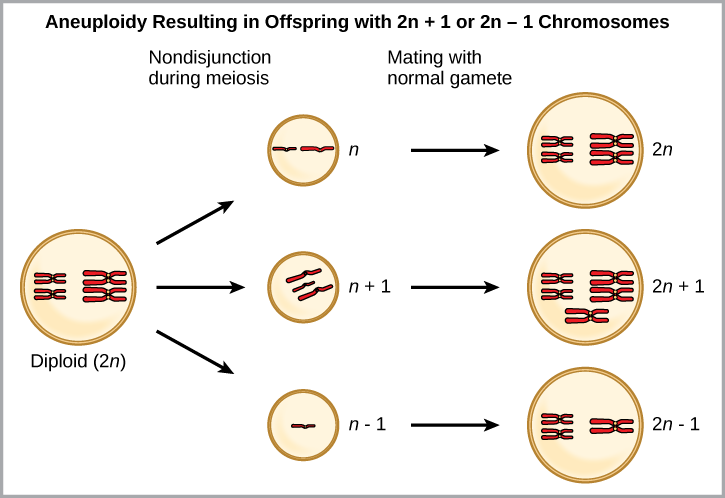
Read the flow chart from top to bottom. The top box names the accident: one chromosome pair fails to separate in meiosis. The two middle boxes show the two faulty gametes: one with 24 chromosomes (one extra) and one with 22 (one missing). Each joins a normal gamete of 23. The bottom boxes show the results: a zygote with 47 chromosomes (trisomy) or with 45 (monosomy). One failed separation, two opposite mistakes.
| Disorder | Chromosomes | Cause | Some features |
|---|---|---|---|
| Down syndrome | 47 (XX or XY) | Three copies of chromosome 21 (trisomy 21), first described by Langdon Down in 1866 | Short stature, small round head, broad palm with a single crease, some delay in learning and speech |
| Klinefelter syndrome | 47, XXY | An extra X in a male | Mostly male body, some breast development, usually sterile |
| Turner syndrome | 45, X0 | One X missing in a female | Short stature, ovaries not fully developed, usually sterile |
Read the table row by row. Down syndrome adds a small autosome: chromosome 21 in three copies. Klinefelter syndrome adds a sex chromosome: XXY instead of XY. Turner syndrome loses one: a single X instead of two. Extra or missing: the middle column counts them, and the last column lists what doctors observe.
Check the numbers: 46 + 1 = 47 for Down and Klinefelter syndromes, and 46 − 1 = 45 for Turner syndrome.
| Question | Mendelian disorders | Chromosomal disorders |
|---|---|---|
| Cause | Change in one gene | Extra or missing chromosome |
| Examples | Haemophilia, sickle-cell anaemia, PKU | Down, Klinefelter and Turner syndromes |
| Inheritance pattern | Follow Mendel's ratios | Usually arise anew by non-disjunction |
Read this table as the section in miniature. The first row separates one misspelled gene from one miscounted chromosome. The second row sorts the six named disorders into two boxes of three. The third row separates ratios that repeat every generation from accidents that usually happen once.
Test the disorder story before moving on.
Summary
Summary
Genetics studies inheritance (passing on of traits) and variation (differences between individuals). Mendel found its basic rules with pea plants: cross, count, and look for ratios. Chromosomes carry the genes, so the rules of breeding match the movements of chromosomes in meiosis.
- Monohybrid cross: F1 shows the dominant trait, and F2 shows 3 : 1 (phenotype) and 1 : 2 : 1 (genotype). Law of dominance and law of segregation explain this. A test cross with a homozygous recessive finds an unknown genotype.
- Incomplete dominance (F2 1 : 2 : 1 phenotype), co-dominance and multiple alleles (ABO blood groups) are variations of simple dominance. Whether an allele looks dominant can depend on which trait is studied.
- Dihybrid cross: F2 9 : 3 : 3 : 1. Law of independent assortment: genes on different chromosomes assort independently. The branch method multiplies two 3 : 1 ratios.
- Chromosomal theory: genes lie on chromosomes. Linked genes are on the same chromosome and are separated by crossing over. Morgan worked this out in fruit flies. Recombination frequencies measure gene distances.
- Polygenic traits depend on many genes and form a bell-shaped range. Pleiotropy: one gene, many effects. The two words point in opposite directions.
- Sex determination: XY in humans (sperm decides), ZW in birds, XO in some insects, haplodiploid in honey bees. The heterogametic sex makes two kinds of gametes.
- Mutation changes DNA: point mutation, frame-shift, chromosomal aberration. Mutagens include UV light and X-rays. Polyploidy adds whole chromosome sets and is used in crop improvement.
- Genetic disorders are Mendelian (single gene: colour blindness, haemophilia, sickle-cell anaemia, PKU, thalassaemia) or chromosomal (Down, Klinefelter, Turner syndromes). Pedigree analysis shows how a trait passes through a family: healthy parents with an affected child mean recessive; an affected parent in every line means dominant.
Revise this chapter in three passes. First, redraw the two famous squares from memory: Tt crossed with Tt, and RrYy crossed with RrYy. Count every box. Second, retell the reading rules aloud: test cross, pedigree rules, who decides sex in each system. Third, explain the two number stories without looking: doubling counts in polygenic crosses and recombination as a measure of distance. Teaching aloud exposes gaps fast.
Six slips to avoid in the examination hall
- Dominant does not mean stronger or more common. It only means the allele shows in the heterozygote.
- The 9 : 3 : 3 : 1 ratio needs independent assortment. Linked genes break it.
- Pleiotropy and polygenic inheritance point in opposite directions. Check one gene to many traits against many genes to one trait.
- The mother does not decide the sex of a human baby. Only sperm carry Y.
- One-base deletions shift the whole reading frame. One-base changes touch one codon.
- Mendelian disorders follow ratios every generation. Chromosomal disorders usually arise anew by non-disjunction.
Exercises
Try these questions without looking at the answers. Write your answer in full sentences first, then compare.
4.1 Mendel used true-breeding lines and counted thousands of plants. Explain how each choice made his ratios trustworthy.
4.2 Fill one line for each pair: (a) dominant and recessive; (b) homozygous and heterozygous; (c) genotype and phenotype.
4.3 A cross Rr × Rr (R = round seed) gives 800 F2 seeds. How many round and how many wrinkled seeds are expected? Show the steps.
4.4 An unknown violet-flowered pea plant is crossed with a white-flowered plant (vv). All 150 offspring are violet. What is the genotype of the unknown plant? Explain.
4.5 A pink snapdragon is crossed with a white snapdragon. What flower colours appear in the offspring, and in what ratio?
4.6 A father has blood group AB and a mother has group O. Which blood groups can their children have, and with what probability?
4.7 A tall plant with yellow seeds (TtYy) is crossed with a tall plant with green seeds (Ttyy). 400 offspring are raised. How many are expected to be (a) tall and green, (b) dwarf and green?
4.8 A plant of genotype RrYy is crossed with rryy and 320 offspring are raised. How many plants fall in each of the four phenotype classes?
4.9 Two genes A and B lie on one chromosome, with A and B on one partner and a and b on the other. Two heterozygous (AaBb) parents are crossed. Which phenotypes appear, and why is there no 9 : 3 : 3 : 1 ratio?
4.10 In a cross with two linked genes, 1000 offspring include 120 recombinants (imagined numbers). Find the recombination frequency. Are the genes tightly or loosely linked?
4.11 In the AaBbCc × AaBbCc cross, what percentage of the offspring carries exactly five capital alleles? Explain without a full square.
4.12 Human height and sickle-cell anaemia both involve genes with wide effects, but they illustrate opposite ideas. Name each idea and explain the difference.
4.13 A couple has three daughters. They believe the next child must be a son. Correct them with the biology of human sex determination.
4.14 In birds, a ZZ male is crossed with a ZW female. What is the sex ratio of the chicks, and which parent decides it?
4.15 Using the three-letter word picture, explain why deleting one DNA letter is usually worse than changing one letter.
4.16 A colour-blind father (XhY) and a carrier mother (XHXh) have daughters. Can any daughter be colour blind? With what probability?
4.17 Two carriers of sickle-cell anaemia (AS × AS) plan three children. What is the chance that all three children are free of the disease?
4.18 A student grows 500 F2 pea plants and finds 370 tall and 130 dwarf. Do these fit a 3 : 1 ratio? Show the steps.
4.19 Match each disorder to its cause: (a) haemophilia, (b) Down syndrome, (c) PKU, (d) Turner syndrome. Causes: faulty gene on the X chromosome; extra copy of chromosome 21; faulty autosomal gene for an enzyme; one missing X chromosome.
4.20 Describe a pedigree that proves a trait is autosomal recessive, and one that proves a trait is autosomal dominant.
Answers
4.1 True-breeding lines gave a clean start, so every difference in the offspring came from the cross itself. Large counts averaged out chance, so the 3 : 1 pattern stood out clearly.
4.2 (a) A dominant allele shows in the heterozygote; a recessive allele shows only in the homozygote. (b) Homozygous means two identical alleles; heterozygous means two different alleles. (c) Genotype is the alleles carried; phenotype is the visible trait.
4.3 Round: . Wrinkled: . Check: .
4.4 VV. A Vv plant crossed with vv would give about half white offspring. With 150 offspring and no white flower, the plant must be homozygous dominant.
4.5 Pink (Rr) × white (rr) gives half pink (Rr) and half white (rr): a 1 : 1 ratio. Unlike pink × pink, no red offspring appear.
4.6 The father gives IA or IB; the mother gives only i. Children are IA i (group A) or IB i (group B), each with probability 50 per cent. Groups AB and O are impossible here.
4.7 (a) 3/4 × 1/2 = 3/8, so . (b) 1/4 × 1/2 = 1/8, so . The tall-green class is three times the dwarf-green class.
4.8 Each class is one quarter: . So 80 round yellow, 80 round green, 80 wrinkled yellow and 80 wrinkled green.
4.9 Only two kinds of gamete (AB and ab) are common, so the offspring are 3 with both dominant traits : 1 with both recessive traits. Independent assortment fails because the genes share a chromosome.
4.10 Frequency = per cent. This is well below 50 per cent, so the genes are tightly linked.
4.11 Six allele slots with five plus and one minus can be arranged in 6 ways, so 6/64, which is 9.4 per cent. The middle counts have the most arrangements.
4.12 Height shows polygenic inheritance: many genes shape one trait. Sickle-cell anaemia shows pleiotropy: one gene change shapes many traits (blood cells, pain, organ damage). Many-to-one against one-to-many.
4.13 Each pregnancy is independent. The father makes X and Y sperm in equal numbers, so every child has about half chance of being a son, whatever came before.
4.14 Half sons (ZZ) and half daughters (ZW). The mother decides it, because her egg carries Z or W while every sperm carries Z.
4.15 Changing one letter spoils one word: THE CAR SAW THE DOG still reads. Deleting one letter shifts every word after it: THE ATS AWT HED OG reads as nonsense.
4.16 Yes. Daughters receive Xh from the father and XH or Xh from the mother, so half are XhXh (affected) and half are XHXh (carriers). Probability: 50 per cent.
4.17 Each child has a 3/4 chance of being AA or AS (disease-free). For three independent children: , which is about 42.2 per cent.
4.18 Expected 375 tall and 125 dwarf. Chi-square = , which is below 3.84, so the results fit 3 : 1.
4.19 (a) Faulty gene on the X chromosome. (b) Extra copy of chromosome 21. (c) Faulty autosomal gene for an enzyme. (d) One missing X chromosome.
4.20 Recessive: two healthy parents (carriers) have an affected daughter, while other children are healthy. Dominant: an affected father and a healthy mother have about half their children affected, with an affected person in every generation.