9. Some Applications of Trigonometry
9. About this chapter
Big idea: A measured angle can reveal an inaccessible height.
Read one small part at a time. Try each example on paper. Then cover the answers and do the practice. Use the diagrams to explain your thinking.
| Word | Meaning |
|---|---|
| Horizontal | Level, like a still water surface. |
| Vertical | Straight up and down. |
| Line of sight | A straight line from your eye to a viewed point. |
9.1 Heights and Distances
Draw the horizontal line through the observer and a vertical line through the object. Mark the angle at the observer, then decide which side is the height difference.
An observer above ground does not measure the full height directly through the tangent ratio. Add the observer height afterwards.
With two observation points, draw both triangles on one diagram and express their bases using the same unknown. Explain the connection between the triangles before solving.
A line of sight joins your eye to the point you look at. Looking up gives an angle of elevation. Looking down gives an angle of depression.
Measure both angles from a horizontal line through your eye. Do not measure from a vertical wall or pole.
When the horizontal reference lines are parallel, the depression angle at the higher point equals the elevation angle at the lower point, by alternate interior angles. Draw both reference lines before naming the angles.
An instrument m above level ground is m horizontally from a vertical mast. The elevation angle is . The height above the instrument is m. The total mast height is m.
Add the instrument height to the rise above its horizontal line of sight.
Two ground-level points lie on the same line on one side of a vertical tower. The nearer is m closer. Elevation angles are nearer and farther. Let be the nearer distance and the height. Then and . Equating gives , hence m and m. The larger angle at the nearer point agrees with the drawing.
A m cable makes a angle with level ground. Its vertical rise is m. Its horizontal reach is m. The cable is the hypotenuse.
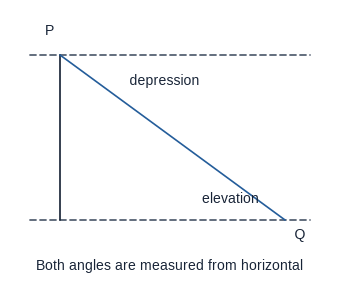
From the nearer ground point N the elevation is 60°. From F it is 30°. The points are 20 m apart.
For the two-viewpoint example above, the nearer distance is m and the farther is m. The height is m. The picture helps you see which distance gets the extra m.
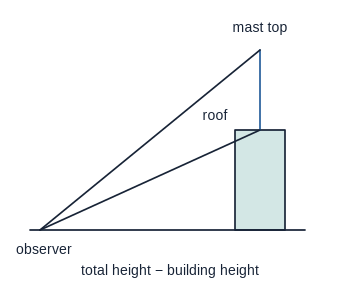
A building is m high. From a ground point, its top has elevation . A mast on the roof reaches elevation . Let the horizontal distance be .
First use the known height: , so . The total height to the mast top is . Subtract the building: mast height m.
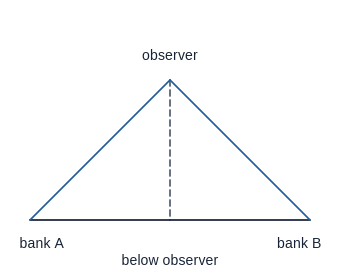
A platform is m above the water. Depression angles to two opposite banks are both . The point directly below the platform lies between the banks. Each horizontal distance is m, so the width is m.
If both points lie on the same side of the point below the observer, subtract their distances instead. Draw the positions before adding or subtracting.
A stationary tower is m high. At elevation , a ground observer is m from its base. At elevation , the distance is m. Walking straight towards the tower covers m.
If the walk takes seconds at steady speed, speed is m/s. The object can move while the tower stays still. The triangle rule is unchanged.
An observer looks from a point 1.6 m above level ground. A vertical structure is 20 m horizontally away. Its top has angle of elevation 45 degrees. Find the structure height.
- Draw a horizontal line from the observer to the structure. The right triangle measures the height above that line, not the full structure height.
- Let the height above eye level be m. Then . The exact tangent value is one.
- Thus m. Add eye height to obtain total height m.
- Check the triangle: its vertical rise and horizontal distance are equal, so its acute angles are both 45 degrees.
Repeat with a 14 m horizontal distance and eye height 1.5 m, keeping the elevation at 45 degrees.
Answers
- The rise above eye level equals the horizontal distance, m. Total height is m. The same angle gives the same ratio even though the triangle is smaller.
Exercise 9.1 — Heights and distances
9.2 Summary
- Draw the line of sight and a horizontal reference.
- Separate eye height from the rise above eye level.
- Two viewpoints can supply two equations.
- Check the answer against the geometric assumptions.