10. Circles
10. About this chapter
Big idea: A tangent touches once and forms a right angle with the contact radius.
Read one small part at a time. Try each example on paper. Then cover the answers and do the practice. Use the diagrams to explain your thinking.
| Word | Meaning |
|---|---|
| Tangent | A line meeting a circle at exactly one point. |
| Secant | A line crossing a circle at two points. |
| Radius | A segment from the centre to the circle. |
10.1 Introduction
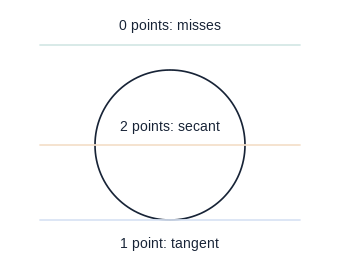
A circle is the boundary at a fixed distance from its centre. A line may cross that boundary twice, touch it once or miss it.
A tangent is defined by its contact with the circle; it does not pass through the interior. Draw the centre and contact point when explaining a tangent theorem.
A neat sketch suggests the right angle, but the theorem supplies the reason.
A circle contains all points at one fixed distance from its centre. That distance is the radius. A line can miss a circle, touch it once, or cross it twice.
A line crossing twice is a secant. A line touching once is a tangent. The touching point is the point of contact.
Imagine moving a straight guide towards a circular disc, keeping its direction fixed. At first contact it is tangent. Farther across the disc it becomes a secant.
10.2 Tangent to a Circle
The perpendicular radius belongs to the particular contact point. A radius to some other boundary point does not automatically make a right angle with the tangent.
Join the centre to the contact point whenever the diagram omits that segment. This often creates a right triangle, allowing an angle sum or Pythagoras calculation.
State the tangent-radius theorem as the reason for the right angle.
A tangent makes a right angle with the radius at the contact point. Let be the centre and the contact point.
Suppose is not perpendicular to the tangent. Draw the perpendicular to that line. A perpendicular is the shortest distance to a line, so .
Then is inside the circle. A line through an inside point crosses the circle twice. But a tangent touches only once. This contradiction proves is perpendicular to the tangent.
The reverse rule works too. Draw a line perpendicular to a radius at its endpoint on the circle. Call the endpoint .
For any other point on the line, Pythagoras gives . So every other point is outside the circle. The line touches only at , making it a tangent.
The tangent at T(5, 0) is perpendicular to radius OT.
If an external point is units from the centre of a circle of radius , its tangent length is . The centre-to-external-point segment is the hypotenuse.
The full straight line through a contact radius is called the normal. It is perpendicular to the tangent at the contact point. A normal is a line, not another curved part of the circle.
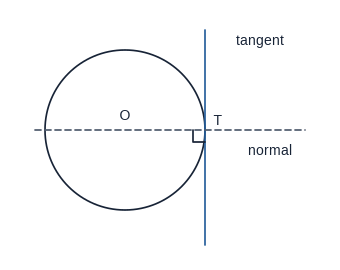
A tangent from external point P touches a circle at T. The circle radius is 5 cm and OP is 13 cm, where O is the centre. Find PT.
- Join O to T. A radius to a point of contact is perpendicular to the tangent, so triangle OTP is right angled at T.
- OP lies opposite that right angle, making it the hypotenuse. Pythagoras gives .
- Substitute: . The positive length is cm.
- Check: , which equals . The tangent segment is shorter than the hypotenuse.
A radius is 8 cm and the centre-to-external-point distance is 17 cm. Find the tangent length.
Answers
- The contact radius makes a right triangle. Tangent length is cm. Check .
10.3 Number of Tangents from a Point on a Circle
Equal tangent lengths are measured from the same external point to the two contact points. Tangents from different external points need not be equal.
In a many-sided figure, label the equal pair from each vertex separately. A whole side may be the sum of two tangent segments.
Build equations from those parts before attempting a perimeter calculation. For a proof, name the two triangles and give the reason for each matched side.
There are no tangents through an interior point, exactly one through a point on the circle, and exactly two through an exterior point. Compare all three positions before choosing a diagram.
Let two tangents from touch a circle at and . Join , and . The contact angles are right angles.
Triangles and share hypotenuse . Their radii and are equal. The triangles are congruent by RHS. So . This also shows that splits the angle between the tangents into two equal parts.
If the two tangent lengths are and , equate them: and each length is . The equality applies to lengths from the same external point.
Quadrilateral has right angles at both contact points. Its angle sum gives . Thus a central angle of gives a tangent angle of .
Let surround a circle, with contact points on consecutive sides. Equal tangents give , , , . Adding these length pairs yields . Pair tangent lengths from the same vertex.
From P(13, 0), tangents touch the radius-5 circle at A and B. OA and OB are perpendicular to the tangents.
The triangles share hypotenuse . Each has a radius of length . RHS congruence proves the tangent lengths equal. Here each tangent is .
Concentric circles share centre O. A chord of the radius-10 circle is tangent to the radius-6 circle at M.
Concentric means having the same centre. Radius meets the chord at a right angle because the chord is tangent to the smaller circle. A perpendicular from the centre to a chord bisects the chord.
For the circles shown, half the chord is . So the full chord length is .
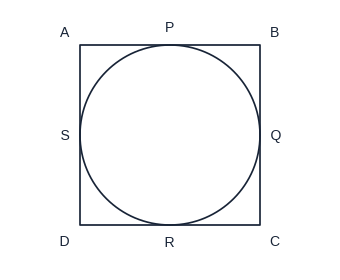
In a general quadrilateral that touches a circle on all four sides, pair tangents from each vertex. Adding the equal pairs gives . The picture is a simple rectangle example of the same length-pair idea.
A circle of radius 5 has an external point P(13, 0). The tangent PT is 12, because OT is perpendicular to PT.
- The right angle is at T, the contact point.
- OP is the hypotenuse: .
- Take the positive square root: .
Try it: Radius is and centre-to-point distance is . Find the tangent length.
Answer: .
Exercise 10.1 — Tangents and radii
Exercise 10.2 — Equal lengths
10.4 Summary
- A tangent meets a circle once and is perpendicular to its contact radius.
- Interior, on-circle and exterior points have zero, one and two tangents.
- Tangents from the same external point have equal lengths.
- Use the radius–tangent right triangle to find missing lengths.