8. Introduction to Trigonometry
8. About this chapter
Big idea: An acute angle fixes side ratios in every right triangle with that angle.
Read one small part at a time. Try each example on paper. Then cover the answers and do the practice. Use the diagrams to explain your thinking.
| Word | Meaning |
|---|---|
| Acute angle | An angle between zero and a right angle. |
| Hypotenuse | The side opposite the right angle. |
| Reciprocal | One divided by a nonzero number. |
8.1 Introduction
Trigonometry connects an acute angle to side-length ratios in a right triangle. The ratios help when measuring the angle is possible but directly measuring a height is difficult.
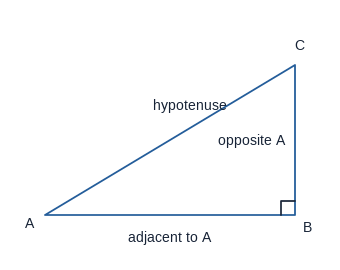
Begin by identifying the right angle and the angle under discussion. Opposite and adjacent are labels relative to that chosen angle.
The hypotenuse is always opposite the right angle.
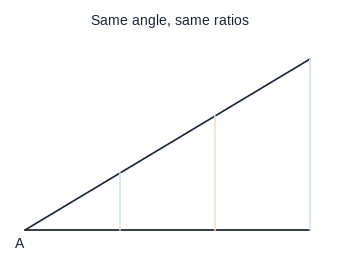
Take two right triangles with the same acute angle. An acute angle is between and . The triangles are similar by AA.
Their sizes may differ, but their matching side ratios are the same. These ratios are called trigonometric ratios.
The hypotenuse is the longest side. It faces the right angle. For your chosen acute angle, the opposite side is across from it.
The adjacent side touches your angle, but is not the hypotenuse. If you switch to the other acute angle, opposite and adjacent swap roles.
History note: Aryabhata used half-chord ideas in astronomical calculation. Later translations and mathematical work developed the terminology used for sine and cosine. Modern trigonometry expresses these geometric relationships as functions.
8.2 Trigonometric Ratios
Different right triangles with the same acute angle are similar. Enlargement multiplies every side by the same factor, so dividing one matching side by another cancels that factor.
This is why a ratio depends on the angle rather than the triangle size. Choose a ratio containing the known side and the required side.
Writing all six ratios is unnecessary when only one links the quantities you need.
For an acute angle ,
The reciprocal ratios are , and . Also . A ratio is undefined when its denominator is zero.
The right angle is at B. Relative to angle A, BC is opposite, AB is adjacent, and AC is the hypotenuse.
For opposite side and adjacent side , the hypotenuse is . Thus , and . The reciprocals are , and .
If , choose opposite side and adjacent side , with . Pythagoras gives hypotenuse , so sine is and cosine is . The scale factor cancels.
For angle , the bottom side becomes opposite and the vertical side becomes adjacent. This is why sine of one acute angle equals cosine of the other.
The notation means the reciprocal , which is . But usually means an inverse function: it finds an angle. You will study that function later. Do not confuse the two meanings.
“sin A” is one function value. It does not mean a number called “sin” multiplied by .
An acute angle belongs to a right triangle. Its opposite side is 9 cm and its hypotenuse is 15 cm. Find the adjacent side, sine, cosine and tangent.
- The hypotenuse is the longest side. Use Pythagoras to obtain the missing leg before finding ratios.
- Adjacent squared . The adjacent side is cm.
- Sine uses opposite over hypotenuse, giving . Cosine uses adjacent over hypotenuse, giving .
- Tangent uses opposite over adjacent, giving . These are ratios, so the centimetre units cancel.
The opposite side is 8 cm and hypotenuse 17 cm. Find the adjacent side and tangent.
Answers
- The adjacent side is cm. Tangent is . Subtract the leg square from the hypotenuse square, rather than adding the two given squares.
8.3 Trigonometric Ratios of Some Specific Angles
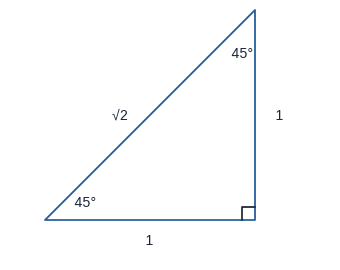
The exact-angle table has geometric reasons. An equal-leg right triangle gives the middle acute angle because its two acute angles are equal.
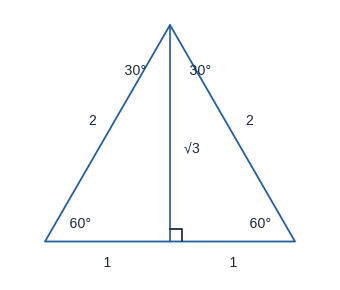
Splitting an equilateral triangle gives the other standard acute angles. Use Pythagoras to obtain the missing side before forming ratios.
Exact root values keep answers precise. A decimal approximation belongs at the final step when the question requests it.
An isosceles triangle has two equal sides. If it is also right-angled, its other two angles are each . Choose both short sides as one.
Pythagoras gives the hypotenuse . So , and .
An equilateral triangle has three equal sides. Choose each side as two. Draw its altitude from the top corner to the midpoint of the base.
This cuts it into two right triangles. Each has hypotenuse two, short side one and other side . Their acute angles are and . Use these sides to build the exact-value table.
| Angle | Sine | Cosine | Tangent |
|---|---|---|---|
| Undefined |
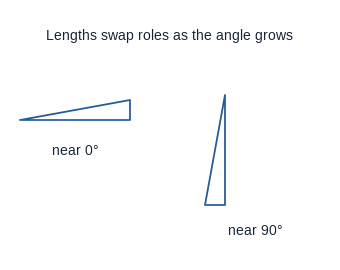
Picture the acute angle shrinking towards zero. The opposite side shrinks towards zero, while adjacent and hypotenuse become almost equal. This gives sine zero and cosine one at .
As the angle approaches , the roles swap. Sine approaches one and cosine approaches zero. Tangent at is undefined because it would divide by zero.
The acute angles of a right triangle are complementary: they sum to . Opposite and adjacent interchange, giving , , and for acute .
| Angle | Cosecant | Secant | Cotangent |
|---|---|---|---|
| Undefined | Undefined | ||
| Undefined |
Get each reciprocal value from the first table. Never take a reciprocal of zero. For example, secant at is undefined because cosine there is zero.
From 0° to 90°, sine rises from 0 to 1 and cosine falls from 1 to 0.
The points show values at familiar angles. The lines between them are guides joining those points, not exact straight-line formulas for sine and cosine.
For , sine and cosine stay between zero and one. Secant is at least one where it exists: . Cosecant is at least one for .
8.4 Trigonometric Identities
An identity holds for every allowed angle, not merely for one tested angle. Start from the more complicated side and use definitions or established identities to transform it.
Keep a single clear chain of equal expressions. Cancellation removes common factors, not terms joined by addition.
Every division requires a nonzero denominator. State a restriction when an expression contains a ratio that is undefined at an endpoint.
An identity is an equation that works for every allowed angle. It is stronger than an equation that works only at one angle.
Divide the Pythagorean equation by the hypotenuse squared. We get The notation means . It does not mean .
Dividing by gives , where cosine is nonzero. Dividing by gives , where sine is nonzero.
Prove , for nonzero sine. Start on the left and replace the numerator by . Cancelling one sine gives the right side. The denominator restriction remains part of the statement.
For , use the difference of squares: , wherever defined.
For an acute angle A, simplify . Explain every change.
- Identify the numerator as part of the identity . Subtract the cosine-square term to obtain .
- Replace the entire numerator. The expression becomes .
- Write the square as a product: . Cancel the common factor to get .
- The cancellation requires to be nonzero. It is positive for an acute angle, so the step is valid under the given condition.
Simplify for an acute angle.
Answers
- The identity gives . Divide the product by to obtain . The denominator is nonzero for an acute angle, which justifies cancellation.
Exercise 8.1 — Side ratios
Exercise 8.2 — Exact angles
Exercise 8.3 — Identities
8.5 Summary
- Similarity makes the ratios depend on angle rather than size.
- Derive exact special-angle values from familiar triangles.
- Complementary angles exchange sine with cosine and tangent with cotangent.
- Keep denominator restrictions when simplifying identities.