9. Biotechnology: Principles and Processes
Objectives
What you will learn
- Trace the development of modern genetic engineering from Cohen and Boyer's first recombinant plasmid construct.
- Explain restriction endonucleases, detailing palindromic recognition cleavage and the generation of cohesive "sticky" ends.
- Label cloning vector pBR322, identifying origin of replication (ori), rop locus, antibiotic selection markers (ampR, tetR), and restriction sites.
- Explain the principle of insertional inactivation and blue-white colony screening using the beta-galactosidase (lacZ) gene.
- Trace the 3-step thermal cycle of Polymerase Chain Reaction (PCR: denaturation at 94°C, annealing at 54°C, extension at 72°C with Taq polymerase).
- Contrast simple stirred-tank and sparged bioreactors regarding aeration, oxygen transfer efficiency, and foam control.
Introduction
Curd sets overnight in a warm kitchen. Tiny bacteria do the work. No one changes their DNA. That is biotechnology in its oldest form.
Biotechnology means using living organisms, their cells or their molecules to make products or to provide services. A bacterium that makes curd fits the definition. So does a cell that carries a human gene to make a medicine.
The European Federation of Biotechnology gives a wide definition. In simple words it says this. Biotechnology combines natural science with living cells, their parts or molecules. The goal is products and services for human use.
Note the last word: services. A product is a thing, like insulin. A service is a job, like cleaning waste water with microbes. Both count as biotechnology.
| Old (traditional) biotechnology | Modern (molecular) biotechnology |
|---|---|
| Uses whole organisms such as yeast and bacteria as they occur | Changes the DNA of the organism on purpose |
| Examples: curd, bread, fermented drinks | Examples: insulin made by bacteria, pest-resistant crops |
| Cannot choose a single gene | Can move one chosen gene from one species to another |
Read the table row by row. Row 1 contrasts use with change. Row 2 gives everyday examples on each side. Row 3 states the sharp limit of the old way. The new way crosses species borders.
| Product you know | Living system behind it | Old or modern? |
|---|---|---|
| Curd | Milk bacteria | Old |
| Bread | Yeast | Old |
| Insulin injections | Bacteria with a human gene | Modern |
| Insect-resistant cotton | Plants with a bacterial gene | Modern |
| DNA match in a crime case | Copied DNA from a tiny sample | Modern |
Read the second table as five small stories. The first two need no DNA change. The last three are impossible without it. Ask of each product: did anyone rewrite DNA? That single question sorts the columns.
Why is the definition so wide? Because the same skill serves many ends. The same fermentation hall can brew a drink or grow a vaccine. The law and the market treat them differently. The biology stays one craft.
A vaccine grown in cells is a product. You can hold its vial. The waste-water plant that cleans a city drain is a service. Microbes eat the waste. No box leaves the plant. Both use living systems for human ends.
A low achiever can master this chapter with one habit. Meet each new term once, slowly. Say it aloud. Link it to one example. Then move on. The chapter rewards steady readers.
What is not biotechnology? A factory that mixes chemicals with no living thing is chemistry, not biotechnology. A cook who follows a recipe with no microbes is cooking, not biotechnology. Life must do part of the work. That is the test.
Who uses biotechnology today? Hospitals use insulin and vaccines. Farms use resistant seeds. Crime labs use copied DNA. Food makers use enzymes. One craft serves them all. This chapter teaches that craft.
In exams, the word services needs an example. Write waste-water cleaning by microbes. Or write fermentation that turns waste into fuel. Both are services, not things. One example earns the mark.
Pause here and sort old from modern before moving on.
9.1 Principles of biotechnology
A farmer once crossed two wheat plants. The children mixed both parents fully. Wanted grains came with unwanted straw. That is the problem this chapter solves.
| Traditional breeding | Genetic engineering |
|---|---|
| Mixes whole genomes of two parents | Moves one chosen gene |
| Works only within mating species | Crosses species borders |
| Carries unwanted genes along | Carries almost nothing extra |
| Takes many generations | Shows results in a few generations |
Read the table as four complaints and four cures. Each row names one limit of breeding. The right cell shows how moving a single gene answers it. The last row matters most for exams.
Two core techniques made modern biotechnology possible. Learn them as a pair.
- Genetic engineering: methods to change the chemistry of DNA or RNA.
- The changed DNA enters a host organism. It alters the features of the host (its phenotype).
- Bioprocess engineering: keeping everything sterile (free from unwanted microbes) so that only the wanted cells grow, in large amounts, to make products such as antibiotics, vaccines and enzymes.
Both are needed. Genetic engineering makes the useful cell. Bioprocess engineering grows it cleanly and in large amounts. A modified cell in a dirty flask would be overgrown by unwanted microbes within hours.
Sexual reproduction mixes genes and creates variation. That is useful for evolution. But it is untidy for a breeder. Unwanted genes travel with the wanted ones. The breeder cannot pick one gene.
Genetic engineering can move just one gene. It can move it between species that could never mate. A bacterial gene can protect a plant. A human gene can work in bacteria. Breeding cannot do either.
Suppose a piece of foreign DNA is pushed into a cell. Usually it is lost when the cell divides. It cannot copy itself. DNA copies itself only if it has an origin of replication (ori). This is the place where copying begins.
A chromosome has its own ori. So the foreign DNA has two options. It must join a chromosome, or ride on DNA with its own ori. A plasmid is exactly this. It is a small, circular DNA. It sits outside the main chromosome. It copies itself.
Read the figure in two halves. Left half: the parent holds loose DNA with no ori. Two arrows lead to two daughters. Only one daughter holds the piece. The label says it is soon lost. Right half: the parent holds a plasmid with ori. The plasmid is copied first. Both daughters receive a copy. The bottom line states the rule. Only what can be copied is passed on.
No ori means no copying. No copying means no inheritance.
A plasmid keeps 100 copies per cell. A dish holds 30 such cells. How many plasmid copies sit in the dish before any division?
Each cell holds 100 copies.
Total: copies.
Result: 3,000 plasmid copies. High copy number multiplies the gene for free.
Cohen and Boyer used a plasmid as a vehicle. A vector is a carrier DNA that delivers foreign DNA into a host. They chose a gene for antibiotic resistance. They cut it out with restriction enzymes. These act like molecular scissors. They joined it into the plasmid with DNA ligase. This acts like glue.
The word vector comes from the idea of a carrier. A mosquito is a vector for the malaria parasite. In the same way a plasmid carries foreign DNA into a cell. The plasmid is the van. The host cell is the house.
- Identify the DNA that carries the wanted gene.
- Introduce that DNA into the host.
- Maintain the DNA in the host and pass it to its descendants (progeny).
Say the three verbs in order: find, deliver, keep. Every later section hangs on one of them. Cutting and PCR serve step one. Vectors and hosts serve step two. Selection and culture serve step three.
| Step | Verb | Sections that serve it |
|---|---|---|
| 1. Identify | Find | Cutting, gel reading, PCR copying |
| 2. Introduce | Deliver | Vectors, competent hosts |
| 3. Maintain | Keep | Selection, culture, bioreactors |
Read the map before you proceed. It tells you where each tool belongs. When a step confuses you, ask which verb it serves. The answer places it at once.
A lab wants bacteria that glow. A jellyfish gene carries the glowing trait. Name what happens at each of the three basic steps.
Identify: find and cut out the jellyfish glow gene.
Introduce: join it to a plasmid and move the plasmid into bacteria.
Maintain: select glowing colonies and grow them, so daughters keep the gene.
Result: Find the gene, deliver it, and keep it. Every project follows the same three verbs.
Bacteria divide fast and accept plasmids with ease. That is why they host most teaching examples. Plants and animals need their own vectors. You will meet those in section 9.2. The principle never changes. Find, deliver, keep.
Phenotype means the visible features of an organism. Height, colour and yield are phenotypes. Genetic engineering changes the phenotype by changing the DNA first. The trait you see starts from the gene you move.
Keeping needs pressure. Without selection, cells may drop the plasmid over generations. Copying extra DNA costs energy. So growers keep the antibiotic in the medium. Only carriers thrive. The trait stays put.
Fix the pair of techniques and the three verbs before moving on.
9.2a Tools of Recombinant DNA: Restriction Enzymes & Electrophoresis
A crime lab receives a tiny blood spot. It must cut the DNA, read the pieces and copy them. Three different tools do those three jobs. This section meets each tool by name.
Recombinant DNA means DNA made by joining pieces from different sources. To make it you need five key tools. These are restriction enzymes, polymerase enzymes, ligases, vectors and a host organism.
| Tool | Job in one line |
|---|---|
| Restriction enzyme | Cuts DNA at a fixed sequence |
| Polymerase enzyme | Builds new DNA strands |
| DNA ligase | Seals gaps between joined pieces |
| Vector | Carries foreign DNA into the host |
| Competent host | Receives the DNA and copies it |
Read the table as a team sheet. Each row is one player and one job. No player can replace another. Cutting, building, sealing, carrying and hosting all must happen.
In 1963 two enzymes were isolated from the bacterium E. coli. One adds methyl groups to DNA. The other cuts DNA. The cutting one stops viruses from growing in the cell. Bacteria use these enzymes as a defence.
The first one to be studied closely was called Hind II. It was characterised about five years later. It always cuts at one particular six-base-pair sequence. This fixed sequence is the recognition sequence. Today more than 900 restriction enzymes are known. They come from over 230 strains of bacteria. Each one recognises its own sequence.
Take EcoRI. The first letter E is the genus. The next two letters co are the first two letters of the species. R is the strain. The Roman numeral I says it was the first enzyme found from that strain.
| Enzyme | Name parts | Recognition sequence |
|---|---|---|
| EcoRI | E + co + R + I | GAATTC |
| BamHI | B + am + H + I | GGATCC |
| HindIII | H + in + d + III | AAGCTT |
Read the table one row at a time. Each name encodes genus, species and strain. Each enzyme owns one sequence. The sequences are short. That shortness matters for the sums below.
Nucleases are enzymes that cut nucleic acids. An exonuclease removes nucleotides from the ends of DNA. An endonuclease cuts at a position inside the DNA. Restriction endonucleases cut inside at their own recognition sequence.
| Nuclease | Where it cuts | How to remember |
|---|---|---|
| Exonuclease | At the ends | Exo means outside |
| Endonuclease | Inside the strand | Endo means within |
| Restriction endonuclease | Inside, at a fixed sequence | A guard with a fixed password |
Read the table as three doors. The first opens at the edges. The second opens in the middle. The third opens only with the right password. Only the third is useful for precise surgery.
A word palindrome reads the same backwards, such as madam. A DNA palindrome reads the same on both strands. Read each strand in its own 5-prime to 3-prime direction. The EcoRI site is an example:
Reading the top strand 5-prime to 3-prime gives GAATTC. Reading the bottom strand 5-prime to 3-prime also gives GAATTC. They match, so the site is a palindrome. A sequence such as GAATTG is not one. Its other strand reads CAATTC.
EcoRI cuts each strand between G and A, a little off the centre. Each piece then ends in a short single strand of 4 bases (AATT). These overhangs are the sticky ends. They stick by hydrogen bonds. Their bases pair with the matching sticky end of a piece cut by the same enzyme.
Read the figure in two halves. Top half: the double strand shows GAATTC above CTTAAG. Two dashed red lines mark the cuts. Each cut sits between G and A, but on opposite strands. The labels say cut here. An arrow marked EcoRI joins top to bottom. Bottom half: two pieces now. Each carries a single-stranded AATT tail. Two leader lines name them sticky end AATT. Now state the lesson. Off-centre cuts leave tails. Tails pair by complementarity.
| End type | What it looks like | Why it matters |
|---|---|---|
| Sticky end | Short single-stranded tail | Pairs neatly with a matching tail |
| Blunt end | Straight cut, no tail | Joins with any blunt piece, less control |
Read the two rows as a choice. Sticky ends choose their partners. Blunt ends accept anyone. For precise work, sticky is better. That is why this chapter uses EcoRI-style enzymes.
Blunt ends still have one honest use. Sometimes the gene lacks a matching sticky site. Then the worker trims both pieces blunt and joins them. Control is weaker, but the job gets done. Exams test sticky ends far more often.
Two pieces cut by the same enzyme have matching sticky ends. That is why a gene and a vector must be cut with the same enzyme. DNA ligase then seals the gaps in the sugar-phosphate backbone.
A random site that is 6 bases long has 4 choices at each position. So the chance of a given 6-base sequence at a given place is . A 4-base site has chance .
In a random DNA of 12,288 base pairs, we expect about sites for a 6-base enzyme. For a 4-base enzyme we expect about sites. This is why enzymes with shorter sites cut more often.
Result: more bases in the recognition sequence means fewer cuts.
Few cuts help cloning. A 6-base enzyme opens a plasmid once, at one clean place. The circle becomes one straight piece. The gene fits into that single gap. Many cuts would shred the vector instead.
Try the same logic on a plasmid. A plasmid has about 4,361 base pairs. By chance it holds roughly 4,361 divided by 4,096, which is about 1.06 six-base sites. So a 6-base enzyme cuts it about once. That single cut opens the circle neatly.
A straight (linear) DNA of 6,000 base pairs (bp) has two EcoRI sites. They sit at 1,500 bp and 4,000 bp from the left end. Find the sizes of the pieces.
Piece 1 runs from 0 to 1,500. Its size is 1,500 bp. Piece 2 runs from 1,500 to 4,000. Its size is bp. Piece 3 runs from 4,000 to 6,000. Its size is bp.
Result: 1,500, 2,500 and 2,000 bp. Check: . Two cuts in a straight DNA always give three pieces.
A second linear DNA has 8,400 bp with sites at 2,100 and 5,600 bp. List the fragment sizes from the left end.
First piece: 0 to 2,100, so 2,100 bp.
Middle piece: bp.
Last piece: bp.
Check: .
Result: 2,100, 3,500 and 2,800 bp from left to right. Two cuts give three pieces again.
After cutting, we have a mixture of fragments. Gel electrophoresis separates them by size. DNA has a negative charge. In an electric field it moves toward the positive electrode (anode). It moves through a jelly-like gel, usually made of agarose. This is a natural substance from seaweed. Small fragments slip through the gel easily and travel far. Large fragments move slowly. So the fragments spread into bands, ordered by size.
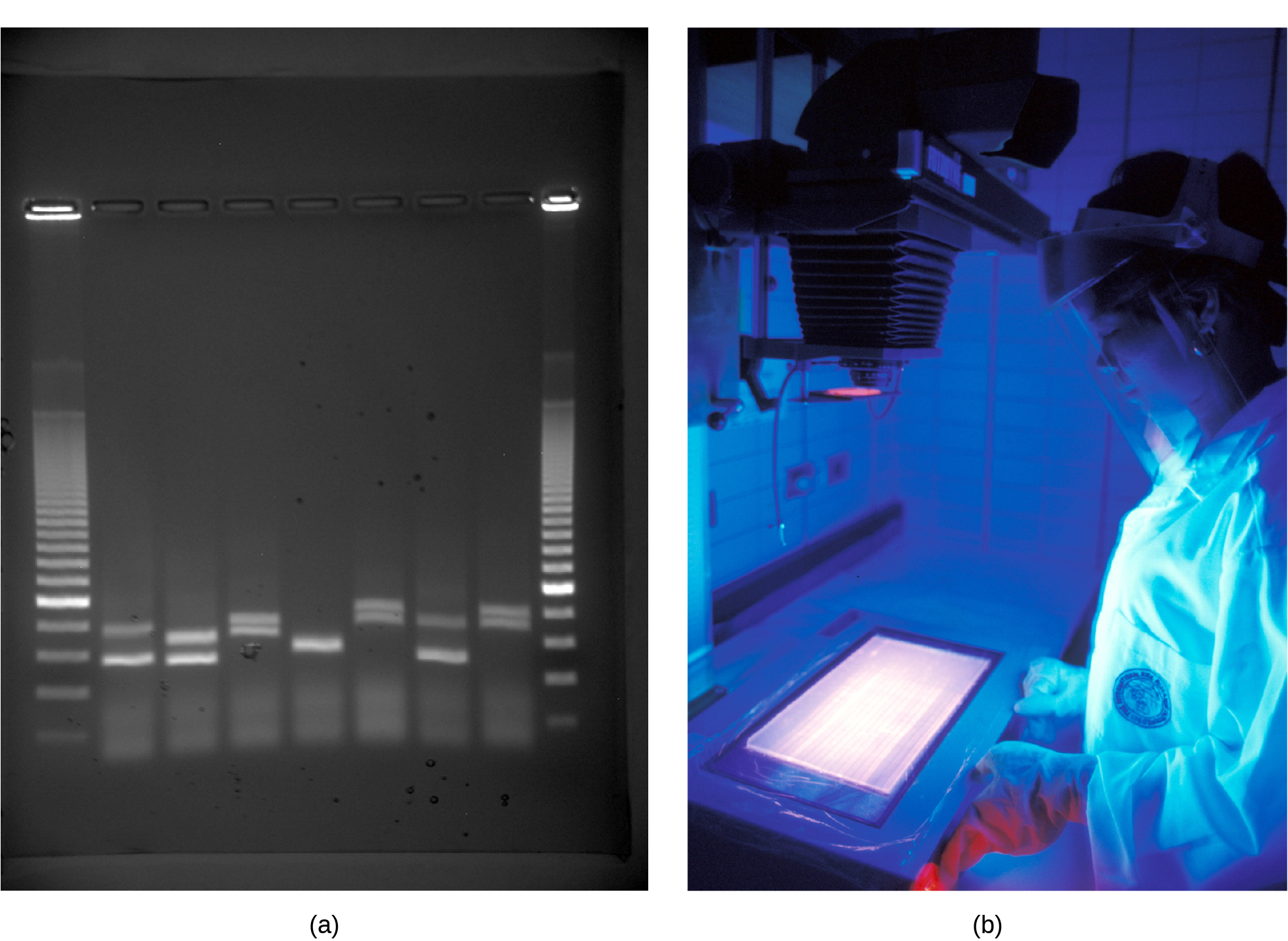
Read the gel in three zones. Top zone: two wells hold the samples. A minus sign marks the negative electrode at the top. Bottom zone: a plus sign marks the anode. DNA moves down, away from minus and toward plus. Middle zone: the ladder lane on the left shows six bands. Their sizes are printed beside them, from 6,000 near the top to 500 near the bottom. The sample lane on the right shows three bands. Trace them against the ladder. Then read the rule. Small moves far. Charge drives the motion. Size decides the order.
Now read the small teaching gel. It holds three pieces: 3,500, 2,800 and 2,100 base pairs. The 3,500 band sits nearest the well. The 2,800 band sits in the middle. The 2,100 band travels farthest. To order unknown bands, always compare with the ladder lane. Largest stays high. Smallest runs low.
The second digest gave 2,100, 3,500 and 2,800 bp. List the bands from the well downward, as seen on the gel.
Order by size, largest first: 3,500, 2,800, 2,100 bp.
Nearest the well: 3,500 bp. Middle: 2,800 bp. Farthest: 2,100 bp.
Result: Top to bottom: 3,500, 2,800, 2,100. Read gels large-to-small from the well.
DNA cannot be seen in ordinary light. The gel is stained with ethidium bromide and viewed under ultraviolet light. Then the bands glow orange. A band can be cut out of the gel. The DNA is removed from it. This step is called elution. Ethidium bromide can cause mutations. People who use it wear gloves and handle the waste carefully.
9.2b Tools of Recombinant DNA: Cloning Vectors & Competent Hosts
Plasmids and bacteriophages can copy themselves inside bacteria. They do this without the help of the main chromosome. Some plasmids exist as one or two copies per cell. Others exist as 15 to 100 copies, or more. Join a foreign gene to a high-copy plasmid. Then the gene is copied as many times too. Bacteriophages make even more copies of their genome in each host cell.
Take a plasmid with 50 copies per cell. In 20 cells the total is copies of the gene. This counts copies before the cells even divide.
- Origin of replication (ori): the place where copying starts. It also sets the copy number.
- High copy number: to get many copies of a gene, use a vector whose ori gives a high copy number.
- Selectable marker: a gene that lets you pick out the cells that took up the vector (the transformants) and kill the rest. Genes for resistance to antibiotics such as ampicillin, chloramphenicol, tetracycline or kanamycin are often used.
- Cloning sites: places where a restriction enzyme cuts. A good vector has just one site for each commonly used enzyme. If there were more, the vector would break into many pieces.
- Small size and easy to isolate, so that it can be moved and handled.
Learn the four needs as four questions. Can it copy? Can we select it? Can we open it once? Can we handle it? A yes to all four makes a vector usable.
Read the plasmid map piece by piece. The grey circle is the plasmid. The left arc marks ori, where copying starts. The top arc marks ampR, the ampicillin resistance gene. The right arc marks tetR, the tetracycline resistance gene. The red dot marks the BamHI cloning site. It sits inside tetR. A leader line at the bottom names it. The caption states the result. An insert at that dot breaks tetR but spares ampR.
In the plasmid shown, the BamHI site sits inside the tetracycline resistance gene (tetR). A foreign gene inserted there breaks tetR. It no longer works. The ampicillin gene is untouched. So we can sort the bacteria like this:
| Bacteria | Grows with ampicillin? | Grows with tetracycline? |
|---|---|---|
| Unchanged bacterium | No | No |
| Transformed, no insert (non-recombinant) | Yes | Yes |
| Transformed with insert in tetR (recombinant) | Yes | No |
Read the table row by row. Row 1: unchanged cells die on both plates. They took up nothing. Row 2: transformants without the insert grow on both. Both genes still work. Row 3: recombinants grow on ampicillin but not on tetracycline. The insert broke tetR. That pattern is the signature of a recombinant.
Plate the cells first on ampicillin. Only transformants grow. Then test those on tetracycline. Those that fail to grow are the recombinants. The method works, but it needs two plates. So it is slow.
A simpler method uses a gene for the enzyme beta-galactosidase. When foreign DNA is inserted inside this gene, the enzyme stops working. On a medium with a chromogenic (colour-giving) substance, cells with a working enzyme turn blue. Cells with the inserted gene stay white. So white colonies are recombinants. Blue colonies are non-recombinants. No second plate is needed.
Read the plate at a glance. The big oval is the dish. Blue dots still make the working enzyme. They carry plasmids with no insert. White rings make no working enzyme. The insert sits inside the colour gene. The labels say it plainly. Blue means no insert. White means insert. Pick the white ones.
A colour plate grows 200 colonies. Of these, 150 are white and the rest are blue. What share of colonies is recombinant?
Blue colonies: .
White share: per cent.
Result: 75 per cent are recombinant. Count white, divide by total, multiply by 100.
Bacteria and viruses have long delivered genes into other cells. Agrobacterium infects many broad-leaf plants. It moves a piece of its DNA, the T-DNA, into the plant cell. This makes the plant cell form a tumour. Scientists remove the tumour-causing part. They disarm the DNA. Then they put the gene of interest in its place. In animals, disarmed retroviruses do a similar job. They enter animal cells and carry the new gene, but without causing disease.
| Vector | Natural job | Disarmed use in the lab |
|---|---|---|
| Plasmid | Carries its own genes in bacteria | Carries a chosen gene into bacteria |
| Bacteriophage | Infects bacteria | Delivers DNA with very high copy number |
| Agrobacterium T-DNA | Moves DNA into plant cells | Carries a chosen gene into crops |
| Retrovirus | Enters animal cells | Carries a chosen gene without causing disease |
Read the table as four delivery vans. Column 2 is the natural route. Column 3 is the lab reuse. The trick is always the same. Keep the delivery skill. Remove the harm.
High copy number has one cost. Each plasmid drains a little energy. Cells still pay it gladly under selection. The gain is thousands of gene copies per dish. Factories accept the small tax.
DNA is hydrophilic (it attracts water). It is large and charged. So it cannot pass through a cell membrane on its own. To make bacteria take up plasmids, they are first made competent. Competent means ready to take up DNA from the surroundings.
One method treats the cells with a specific concentration of a calcium salt. This makes the wall more permeable. The cells are mixed with the plasmid on ice. Then they are placed briefly at 42 degrees (heat shock). Then they return to ice. Some cells take in the DNA.
| Method | Used for | How it works |
|---|---|---|
| Calcium treatment and heat shock | Bacteria | Cells are made competent, then briefly heated so DNA can enter |
| Micro-injection | Animal cells | DNA is injected straight into the nucleus with a fine needle |
| Biolistics (gene gun) | Plant cells | Tiny gold or tungsten particles coated with DNA are fired into cells |
| Disarmed pathogen vector | Plants and animals | A harmless version of a microbe carries the DNA into the cell |
Read the methods table by target. Bacteria take a warm shock. Animal cells take a fine needle. Plant cells take a gene gun. Whole tissues take a disarmed carrier. The barrier differs, so the door differs.
Why does heat shock work at all? Calcium ions coat the DNA and the wall, hiding their charges. The brief heat opens small gaps. DNA slips through before the wall reseals. Cold on both sides keeps the cells alive through the shock.
Choosing a method is simple in exams. Soft single cells take chemicals and shock. Large single cells take a needle. Walled plant cells take a gun. Whole organisms take a disarmed carrier. Match the door to the wall.
Uptake is never perfect. Suppose 400 cells are spread and 40 grow on the selective plate. The success share is per cent. The rest either missed the plasmid or failed to express it. Selection keeps only the winners.
Name each tool and its job before moving on.
9.3a Processes of rDNA: Isolation, Cutting & PCR Amplification
A school kitchen follows a fixed recipe. It prepares, cooks, serves and cleans. A gene lab follows a fixed order too. This section walks that order from start to finish.
Making a recombinant protein follows a fixed order of steps. First DNA is isolated. It is cut, and the wanted fragment is selected. The fragment is joined into a vector. The vector is put into a host. The host is grown in large amounts. Then the product is collected and purified.
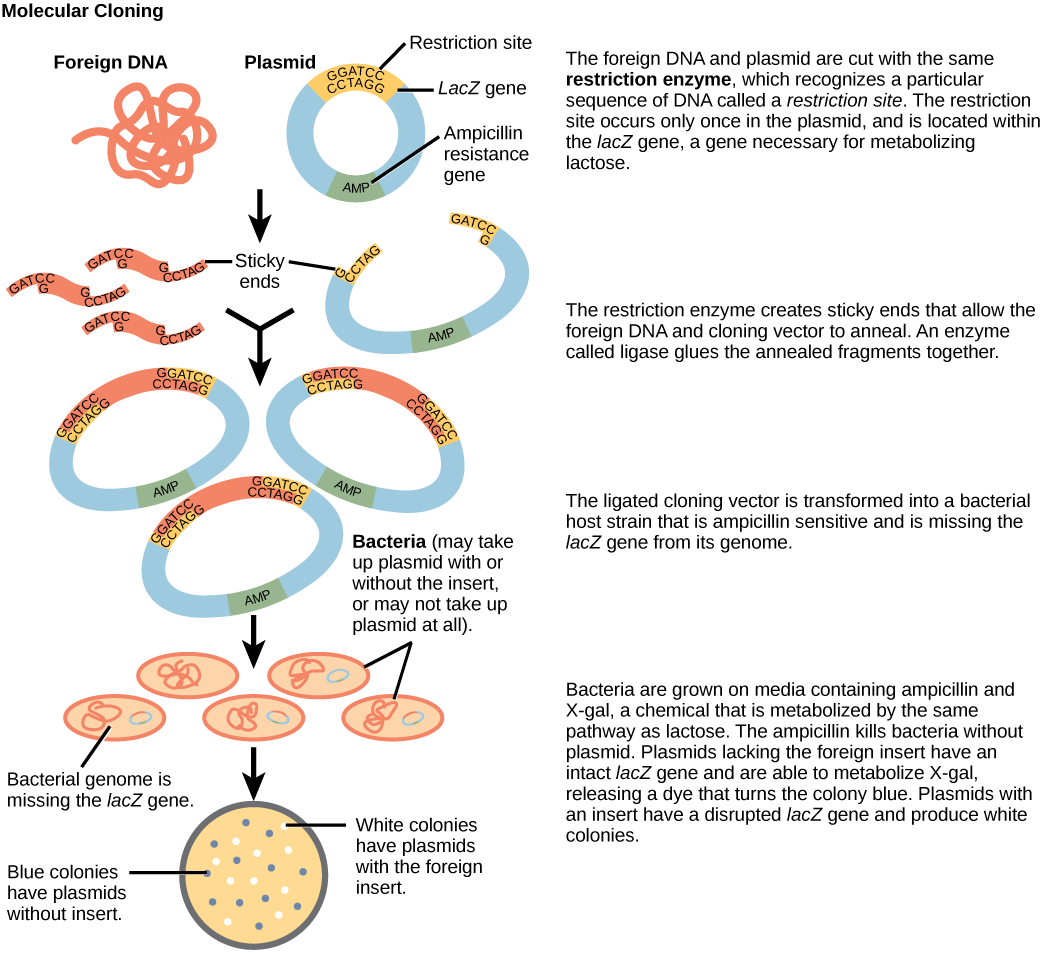
Read the flow from top to bottom. Box 1 cuts both pieces with the same enzyme. Box 2 pairs the sticky ends by hydrogen bonds. Box 3 seals the backbone with ligase. Box 4 moves the plasmid into a competent host. Box 5 selects the transformed cells. Box 6 grows them and purifies the product. Six boxes, one direction, no shortcuts.
DNA is the genetic material in most organisms. To cut it with restriction enzymes it must be pure. But DNA sits inside cells, mixed with RNA, proteins, sugars and lipids. So the cell must be broken open. Then the DNA must be separated. Different cells need different enzymes:
| Cell type | Enzyme used to break the cell wall |
|---|---|
| Bacteria | Lysozyme |
| Plants | Cellulase |
| Fungi | Chitinase |
Read the small table as three locks and three keys. Bacteria open with lysozyme. Plant walls open with cellulase. Fungal walls open with chitinase. The wrong key wastes the sample.
Read the isolation flow in four steps. Step 1 opens the cells with the matching enzyme from the table. Step 2 removes RNA with ribonuclease. Step 3 removes proteins with protease. Proteins include histones that coil the DNA. Step 4 adds chilled ethanol. Pure DNA does not dissolve in it. It appears as fine white threads. These can be lifted out by spooling with a glass rod. Each step removes one impurity.
Next the unwanted molecules are removed one by one. RNA is removed with ribonuclease. Proteins (including histones that coil the DNA) are removed with protease. Finally chilled ethanol is added. The pure DNA does not dissolve in it. It appears as fine white threads, which can be lifted out by spooling with a glass rod.
The pure DNA is incubated with a restriction enzyme at its best conditions. The progress of the cutting is checked by gel electrophoresis. The vector is cut with the same enzyme. The cut gene and the cut vector are then mixed. DNA ligase is added to join them. The result is the recombinant DNA.
The gel check catches partial digestion. Complete cutting shows only the expected bands. Extra bands warn that some molecules escaped the enzyme. Workers then extend the incubation and cut again. Never ligate a half-cut mixture.
The cut plasmid has 4,000 bp and the gene fragment has 1,200 bp. What is the size of the recombinant plasmid?
Joining adds the insert to the vector.
bp.
Result: The recombinant plasmid has 5,200 bp.
A cut plasmid has 5,200 bp and a gene piece has 900 bp. The gene is ligated into the single cloning site. What is the recombinant size, and how many bands would one cut show?
Add insert to vector: bp.
One cut in a circle gives one linear piece, so one band.
Result: 6,100 bp, seen as a single band. Ligation bookkeeping always adds.
PCR stands for polymerase chain reaction. It makes millions of copies of one chosen DNA segment in a test tube (in vitro). It needs the template DNA. It needs two primers. Primers are short pieces of DNA, made chemically. They match the two ends of the target. It also needs nucleotides and a heat-stable DNA polymerase. The polymerase comes from the hot-spring bacterium Thermus aquaticus. It is called Taq polymerase. It is not destroyed by the high temperature used in the reaction.
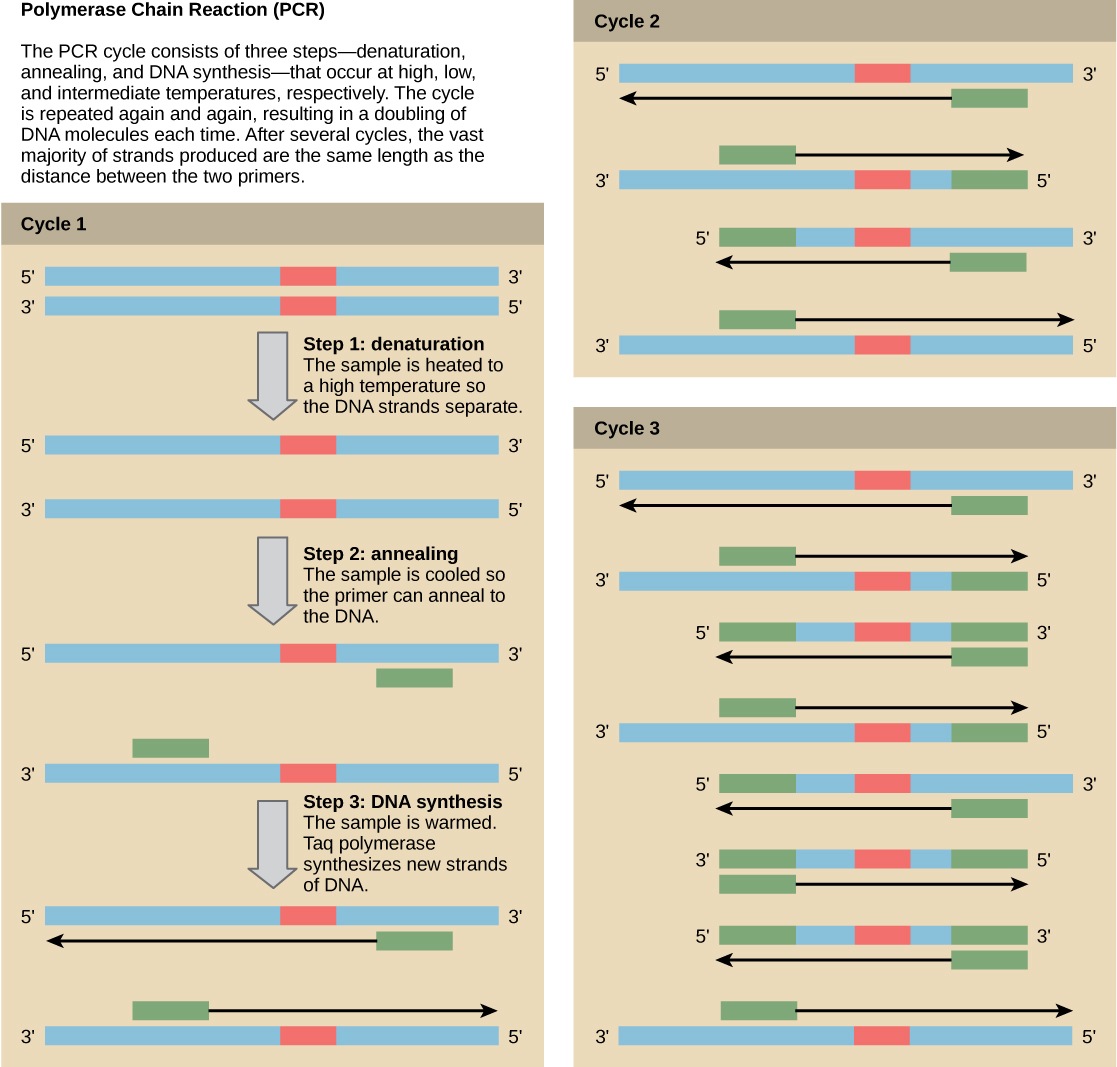
Read the three boxes left to right. Box 1 denatures at about 94 degrees. The two strands split. Box 2 anneals at about 55 degrees. Each primer binds its matching place. Box 3 extends at about 72 degrees. Taq builds a new strand from each primer. Two arrows join the boxes in order. A return arrow below says repeat. One DNA becomes 2, then 4, then 8, and so on.
Each cycle has three steps. Denaturation: heating to about 94 degrees separates the two strands. Annealing: cooling to about 55 degrees lets each primer bind to its matching place. Extension: at about 72 degrees Taq polymerase builds a new strand from each primer. The machine repeats this cycle 25 to 35 times.
Why 55 degrees for annealing? Primers are short and picky. Too hot, and they float off without binding. Too cold, and they stick at wrong places. About 55 degrees is the middle path. It favours exact matches and starves wrong ones.
Primer design matters as much as temperature. Each primer must match its end exactly. One wrong base weakens binding. Two wrong bases can kill the reaction. That is why primers are made chemically to order.
Read the doubling strip left to right. Box 1 holds one DNA at cycle zero. Box 2 holds two DNAs after one cycle. Box 3 holds four after two cycles. Box 4 holds eight after three cycles. Each box doubles the one before. The caption states the rule. After n cycles, one molecule gives 2 to the power n.
Every cycle doubles the number of copies of the target (in the ideal case). After n cycles, one starting molecule gives 2 to the power n copies.
| Cycles | Copies from 1 molecule |
|---|---|
| 1 | 2 |
| 2 | 4 |
| 3 | 8 |
| 5 | 32 |
| 10 | 1,024 |
| 20 | 1,048,576 |
| 30 | 1,073,741,824 |
Read the table as proof of doubling. One cycle gives 2. Two cycles give 4. Five cycles give 32. Thirty cycles pass a billion. Each row doubles the row before in spirit. Small repeats build huge numbers.
A PCR starts with 50 copies of the target. How many copies are there after 10 cycles? How long does 30 cycles take if one cycle lasts 2 minutes?
After 10 cycles each molecule has become .
So copies.
30 cycles take minutes.
Result: 51,200 copies after 10 cycles. 60 minutes (one hour) for 30 cycles.
A second PCR starts with 40 copies and runs 12 cycles. A lab slot allows 28 cycles at 3 minutes each. Find the final copies and the slot length.
Doubling 12 times multiplies by .
Copies: .
Time: minutes.
Result: 163,840 copies, in 84 minutes. More starting copies save cycles.
Straight line graph: the vertical axis is the base-10 logarithm of the number of DNA copies and the horizontal axis is the number of PCR cycles. The line rises steadily from 0 at zero cycles to about 9 at 30 cycles, which means about a billion copies.
Read the graph axis by axis. The bottom axis counts cycles from 0 to 30. The side axis shows the logarithm of copies from 0 to 10. The line rises straight. Straight on a log scale means doubling at each step. Three dots mark checkpoints at 10, 20 and 30 cycles. At 30 the line nears 9. That means about a billion copies.
In a real tube the doubling is not perfect. It also slows when the reagents run low. If each cycle gave only 85 per cent more, then gives about 103,550,417 copies in 30 cycles. That is still about a hundred million copies. So PCR is a very powerful way to amplify a gene.
9.3b Processes of rDNA: Transformation, Bioreactors & Downstream Processing
The competent host takes up DNA from its surroundings. Suppose the recombinant plasmid carries an ampicillin resistance gene. It is moved into E. coli. The transformed cells become ampicillin resistant. If we spread the cells on a plate containing ampicillin, only the transformants grow. Untransformed cells die. So the antibiotic works as a filter.
Death is the selection. Ampicillin blocks wall building in growing cells. Resistant cells destroy it with their enzyme first. Sensitive cells burst and vanish. The plate reads the genes by survival.
A student mixes 0.01 microgram of plasmid DNA with competent cells. After recovery, 100 microlitres of the 1,000 microlitres of cells is spread on an ampicillin plate. It gives 300 colonies. Find the transformation efficiency (colonies per microgram DNA), using the colonies from the whole 1,000 microlitres.
The plated part is of the cells.
The whole mixture would give colonies.
Efficiency colonies per microgram.
Result: About 180,000 transformants per microgram of DNA.
The aim is usually a useful protein. Sometimes a gene is placed in a different (heterologous) host. The protein it makes there is called a recombinant protein. The gene must be expressed. So the conditions have to be right for the host to read it. A small laboratory flask makes only a little protein. To make large amounts we need larger vessels and tightly controlled conditions.
In a batch culture the cells grow in a fixed amount of medium until it runs out. In a continuous culture used medium is drained from one side. Fresh medium is added at the other. This keeps the cells in the exponential (log) phase. There they divide fastest. Continuous culture gives more biomass and a higher yield.
| Culture | Medium supply | Growth and yield |
|---|---|---|
| Batch culture | Fixed amount, runs out | Growth slows; smaller yield |
| Continuous culture | Fresh in, used out | Stays in fast phase; larger yield |
Read the table as two kitchens. Batch cooks one pot and stops. Continuous keeps fresh stock flowing. The second stays busy longer. That is why factories prefer it.
A batch tank of 400 units is imagined here only to show the sums. At 4 grams per litre in 100 litres, the yield is grams. A continuous tank at 8 grams per litre in the same volume gives grams. Same tank, double output.
Bacteria double every 20 minutes. Starting from 1 cell, how many cells are there after 180 minutes (3 hours), if growth stays exponential?
The number of doublings is .
The number of cells is .
Result: 512 cells from one cell (in ideal conditions). That is why bacteria are fast, cheap factories.
A second culture doubles every 25 minutes for 150 minutes. It starts from 200 cells. Find the doublings and the final count.
Doublings: .
Growth factor: .
Final cells: .
Result: 12,800 cells. Starting from more cells multiplies the harvest.
A bioreactor is a large vessel for growing cells. In it, raw materials are changed into products by cells. It uses microbial, plant or animal cells. Bioreactors handle large volumes, usually 100 to 1,000 litres or more. They give the best conditions for growth. These include temperature, pH, substrates, salts and oxygen. The most common is the stirred-tank type. It is a cylinder (often with a curved base) with a stirrer. In a sparged tank sterile air is bubbled in from the bottom. The stirrer and the bubbles spread the oxygen and mix the contents.
Read the tank from top to bottom. Top: a motor box drives a shaft down the centre. Two flat blades stir the broth. The pale band is the liquid surface. Middle: two labels name the foam control and the temperature and pH probes. Each has a leader line to its part. Lower side: a sampling port lets small amounts out for testing. Bottom: an upward arrow marks sterile air entering. Small ovals above it are sparger bubbles. The caption says culture medium plus cells. Every part guards growth.
| Condition | Why it matters | What goes wrong without it |
|---|---|---|
| Temperature | Enzymes work best in a narrow range | Growth slows or cells die |
| pH | Proteins keep shape only near the set pH | Product loses activity |
| Oxygen supply | Aerobic cells need oxygen to grow | Culture starves and stalls |
| Mixing | Spreads food, air and heat evenly | Dead zones form; yield falls |
| Foam control | Foam blocks air flow and sensors | Tank overflows; readings fail |
| Sampling port | Checks growth without opening the tank | Contamination enters during checks |
Read the conditions table as cause and effect. Column 2 gives the reason for control. Column 3 gives the price of neglect. A bioreactor is a promise. It holds every condition steady while cells work.
A tank holds 100 litres of culture. The imagined rate is 4 litres of sterile air per litre of culture each hour. How much sterile air must the sparger supply per hour?
Air needed: litres per hour.
Result: 400 litres of sterile air per hour. Big tanks breathe hard.
A bioreactor has an agitator (stirrer). It has an oxygen system, foam control, and temperature and pH control. A sampling port lets small amounts out for testing during the run.
A run lasts 24 hours. Samples are drawn every 2 hours. Each test uses 5 mL. How many samples are drawn, and what total volume do they use?
Number of samples: .
Total volume: mL.
Result: 12 samples, 60 mL in all. Small checks guard a big tank.
- Control: temperature, pH and oxygen are measured and adjusted automatically.
- Volume: it can hold hundreds of litres, so the output is large.
- Sampling and monitoring without opening the culture, which lowers the risk of contamination.
- Repeatable results from batch to batch.
Read the list as four wins. Control beats guessing. Volume beats flasks. Closed sampling beats open plates. Repeat beats luck. That is why industry pays for steel tanks.
When the cells have made the product, it still must be made ready for use. Downstream processing is the group of steps that separate and purify the product. It adds preservatives and other ingredients (formulation). It carries out clinical trials if it is a drug. It runs strict quality control. The details differ from product to product.
Read the downstream flow top to bottom. Box 1 separates cells from liquid. Box 2 purifies the product away from impurities. Box 3 formulates it with preservatives and carriers. Box 4 tests it in trials where the law needs them. Box 5 checks quality and releases only safe batches. A drug skips no step. That line is the whole ethic.
Formulation means packing the product for real life. Preservatives stop microbes from spoiling it. Carriers like salts and sugars keep the dose stable. Without them, a pure drug would decay on the shelf within days.
Recovery is never full. Suppose a crude batch holds 1,000 mg of product. Purification keeps 70 per cent. The pure yield is mg. The rest is lost with impurities. Purity costs quantity.
- Skip separation: cell debris stays in the dose and triggers reactions.
- Skip purification: related proteins mimic the drug and blunt its effect.
- Skip formulation: the product spoils on the shelf within days.
- Skip trials: rare harms stay hidden until wide use.
- Skip quality checks: one bad batch can harm many patients.
Read the list as five warnings. Each skipped step leaves a specific harm. Regulators demand every step for drugs. Food enzymes follow lighter but similar rules.
Trace the full recipe once more, then test each stage.
Summary
Summary
Biotechnology makes products and provides services using living organisms, cells or enzymes. Modern biotechnology became possible when scientists learned to change DNA and to build recombinant DNA. This process is called recombinant DNA technology or genetic engineering.
- Two core techniques: genetic engineering and bioprocess engineering (sterile, large-scale growth).
- Three basic steps: identify the gene, introduce it into a host, maintain it and pass it on.
- Tools: restriction enzymes (cut DNA at palindromic sites and leave sticky ends), DNA ligase (joins DNA), vectors such as plasmids (carry the gene), and competent hosts.
- Vector features: origin of replication, selectable marker, unique cloning sites. Breaks in markers (insertional inactivation) and the colour marker help to find recombinants.
- Isolation: open cells with the matching enzyme, remove RNA and proteins, spool DNA with chilled ethanol.
- Cutting and joining: cut gene and vector with the same enzyme, pair sticky ends, seal with ligase. Two cuts in linear DNA give three pieces.
- Gel reading: DNA runs to the positive electrode. Small pieces travel far. Elution recovers DNA from a band.
- PCR: denaturation, annealing and extension, repeated. One cycle doubles the DNA, so 30 cycles give about a billion copies from one molecule.
- Culture: batch runs out, continuous stays in fast phase. Stirred-tank bioreactors control temperature, pH, oxygen, mixing and foam. Sampling guards each run.
- Downstream: separate, purify, formulate, test and check quality before release.
Cut with the same enzyme, copy with care, and purify before use.
Retell the chapter as one story. A cutter opens DNA. Glue joins it to a carrier. The carrier enters a host. The host is copied by PCR and grown in tanks. The product is cleaned and checked. Six verbs, one story.
- Cutter: restriction enzyme at its fixed sequence.
- Glue: DNA ligase on matching sticky ends.
- Carrier: plasmid with ori and markers.
- Door: competent host by shock, needle or gun.
- Copier: PCR doubling 2 to the power n.
- Tank: stirred, sparged, sampled and controlled.
- Cleaner: downstream steps before release.
Read the hooks as seven pictures. Each noun carries one tool. Recall the noun and the job returns with it. Cover the right halves and test yourself.
The next chapter spends this tool kit. It shows insulin, vaccines, resistant crops and other products in daily use. Read it with this chapter open beside you. Every tool you learned here will appear there, working for people.
- Ends: DNA runs to the positive electrode, never the negative.
- Same enzyme: mismatched sticky ends cannot be sealed by ligase.
- White means insert: blue colonies carry empty vectors.
- Live cells not needed: PCR copies DNA in a tube.
- Circles differ: one cut in a circle gives one band, two cuts give two.
Read the traps before the exercises. Each states one error plainly. Then it states the truth. Examiners reuse these five yearly.
Exercises
Try these questions without looking at the answers. Write your answer in full sentences first, then compare.
9.1 Which of the following is NOT used to isolate DNA from a plant cell? (a) cellulase (b) ribonuclease (c) protease (d) Taq polymerase
9.2 Match each enzyme to its job: (a) lysozyme (b) ribonuclease (c) protease (d) Taq polymerase. Jobs: opens bacterial walls, removes RNA, removes proteins, builds DNA in PCR.
9.3 A linear DNA of 7,200 bp is cut by EcoRI at 1,600 bp and 4,900 bp. Work out the three fragment sizes. How many bands would a gel show, and which band travels farthest?
9.4 A circular plasmid of 5,200 bp has two sites for an enzyme, at 900 and 2,600. What two fragments form? What would a single cut show instead?
9.5 A vector of 5,200 bp receives a gene of 900 bp at its single cloning site. Find the recombinant size and show the check.
9.6 Why must the vector and the source DNA be cut with the same restriction enzyme?
9.7 A student says the HindIII site AAGCTT is not a palindrome. Prove the student wrong by writing both strands.
9.8 Complete the copy numbers from one molecule: 1 cycle gives 2, 2 cycles give 4, 3 cycles give 8. What does 25 cycles give, and what pattern do you see?
9.9 A PCR without primers gives no product, although template, nucleotides and Taq are present. Explain the role of (a) primers, (b) high temperature, (c) the heat-stable polymerase.
9.10 A vector carries ampicillin resistance and tetracycline resistance. A gene is placed inside the tetracycline gene. Which plates show recombinants, and how?
9.11 A plate grows 150 colonies on ampicillin. Tested colour plates show 120 white and the rest blue. What share is recombinant, and which colonies should be picked?
9.12 Distinguish between: (a) exonuclease and endonuclease; (b) plasmid DNA and chromosomal DNA.
9.13 A lab must move DNA into bacteria, animal cells and plant cells. Name one delivery method for each and say why it fits.
9.14 A bioreactor alarm shows falling oxygen and thick foam. Name the two systems that must act and explain why each matters.
9.15 A batch tank yields 400 g from 100 litres at 4 g per litre. A continuous tank yields 800 g at 8 g per litre. Show both sums and state which system gives more.
9.16 Bacteria double every 25 minutes. A culture starts with 200 cells and grows for 150 minutes. Find the doublings and the final count.
9.17 A student spreads 50 of 500 microlitres of recovered cells and counts 180 colonies. The DNA used was 0.005 microgram. Find the efficiency for the whole mixture.
9.18 Crude extract holds 1,000 mg of product. Purification keeps 70 per cent. Find the pure yield and list the downstream steps in order.
9.19 A selective plate is spread with 400 cells and grows 40 colonies. What share took up the plasmid? What does the rest show?
9.20 A student plates all recovered cells with 240 colonies from 0.02 microgram of DNA. Find the transformation efficiency and explain its unit.
Answers
9.1 (d). Taq polymerase copies DNA in PCR. It does not open cells or clean extracts. Cellulase opens the wall, ribonuclease removes RNA, protease removes proteins. If you picked (a), recall that plant walls need cellulase.
9.2 (a) opens bacterial walls. (b) removes RNA. (c) removes proteins. (d) builds DNA in PCR. Each tool has one job.
9.3 Sizes: 1,600, 3,300 and 2,300 bp. Check: 1,600 + 3,300 + 2,300 = 7,200. Three bands appear. The smallest piece (1,600 bp) travels farthest.
9.4 Two pieces: 1,700 bp and 3,500 bp. Check: 1,700 + 3,500 = 5,200. A single cut would give one linear band of 5,200 bp.
9.5 Recombinant: 5,200 + 900 = 6,100 bp. The insert adds fully. Nothing is lost in ligation bookkeeping.
9.6 Only then do the ends carry matching sticky ends. Matching tails pair by hydrogen bonds. Ligase can then seal the backbone. Different enzymes leave mismatched ends.
9.7 Top strand 5-prime to 3-prime: AAGCTT. Bottom strand: TTCGAA. Read 5-prime to 3-prime it is AAGCTT. The two read the same, so it is a palindrome.
9.8 33,554,432 copies. Each cycle doubles the last count. So after n cycles the count is 2 to the power n. If you wrote 50, you doubled once instead of 25 times.
9.9 (a) Primers mark where copying starts and give Taq a base to extend. (b) High heat separates the two strands so primers can bind. (c) Taq builds new strands and survives the heating, so it works every cycle.
9.10 Recombinants grow on ampicillin but not on tetracycline. The insert broke the tetracycline gene but spared the ampicillin gene.
9.11 White share: per cent. Pick the white colonies. White means the insert broke the colour gene. Blue means no insert.
9.12 (a) An exonuclease removes nucleotides from the ends of DNA. An endonuclease cuts inside the DNA. (b) Plasmid DNA is a small circular molecule outside the chromosome that copies itself. Chromosomal DNA is the main, much longer genetic material.
9.13 Bacteria: calcium treatment with heat shock, which makes walls permeable. Animal cells: micro-injection into the nucleus, which crosses the membrane directly. Plant cells: biolistics, which shoots coated particles through the wall.
9.14 The sparger and stirrer must raise oxygen supply, because aerobic cells stall without air. Foam control must remove foam, because foam blocks air flow and blinds the sensors.
9.15 Batch: g. Continuous: g. The continuous system gives more because it stays in the fast growth phase. If your sums disagree, recheck litres times grams per litre.
9.16 Doublings: 150 / 25 = 6. Growth factor: 2 to the power 6 = 64. Final: 200 x 64 = 12,800 cells. If your count is too small, check whether you multiplied by the starting cells.
9.17 Plated share: . Whole mixture: 180 / 0.1 = 1,800 colonies. Efficiency: 1,800 / 0.005 = 360,000 colonies per microgram.
9.18 Pure yield: mg. Order: separate, purify, formulate, test in trials where needed, and run quality control. The steps make the product safe and pure.
9.19 Share: 40 / 400 x 100 = 10 per cent. The rest missed the plasmid or failed to express it. Selection keeps only the winners.
9.20 Efficiency: 240 / 0.02 = 12,000 colonies per microgram. The unit counts winners per unit of DNA used.