1. Sexual Reproduction in Flowering Plants
Objectives
What you will learn
- Trace the sequential stages of microsporogenesis and megasporogenesis from diploid mother cells to mature gametophytes.
- Label the structural components of a dithecous anther, an anatropous ovule, and a 7-celled, 8-nucleate female gametophyte.
- Differentiate between autogamy, geitonogamy, and xenogamy in terms of genetic consequence and ecological agents.
- Explain double fertilisation, distinguishing syngamy from triple fusion and tracking resulting ploidies (2n vs. 3n).
- Contrast the development of dicotyledonous and monocotyledonous embryos, identifying specialised tissues (scutellum, coleoptile, coleorhiza).
- Differentiate apomixis from parthenocarpy and assess the commercial value of apomictic hybrids.
Introduction
Every flower you have ever seen exists for one reason: to help the plant make seeds. The bright colours, the smell and the sweet nectar are not decorations for people. They are signals that attract insects and birds, and those visitors help carry pollen from one flower to another.
Flowering plants are called angiosperms. The word means a plant whose seeds are enclosed, and in flowering plants the seeds develop inside a fruit. Most of the food crops that people grow, such as wheat, rice, maize, pulses and vegetables, are angiosperms. When you eat a grain of wheat or a bean, you are eating the packed product of the journey this chapter describes.
Read the road map from top to bottom. It starts with the flower making its gametes. Then pollination carries pollen to the stigma. Then a pollen tube grows down to the embryo sac. Then two fusions happen at once. The journey ends with a seed and a fruit. Each box is one section of this chapter, so you always know where you are.
The journey has a fixed order, and the order matters:
- A flower makes male gametes (inside pollen grains) and female gametes (inside the ovule).
- Pollination: pollen is carried from the male part to the female part.
- Fertilisation: a male gamete fuses with a female gamete. In flowering plants this happens twice at the same time, so it is called double fertilisation.
- The fertilised ovule grows into a seed, and the ovary grows into a fruit.
A gamete is a reproductive cell that carries half the normal number of chromosomes. Two gametes fuse to give back the full number, so the chromosome count stays constant from one generation to the next. You will meet the symbols and many times in this chapter. The symbol stands for the half set, called haploid. The symbol stands for the full set, called diploid.
Throughout the chapter we use an imagined plant with chromosomes as a running example. Halving gives . Watch: becomes through meiosis, and plus becomes again at fertilisation. This repeated check keeps every step honest.
Flowering plants dominate the land today. There are hundreds of thousands of species, and they feed almost every land animal, including people. Two features explain their success. First, the seed is packed with food and wrapped in a protective coat, so the young plant starts life with supplies. Second, the fruit helps the seed travel to new places. Both features grow directly out of the events in this chapter.
Here is what you will be able to do by the end of the chapter:
- Name the four rings of a flower and say what each one does.
- Trace how a pollen mother cell becomes two male gametes, with chromosome numbers at each step.
- Trace how a megaspore mother cell becomes the seven-celled embryo sac.
- Explain autogamy, geitonogamy and xenogamy, and say which one creates variation.
- Work out the chromosome numbers of the zygote and the endosperm for any .
- Say what each part of the flower becomes after fertilisation.
An imagined plant has chromosomes. How many chromosomes are in its gamete?
A gamete carries half the full set, so divide: .
Check: doubling back gives , which matches .
Result: The gamete has chromosomes.
1.1 The flower: the organ of sexual reproduction
Flowers are beautiful, and people use them for decoration and gifts. To a biologist a flower is something more important: it is the organ where sexual reproduction takes place. A flower is a short stem that has been changed to carry reproductive structures instead of leaves.
A typical flower has four sets of parts, arranged in rings on a swollen base called the thalamus. The thalamus is also called the receptacle. It holds every part of the flower in place, like a platform holding four rings.
| Ring (outside to inside) | Parts | Job |
|---|---|---|
| Calyx | Sepals (usually green) | Protect the bud |
| Corolla | Petals (often coloured) | Attract pollinators |
| Androecium | Stamens | Male parts: make pollen |
| Gynoecium | One or more pistils (carpels) | Female part: holds the ovules |
Read the table from the outside in. The calyx and corolla are the outer two rings. Together they are called the perianth. They do not make gametes. The androecium and gynoecium are the inner two rings. They are the working reproductive parts, and the rest of this chapter is about them.
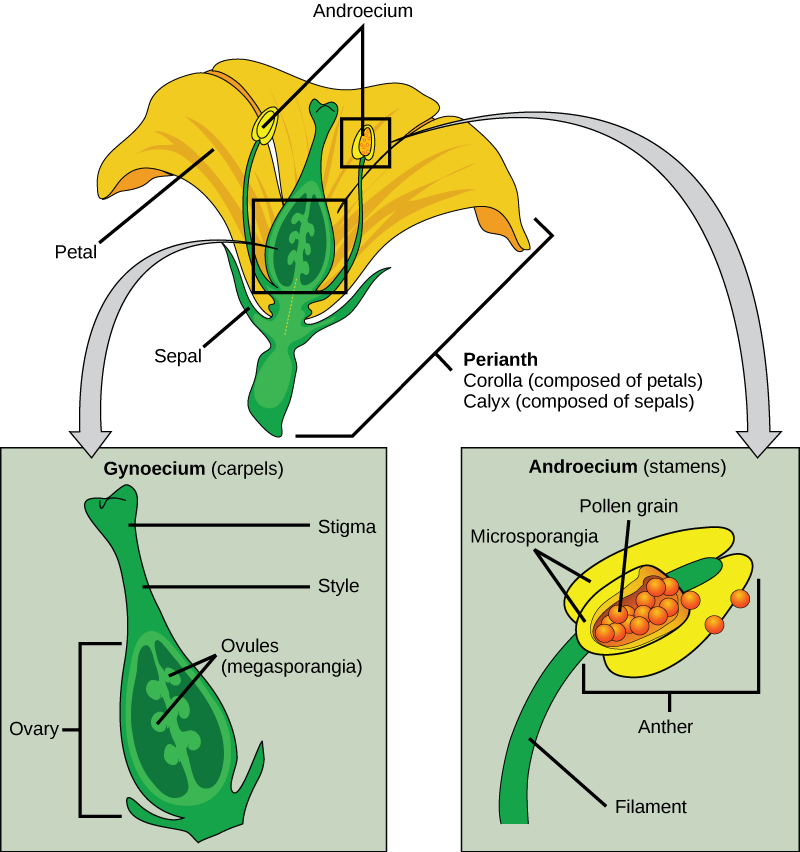
Read the figure slowly, from the outside to the centre. At the bottom you see the stalk and the swollen thalamus. From the thalamus rise small green sepals and two large petals. Inside the petals stand the stamens: each has a thin filament with an anther at the tip. In the very centre stands the pistil: a stigma on top for catching pollen, a style like a neck, and a swollen ovary at the base that holds an ovule.
Many flowers contain both stamens and a pistil. These are bisexual flowers. The word also used is hermaphrodite. Some flowers have only stamens or only a pistil. These are unisexual flowers. A plant with separate male and female flowers on the same plant is called monoecious. Maize is an example. A plant with male and female flowers on different plants is called dioecious. Papaya is an example.
There is one more useful pair of words. A flower with all four rings is called complete. A flower missing any ring, for example one with no petals, is called incomplete. A complete flower can still be unisexual, because completeness is about rings while bisexual is about having both reproductive parts. Keep the two pairs separate and they never confuse you.
A plant does not flower by chance. Weeks before any flower is visible, hormones and changes in the stem tip decide that the plant will flower. Day length and temperature are common triggers. Warmth and light act as signals, growth substances carry the message, and only then do flower buds appear, followed by the stamens and pistils inside them.
A good way to learn this section is to dissect a real flower. Take a large, simple flower and remove the parts ring by ring with forceps: sepals first, then petals, then stamens, counting each ring as you go. Lay each ring on paper and draw what you see. Then cut the ovary open with a blade and look for the tiny ovules inside. One careful dissection teaches more than reading the table five times.
While you work, ask two questions about every flower: which rings are present, and are both reproductive parts present? The first answer tells you complete or incomplete. The second tells you bisexual or unisexual. With those two answers you can place any flower you meet in this chapter.
Keep the exact exam terms ready while you dissect. Calyx, corolla, androecium and gynoecium name the four rings. Thalamus names the base. Filament, anther, stigma, style, ovary and ovule name the working parts. Every later section reuses these words, so learning them now saves effort later.
A flower has 5 sepals and 5 petals. How many perianth parts does it have in total?
The perianth is sepals plus petals, so add: 5 + 5 = 10.
Check: 10 is larger than either ring alone, which makes sense for a sum.
Result: The flower has 10 perianth parts.
A flower has 6 stamens and 1 pistil. Is it bisexual or unisexual? Give a reason.
A bisexual flower carries both stamens and a pistil in the same flower.
This flower has both, so it is bisexual. A unisexual flower would carry only one of the two.
Result: The flower is bisexual because it holds stamens and a pistil together.
A flower has sepals, petals and stamens but no pistil. Is it complete? Is it bisexual?
A complete flower needs all four rings, so without a pistil it is incomplete.
A bisexual flower needs both stamens and a pistil, so without a pistil it is unisexual (male).
Result: The flower is incomplete and unisexual.
1.2a Pre-fertilisation: Male Structures (Stamen & Pollen)
Before fertilisation can happen, the flower has to make its gametes and then bring them close together. This section covers everything up to the moment of fertilisation: how pollen forms, how the ovule and embryo sac form, how pollen reaches the stigma, and what happens next. It is the longest section because it holds most of the new vocabulary. Learn it in three passes: the male side, the female side, then pollination.
A typical stamen has two parts: a slender stalk called the filament and, at the tip, a bag-like anther. The filament holds the anther up where pollen can be picked up by wind or visitors. The anther is where pollen is made.
Most anthers have two lobes, and each lobe has two chambers, so there are usually four pollen sacs in each anther. Each pollen sac is a microsporangium. An anther with four pollen sacs is called tetrasporangiate. An anther with two lobes is bilobed, and with two chambers per lobe it is dithecous. These three words simply count what you would see in a cross-section: two lobes, two chambers per lobe, four sacs in total.
The pollen sacs run along the length of the anther and are packed with pollen grains. Our imagined plant has 4 pollen sacs per anther, with 250 pollen mother cells in each sac. Each mother cell will make 4 pollen grains. So one anther makes pollen grains. A flower with 6 stamens makes grains. Real numbers differ from species to species, but they are always large, because most pollen never reaches a stigma.
If you cut across a young anther you see a pollen sac with a wall of four layers. The centre is filled with tightly packed cells called sporogenous tissue. Every pollen mother cell comes from this tissue.
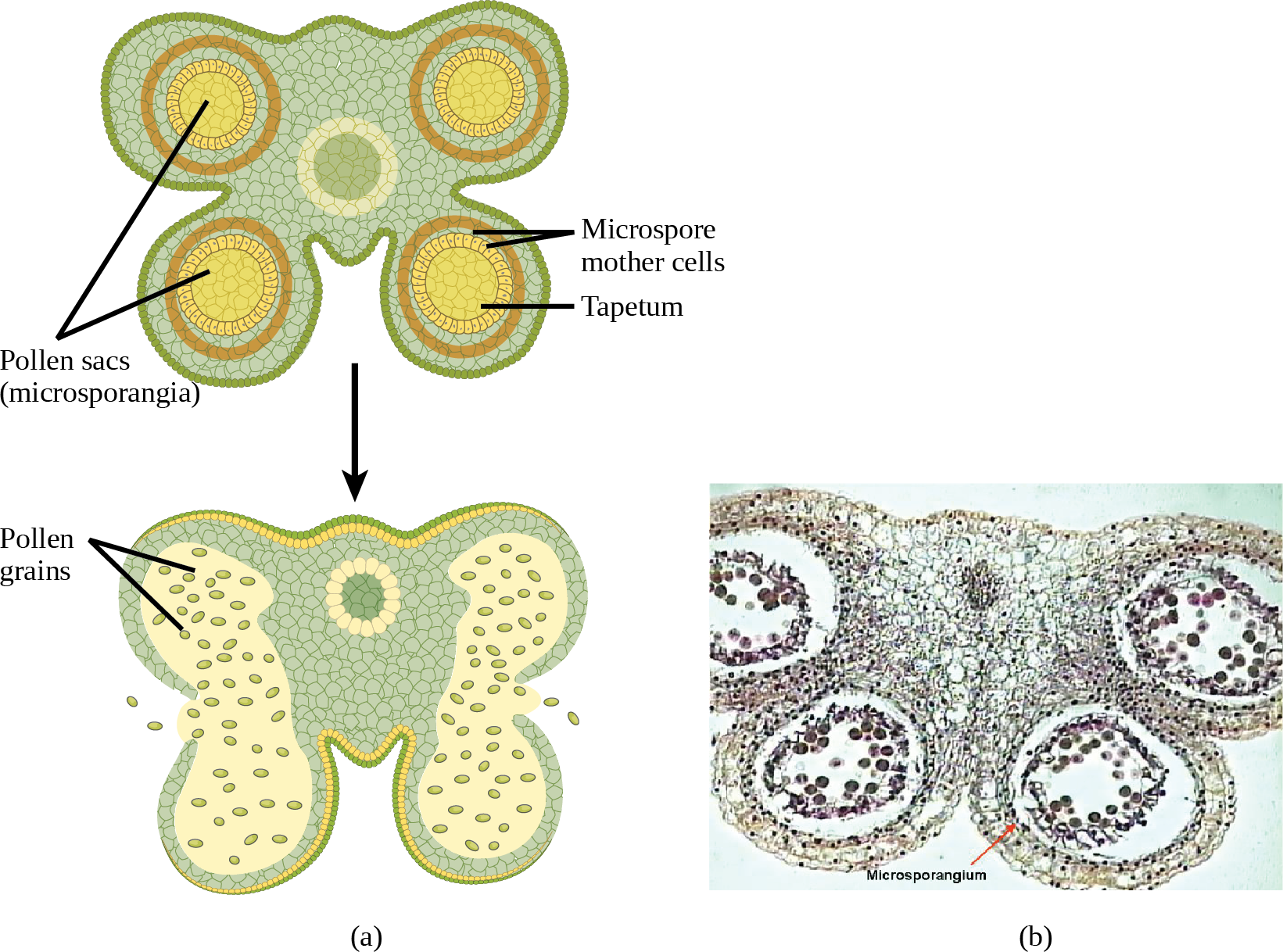
Read the figure from the outside in. The outermost ring is the epidermis, a protective skin. The next ring is the endothecium, a fibrous layer. The middle layers wear away as the anther matures. The innermost ring is the tapetum, which touches the developing pollen. At the centre lie the pollen mother cells.
| Layer | What it does |
|---|---|
| Epidermis | Outer skin; protects the sac |
| Endothecium | Fibrous layer; its cells shrink as they dry and help the anther burst open to release pollen |
| Middle layers | Thin layers that wear away as the anther matures |
| Tapetum | Innermost layer; feeds the developing pollen grains and supplies material for the pollen wall. Its cells have dense cytoplasm and often more than one nucleus |
Cells of the sporogenous tissue are the pollen mother cells. They are also called microspore mother cells. Each one divides by meiosis to make four cells joined together, called a microspore tetrad. Meiosis halves the chromosome number, so a pollen mother cell with makes four microspores with . This process is microsporogenesis. The prefix micro means small, and sporogenesis means the making of spores. As the anther ripens, the four cells of a tetrad separate. Each one develops into a pollen grain.
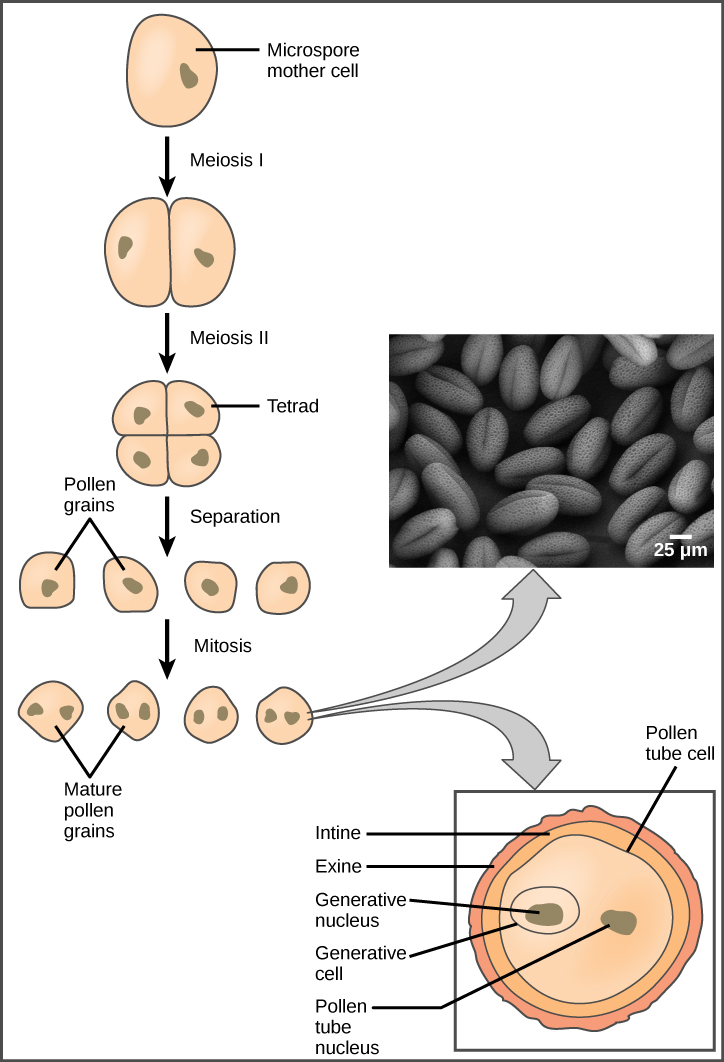
Read the flow chart from top to bottom and check the numbers. It starts with one diploid pollen mother cell. Meiosis cuts the number in half and makes four cells, the tetrad. Then one round of mitosis in each microspore builds the two-celled pollen grain. Notice that meiosis changes the chromosome number while mitosis keeps it the same.
| Stage | Division | Chromosome number |
|---|---|---|
| Pollen mother cell | None yet (starting cell) | Diploid, |
| Microspore tetrad (4 cells) | Meiosis | Haploid, |
| Pollen grain (2 cells) | Mitosis | Haploid, |
Why must the first division be meiosis? If pollen were made by ordinary division, it would keep the full chromosome number. Then after fertilisation the number would double with every generation. Meiosis keeps the number steady from parent to offspring.
A pollen grain is the male gametophyte. A gametophyte is the stage of a plant that makes gametes. The pollen grain is tiny but complete: it carries everything needed to deliver two male gametes. Grains are usually round and measure about 25 to 50 micrometres across. One micrometre is one thousandth of a millimetre. At 50 micrometres, about 20 grains would fit side by side along 1 millimetre, since . At 25 micrometres, about 40 would fit, since .
A pollen grain has a two-layered wall. The hard outer layer is the exine. It is made of a very tough substance called sporopollenin, which resists high temperature, strong acids and strong bases, and no known enzyme breaks it down. This is why pollen is often well preserved in fossils. The exine has one or more thin spots called germ pores, where the sporopollenin is absent. The soft inner layer is the intine, made of cellulose and pectin.
Pollen development and the walls of a mature pollen grain.
Read the figure as two walls and two cells. The thick outer wall is the exine and the thin inner wall is the intine. The small gap in the exine is the germ pore, and the pollen tube will grow out through it. Inside, the large vegetative cell stores food and has a big nucleus. Tucked inside its cytoplasm floats the small generative cell with its own nucleus.
The generative cell later divides to make two male gametes. In many species pollen is shed at this two-celled stage, and the division happens later inside the pollen tube. In other species the generative cell has already divided, so the grain is shed at the three-celled stage. Both routes end with the same product: two male gametes ready for double fertilisation.
As a check on the numbers, one pollen grain releases 2 male gametes. So 50 germinating grains release male gametes. This pairing of one tube with two gametes is exactly what double fertilisation needs.
Pollen is rich in protein, sugars and vitamins, and some people take pollen tablets as a supplement. But pollen of many plants also causes allergies and breathing problems in some people, including sneezing, runny nose and asthma. Anyone with a known pollen allergy should avoid it.
After being shed, pollen must reach a stigma while it is still alive. How long it stays viable depends on the plant. In cereals such as rice and wheat, pollen loses viability within about half an hour. In some families, such as legumes, pollen stays alive for months. Pollen can also be stored frozen in liquid nitrogen at about minus 196 degrees Celsius, in pollen banks, for use in crop breeding.
A pollen mother cell of the imagined plant () divides by meiosis. How many microspores form, and how many chromosomes does each carry?
Meiosis of one cell gives a tetrad of microspores.
Meiosis halves the number: .
Check: , the starting number.
Result: Four microspores form, each with chromosomes.
1.2b Female Structures (Pistil & Embryo Sac)
The gynoecium is the female part of the flower. It may have one pistil or several. A gynoecium with one pistil is called monocarpellary. If there are several pistils, they may stay separate, which is called apocarpous, or join together, which is called syncarpous. These words only describe whether the female parts are single, separate or joined.
Each pistil has three parts: the stigma at the top, a landing place for pollen; the style, a stalk that the pollen tube grows through; and the ovary at the base. Inside the ovary is a cavity, and attached to its wall by a cushion called the placenta are one or more ovules. An ovary may carry one ovule, as in wheat and mango, or many, as in a pea pod. The number of ovules sets the maximum number of seeds the fruit can hold.
An ovule is a small oval structure. It is attached to the placenta by a stalk called the funicle. The point where the funicle joins the ovule is the hilum, a small scar you can see on a bean seed. The body of the ovule is protected by one or two layers called integuments. They surround the ovule except for a small opening at the top called the micropyle. The base of the ovule, opposite the micropyle, is the chalaza. Inside the integuments is a mass of cells called the nucellus, which stores food. One cell of the nucellus near the micropyle will become the megaspore mother cell. Inside the nucellus lies the embryo sac, the female gametophyte.
Read the figure from the top down. At the very top is the small micropyle opening. Below it, two integument layers wrap around the nucellus like coats. Deep inside the nucellus sits the embryo sac. At the bottom is the chalaza, and the funicle stalk runs from the ovule to the ovary wall. Notice that the embryo sac is buried in the middle: the pollen tube has a long journey to reach it.
An ovule usually has a single megaspore mother cell near the micropyle. It is a large cell with dense cytoplasm and a prominent nucleus. The mother cell divides by meiosis to give four megaspores. This process is megasporogenesis. In most flowering plants only one megaspore survives, and the other three break down and disappear. The survivor is the functional megaspore.
Only 1 of 4 megaspores survives, so the survival rate is . The plant starts with four and keeps one. That single cell must then build the whole female gametophyte on its own. Its development into an embryo sac from a single megaspore is called monosporic development. Mono means one, and sporic refers to the spore it came from.
The functional megaspore nucleus divides by mitosis three times in a row. After the first division there are 2 nuclei, then 4, then 8. Counting the doublings gives nuclei. The nuclei move to the two ends, with some going to each end. Cell walls then form around six of the eight nuclei. The embryo sac now has seven cells but eight nuclei.
Read the flow chart from top to bottom and watch where cells are lost and gained. Meiosis makes four megaspores, then three degenerate, so only one line continues. That survivor divides by mitosis three times: 1, 2, 4, then 8 nuclei. The last box shows the final arrangement: seven cells holding eight nuclei.
- Three cells at the micropylar end make the egg apparatus: one egg cell and two synergids. The synergids have special thickenings called filiform apparatus that guide the pollen tube.
- Three cells at the opposite (chalazal) end are the antipodals.
- One large central cell sits in the middle. It holds two polar nuclei, one from each end.
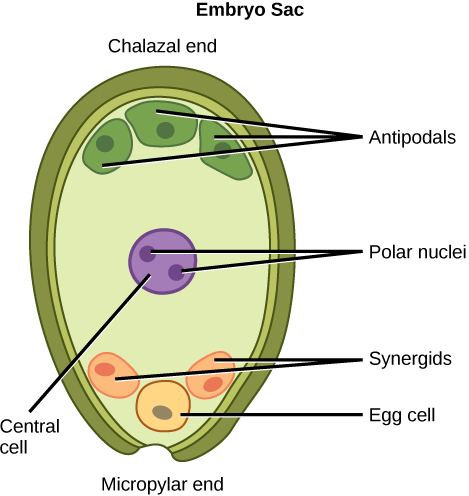
Mature embryo sac: egg apparatus, polar nuclei and antipodal cells.
Read the figure from the top (micropylar end) to the bottom (chalazal end). At the top, one egg cell sits between two synergids: that trio is the egg apparatus. In the middle, the large central cell holds two polar nuclei. At the bottom, three antipodal cells close the sac. The top receives the pollen tube, the middle becomes food, and the bottom cells play only a minor role.
Check the arithmetic: 3 (egg apparatus) + 3 (antipodals) + 1 (central cell) = 7 cells. Nuclei: 3 + 3 + 2 polar nuclei = 8. The central cell is large, so it holds two nuclei in one cell, which is why the number of cells is smaller than the number of nuclei. This seven-celled, eight-nucleate pattern is the most common type and the one examiners expect.
| Feature | Male gametophyte (pollen grain) | Female gametophyte (embryo sac) |
|---|---|---|
| Where it forms | In the pollen sac of the anther | In the ovule, inside the ovary |
| Starting cell | Pollen mother cell | Megaspore mother cell |
| First division | Meiosis to 4 microspores | Meiosis to 4 megaspores, 3 degenerate |
| Final cells | 2 or 3 cells (vegetative + generative or gametes) | 7 cells with 8 nuclei |
| Size | Tiny and free; travels in air or on animals | Buried inside the ovule; never leaves |
The functional megaspore nucleus divides by mitosis three times. How many nuclei result? Show each doubling.
Start with nucleus. After division 1: .
After division 2: . After division 3: .
Check: .
Result: Eight nuclei result, arranged later as 7 cells.
1.2c Pollination & Outbreeding Devices
The pollen is in the anther, and the egg is deep inside the ovule. They must meet. Pollination is the transfer of pollen grains from the anther to the stigma. It is only the first step. Flowering plants cannot walk, so they use outside helpers: wind, water or animals.
Read the figure by following the three arrows. The looping arrow stays inside flower A: that is autogamy, pollination within one flower. The solid arrow runs from flower A to flower B on the same plant: that is geitonogamy. The dashed arrow crosses from plant 1 to flower C on plant 2: that is xenogamy. Only the last arrow brings pollen from a genetically different plant.
| Type | Transfer | Genetic result |
|---|---|---|
| Autogamy | Anther to stigma of the same flower | Offspring very similar to the parent |
| Geitonogamy | Anther to stigma of another flower on the same plant | Genetically like autogamy, but needs a pollinating agent |
| Xenogamy | Anther to stigma of a flower on a different plant | Only type that brings new gene combinations (variation) |
Some plants never open their flowers, so pollen can only fall on the stigma of the same flower. These are cleistogamous flowers. Their advantage is that seeds are guaranteed even if no pollinator comes. Their disadvantage is that there is no variation. Flowers that open and expose their anthers and stigma are chasmogamous. Some plants, such as the common pansy and Commelina, make both kinds of flowers on the same plant, which gives them both safety and variation.
| Agent | Typical features of the flower |
|---|---|
| Wind (abiotic) | Light, dry, non-sticky pollen made in large amounts; feathery stigma to catch it; flowers small, plain, without nectar. Examples: maize and other grasses |
| Water (abiotic) | Rare, found in about 30 genera, mostly in water plants. Pollen is often long and ribbon-like and floats or travels under water |
| Animals (biotic) | Large, coloured, scented flowers with nectar or other rewards; sticky pollen. Bees, butterflies, moths, flies, beetles, wasps, birds and bats can all pollinate |
Most flowering plants use animals. The flower and the animal often suit each other closely. For example, the colour, the scent and the depth of the flower decide which animal can reach the nectar. Small flowers are often crowded together in a cluster so that the whole cluster looks like one large, easy-to-see flower. In return for carrying pollen, the animal gets a reward such as nectar, pollen to eat, or a safe place to lay eggs.
Wind-pollinated and water-pollinated flowers are not colourful and do not make nectar. The reason is simple: they do not need to attract animals, and making colour and nectar costs the plant energy that it can spend on making more pollen instead.
Notice the matching design. Wind-pollinated flowers release huge amounts of smooth, light pollen above feathery stigmas that comb the air. Animal-pollinated flowers make smaller amounts of sticky, often patterned pollen and offer nectar in return for a ride. Each design wastes less where waste is likely: wind is unreliable, so it uses cheap pollen in bulk; animals are precise, so it pays them with food.
A bisexual flower could pollinate itself easily. But self-pollination over many generations reduces variation and can weaken the offspring. So many plants have devices that favour cross-pollination:
- Pollen release and stigma ripening happen at different times, so the two cannot meet in the same flower.
- Anther and stigma are placed at different positions so that pollen cannot reach the stigma of the same flower.
- Self-incompatibility: a genetic mechanism that stops pollen from the same flower, or the same plant, from fertilising the ovules.
- Unisexual flowers. If a plant has male and female flowers on the same plant (monoecious, for example maize and castor), self-pollination within a flower is avoided, although geitonogamy is possible. If male and female flowers are on different plants (dioecious, for example papaya), both autogamy and geitonogamy are avoided.
Pollination does not guarantee that the right pollen arrives. The stigma may receive pollen of the same species (compatible) or the wrong species or the same plant (incompatible). The pistil recognises the pollen using chemical signals. Compatible pollen is accepted and germinates. Incompatible pollen is rejected, either by stopping germination on the stigma or by stopping the pollen tube in the style.
Read the flow chart from the top. Every grain lands on the stigma, but then the path splits. The left branch shows compatible pollen: it germinates and the tube reaches the ovule. The right branch shows incompatible pollen: growth is blocked and no fertilisation follows. The pistil is therefore a checkpoint, not just a landing pad.
After compatible pollination, the pollen grain takes up water and germinates through a germ pore. It grows a pollen tube through the tissue of the stigma and style and into the ovary. The tube is guided toward the ovule and enters it through the micropyle. Finally it enters one synergid. Growth is fast. As an imagined example, a tube growing 2 millimetres per hour through a 30 millimetre style would take hours to cross it.
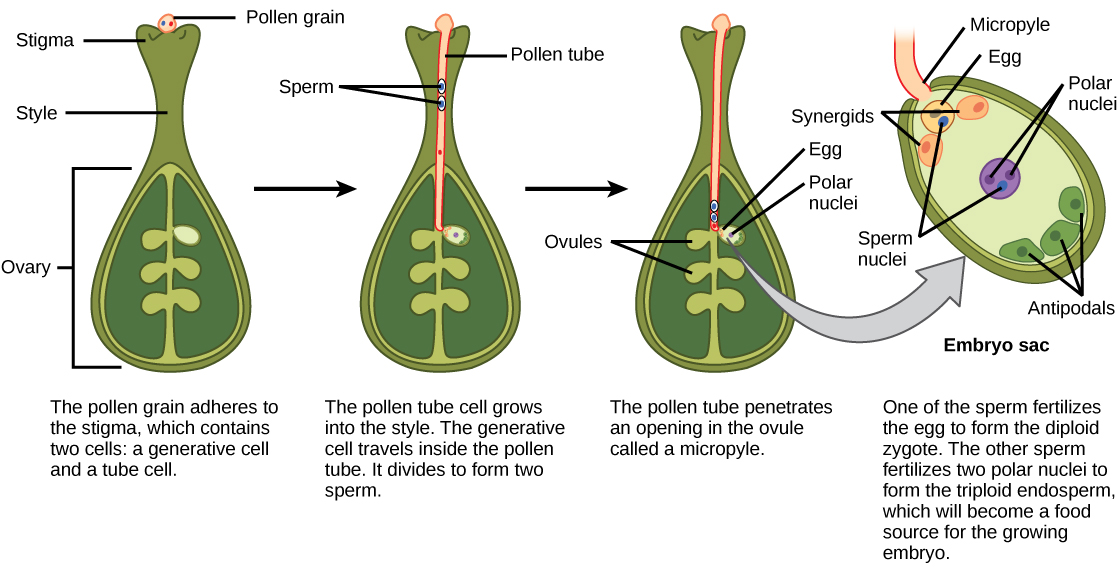
Read the figure from top to bottom, following the dashed tube. A pollen grain sits on the stigma. The tube passes down through the style and into the ovary. There it turns toward the ovule, enters through the micropyle, and reaches the embryo sac. The labels on the left name each station; the label on the right names the travelling tube.
| Step | Where | What happens |
|---|---|---|
| 1. Landing | Stigma | Pollen grain lands; pistil checks compatibility |
| 2. Germination | Stigma surface | Grain takes up water; tube grows out through a germ pore |
| 3. Growth | Style | Tube grows down through style tissue toward the ovary |
| 4. Entry | Ovule micropyle | Tube enters the ovule, then one synergid, and releases 2 male gametes |
Plant breeders cross different varieties to combine useful traits, for example high yield and disease resistance. They must make sure that only the chosen pollen reaches the stigma. Two steps are used:
- Emasculation: if the female parent has bisexual flowers, the anthers are removed from the bud with forceps before they burst. This prevents self-pollination.
- Bagging: the emasculated flower (or a female flower if flowers are unisexual) is covered with a small bag of fine paper or cloth to prevent unwanted pollen from landing. When the stigma is ready, the breeder dusts it with pollen from the chosen male parent and covers it again until the fruit starts to form.
1.3 Double fertilisation
The pollen tube has reached the micropyle. What happens next is a special feature of flowering plants: two fusions take place in the same embryo sac. This is called double fertilisation. No other group of plants does exactly this.
The tip of the pollen tube enters one synergid and bursts, releasing two male gametes into its cytoplasm. The synergid then breaks down, and the two male gametes move to different places:
- Syngamy: one male gamete moves to the egg cell and fuses with its nucleus. The result is a zygote, which is diploid. The zygote will form the embryo.
- Triple fusion: the other male gamete moves to the central cell and fuses with the two polar nuclei. This fusion involves three haploid nuclei, so it is called triple fusion. The result is the primary endosperm nucleus (PEN), which is triploid. The central cell becomes the primary endosperm cell. It will form the endosperm, the food-storage tissue for the embryo.
Read the flow chart from the top. One box at the top releases two male gametes. The left branch follows gamete 1: it joins the egg (syngamy) and the result is a diploid zygote, which becomes the embryo. The right branch follows gamete 2: it joins the two polar nuclei (triple fusion) and the result is a triploid primary endosperm nucleus, which becomes the endosperm. The two branches never mix.
Check the chromosome numbers for our imagined plant. The egg contributes and the male gamete , so the zygote has chromosomes (). The two polar nuclei contribute and the second male gamete adds 12, so the primary endosperm nucleus has chromosomes (). Halving by meiosis and doubling by fusion balance each other exactly.
Both fusions need the pollen tube, and both happen inside the same embryo sac. So both are part of one event. The other cells of the embryo sac (the synergids and antipodals) disappear after fertilisation, because their guiding and support jobs are done.
Double fertilisation is also efficient. The food tissue (endosperm) forms only when the egg is also fertilised, because both fusions are triggered by the same pollen tube. The plant never wastes energy packing food around an unfertilised egg. This close link between embryo and food supply is one reason flowering plants reproduce so successfully.
Follow one generative cell from start to finish to see the whole story. It travels inside the pollen grain, divides into two male gametes, and rides the pollen tube into the embryo sac. There the twins separate: one joins the egg and one joins the central cell. A single pollen grain therefore fathers both the embryo and its food store. That shared fatherhood is exactly what the word double means here: two fusions, one pollen tube, one embryo sac.
| Feature | Syngamy | Triple fusion |
|---|---|---|
| Nuclei that fuse | 1 male gamete + egg | 1 male gamete + 2 polar nuclei |
| Number of nuclei | 2 | 3 |
| Result | Zygote () | Primary endosperm nucleus () |
| Grows into | Embryo | Endosperm |
Step back and see the full ploidy path of the chapter. The plant body is diploid (). Meiosis in the anther and in the ovule produces haploid () gametophytes. Fusion at syngamy restores the diploid () zygote, while triple fusion builds the triploid () endosperm beside it. So the numbers swing to and back to every generation, with one side branch that feeds the embryo. If you can write this loop for any starting , every number question in the chapter becomes routine.
In the imagined plant (), what are the chromosome numbers of the zygote and the primary endosperm nucleus?
Zygote: egg () + male gamete (), so .
Primary endosperm nucleus: 2 polar nuclei () + male gamete (), so .
Check: is and is , as expected.
Result: The zygote has chromosomes; the primary endosperm nucleus has .
In a plant with , what are the chromosome numbers of the zygote and the primary endosperm nucleus?
Halve first: , so .
Zygote: . Primary endosperm nucleus: .
Result: The zygote has chromosomes; the primary endosperm nucleus has .
1.4 After fertilisation: structures and events
After double fertilisation, several things happen together. The endosperm and the embryo develop, the ovule matures into a seed, and the ovary matures into a fruit. These events are collectively called post-fertilisation events. Post simply means after.
Read the figure as six before-and-after pairs. On the left is what the flower had; on the right is what it becomes. The zygote becomes the embryo and the primary endosperm nucleus becomes the endosperm. The integuments harden into the seed coat and the whole ovule becomes the seed. The ovary becomes the fruit and its wall becomes the fruit wall. Learn these six pairs together, because examiners love them.
Endosperm develops before the embryo. This makes sense: the embryo needs food waiting for it when it starts to grow. The primary endosperm cell divides again and again to make a triploid tissue full of stored food, rich in starch, protein or oil.
In the most common type, called free-nuclear endosperm, the nucleus divides many times without making cell walls, so the endosperm is first a liquid with many free nuclei. Cell walls form later. Tender coconut water is a familiar example of free-nuclear endosperm, and the white kernel is the cellular endosperm that forms later. In another type, walls form after every division, so the tissue is cellular from the start.
| Endosperm type | How it forms | Example |
|---|---|---|
| Free-nuclear | Nuclei divide without walls at first; walls form later | Coconut (water, then kernel) |
| Cellular | A wall forms after every division | Many small-seeded plants |
In some seeds, such as pea, groundnut and bean, the embryo uses up all the endosperm before the seed is mature, and the food is stored in the cotyledons instead. These are non-albuminous seeds. In others, such as wheat, rice, maize and castor, the endosperm remains in the ripe seed. These are albuminous seeds. In a few seeds, such as black pepper and beet, part of the nucellus also remains. This leftover tissue is called perisperm.
| Seed class | Endosperm in the ripe seed | Where food is stored | Example |
|---|---|---|---|
| Albuminous | Present | In the endosperm | Wheat, rice, maize, castor |
| Non-albuminous | Used up before ripening | In the cotyledons | Pea, groundnut, bean |
The embryo develops at the micropylar end of the embryo sac, where the zygote lies. The zygote usually waits and divides only after some endosperm has formed. This gives the embryo a food supply to grow on. The stages of a dicot embryo are the proembryo, then the globular stage, then the heart-shaped stage, then a mature embryo. Each stage adds more cells and more shape.
A mature dicot embryo has an embryonal axis and two cotyledons (seed leaves). The part of the axis above the cotyledons is the epicotyl, which ends in the plumule (the future shoot). The part below the cotyledons is the hypocotyl, which ends in the radicle (the future root), covered by a root cap.
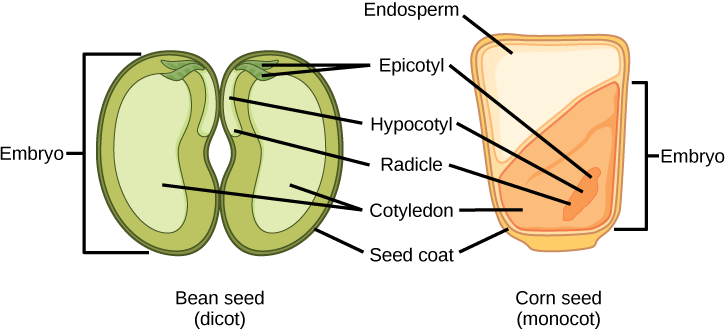
Read the figure from top to bottom. At the top sits the plumule, the future shoot, at the end of the short epicotyl. On either side spread the two large cotyledons, the seed leaves. Below them runs the hypocotyl, ending in the radicle, the future root. Above the cotyledons means shoot; below means root.
A monocot embryo has only one cotyledon. In grasses it is called the scutellum and lies on one side of the axis. The plumule is covered by a protective sheath, the coleoptile, and the radicle and root cap are covered by the coleorhiza. Coleo means sheath, so each name tells you that it wraps something.
Compare the maize scutellum and embryonic axis with the two cotyledons of a bean.
Read the figure by comparing it with the dicot embryo. Here there is only one cotyledon, the scutellum, lying flat on one side. The plumule at the top wears the coleoptile like a cap, and the radicle at the bottom wears the coleorhiza. One cotyledon with two sheaths is the signature of a grass embryo.
| Feature | Dicot embryo | Monocot (grass) embryo |
|---|---|---|
| Cotyledons | Two | One (scutellum) |
| Shoot protection | Plumule at the tip of the epicotyl | Plumule wrapped in the coleoptile |
| Root protection | Radicle with a root cap | Radicle wrapped in the coleorhiza |
A seed is the final product of sexual reproduction in angiosperms. You can think of it as a fertilised ovule that has matured. A seed has a seed coat, the cotyledons, and an embryo axis. The integuments of the ovule harden into the seed coat. The micropyle stays as a tiny pore that lets water enter and helps the seed germinate. Water is lost as the seed ripens, so a mature seed is dry. It enters dormancy, a resting state in which the embryo is inactive. When conditions are right (moisture, oxygen and a suitable temperature) the seed germinates.
Seed dormancy also helps farmers and breeders. Because a dormant seed stays alive without growing, it can be dried, packed and stored for months before sowing. Seed banks keep thousands of varieties alive this way, so a variety is not lost if one season fails. When the stored seed is given water, air and warmth, it wakes up and germinates as if freshly harvested.
While the ovules become seeds, the ovary becomes a fruit. The ovary wall becomes the wall of the fruit, the pericarp. In most plants the other flower parts wither and fall off. In a few plants, such as apple, strawberry and cashew, other parts of the flower, such as the thalamus, also grow and become part of the fruit. These are called false fruits. Fruits developed only from the ovary are true fruits.
Most fruits develop after fertilisation. In a few species the fruit develops without fertilisation. These are parthenocarpic fruits, and they are seedless. Banana is a natural example. In some other plants, spraying growth hormones can induce seedless fruits. Partheno means without fertilisation, and carpic refers to the fruit.
An ovary holds 8 ovules, and 6 of them become seeds. What is the percentage seed set?
Only fertilised ovules become seeds. Divide seeds by ovules: .
Multiply by 100: . So the seed set is .
Result: The seed set is 75%.
- Pollination and fertilisation do not need water in flowering plants, so the plant can reproduce on dry land.
- Seeds carry stored food, so the young plant has a good start. The fruit and seed coat protect the embryo.
- Seeds can be dispersed far from the parent, so they spread the species and reduce competition.
- Seeds can stay dormant, so the plant waits for good conditions. People can also store seeds as food and for sowing next season.
- Seeds made by sexual reproduction mix the genes of two parents, giving variation that helps a species adapt.
Seeds can stay alive for very different lengths of time. Some lose viability within a few months. Others last for many years. Famous examples are a seed of a lupine from the cold north that germinated after about 10,000 years of frozen storage, and a date palm seed about 2,000 years old that also germinated. Dormancy plus a tough coat makes seeds the great survivors of the plant kingdom.
1.5 Apomixis and polyembryony
Seeds usually form after fertilisation. But a few flowering plants, including some grasses and some members of the sunflower family, have a shortcut. They form seeds without fertilisation. This is called apomixis. It is a kind of asexual reproduction that mimics sexual reproduction, because the plant still makes seeds. Apo means away from, and mixis means mixing, so the word says that no mixing of gametes happens.
There are different ways in which this can happen. In one, the egg cell forms without meiosis, so it is already diploid, and it develops into an embryo without being fertilised. The chromosome number never halves, so no male contribution is needed. In another, some diploid cells of the nucellus next to the embryo sac simply start dividing and form embryos that protrude into the embryo sac. In both cases the offspring carry only the genes of the mother plant.
Farmers grow hybrid varieties of many crops because they give higher yields. A hybrid is the offspring of two different parent lines, and it combines their strengths. There is a problem. The seeds from a hybrid plant do not breed true. When a hybrid makes seeds, its genes get shuffled by meiosis and fusion, so the next generation loses the hybrid good traits. Farmers must therefore buy fresh hybrid seeds every year, which is expensive.
Imagine a farmer who needs 40 kg of hybrid seed every sowing season. Over 3 seasons that means buying kg of seed. If the hybrid were apomictic, its seeds would be exact copies of the parent. The hybrid traits would not be lost, and the farmer could keep part of each harvest and sow it again, year after year. This is why scientists are trying to bring apomixis into hybrid crop plants.
Apomixis should not be confused with vegetative propagation. In vegetative propagation a new plant grows from a stem cutting, a tuber or a leaf, and no seed forms at all. In apomixis a proper seed forms, with a seed coat and dormancy, but without fertilisation. The seed habit is kept, so the plant still enjoys dispersal, dormancy and easy storage, while the genes stay fixed like a clone.
Research groups are testing two routes to apomictic crops. One route transfers the genes behind natural apomixis into crop plants. The other route engineers the same result by changing how meiosis and fertilisation work in the ovule. Both routes are still experimental, which is why this section ends with hope rather than a finished method. The biology you have learned here is the foundation those breeders build on.
| Feature | Sexual seed | Apomictic seed |
|---|---|---|
| Fertilisation | Needed | Not needed |
| Meiosis and gamete fusion | Yes | No (or no fusion) |
| Offspring compared with parent | Genetically different | Genetically identical |
| Use for hybrid crops | Hybrid vigour is lost after one generation | Hybrid traits are kept |
Sometimes a seed contains more than one embryo. This is polyembryony. Poly means many. It happens in some species of citrus and mango, and it often results from some nucellus cells developing into embryos in addition to the fertilised egg. If you open and split a few seeds of citrus fruits you may see more than one embryo. One of them comes from the zygote and the extras come from the surrounding tissue.
These extra embryos form directly from diploid nucellus cells, without any meiosis or fusion. That process is called adventive embryony, and it is one natural route to apomixis: the extra embryos are clones of the mother plant even though the seed also holds a normal sexual embryo. So a single citrus seed can carry both a sexual embryo and one or more clonal embryos side by side.
For a grower this is convenient. Seedlings raised from the clonal nucellar embryos grow true to the parent variety, while the sexual seedling may differ. Nurseries therefore often select the strong, uniform nucellar seedlings and remove the weak or off-type one. Polyembryony thus gives the grower the same benefit as apomixis: planting material that repeats the parent.
Summary
Summary
The flower is the organ of sexual reproduction in angiosperms. The stamens (androecium) are the male parts and the pistils (gynoecium) are the female part. Every step after that moves the male gametes toward the female gamete and packs the result into a seed.
- Anther and pollen: a typical anther is bilobed, dithecous and tetrasporangiate. A pollen sac has four wall layers (epidermis, endothecium, middle layers, tapetum) around the sporogenous tissue. Pollen mother cells divide by meiosis to form microspore tetrads, and each microspore becomes a pollen grain with a vegetative cell and a generative cell.
- Pollen grain: the male gametophyte. It has an exine of sporopollenin with germ pores, an inner intine, a vegetative cell and a generative cell. It is shed at the two-celled or three-celled stage.
- Pistil and ovule: the pistil has a stigma, style and ovary. An ovule has a funicle, hilum, integuments, a micropyle, a nucellus, a chalaza and an embryo sac. A megaspore mother cell makes four megaspores; one survives as the functional megaspore.
- Embryo sac: seven cells and eight nuclei: egg apparatus (egg and two synergids), central cell with two polar nuclei, and three antipodals. It forms by three rounds of mitosis from one functional megaspore.
- Pollination: autogamy, geitonogamy and xenogamy; carried by wind, water or animals. Outbreeding devices favour cross-pollination. After compatible pollen lands, a pollen tube grows through the style to the embryo sac.
- Double fertilisation: syngamy gives a diploid zygote; triple fusion gives a triploid primary endosperm nucleus. Both happen in the same embryo sac.
- After fertilisation: the zygote becomes the embryo, the primary endosperm nucleus becomes the endosperm, the ovule becomes the seed and the ovary becomes the fruit. Dicot embryos have two cotyledons; monocot embryos have one (scutellum in grasses). Albuminous seeds keep endosperm; non-albuminous seeds store food in the cotyledons.
- Apomixis and polyembryony: apomixis makes seeds without fertilisation, keeping hybrid traits; polyembryony gives more than one embryo in a seed.
- Seed success: seeds survive because they are dry, dormant, protected and packed with food; fruits protect them and carry them to new places.
Revise this chapter in three passes. First, memorise the six before-and-after pairs of fertilisation. Second, practise the chromosome path to to (and for the endosperm) until you can do it for any starting number. Third, redraw the embryo sac and the pollen tube path from memory. Most examination questions come from these three tasks.
Five traps to avoid in the examination hall
- Pollen grain is the male gametophyte, not a gamete. The male gametes are made by its generative cell.
- The embryo sac has 7 cells and 8 nuclei, not 8 cells. The central cell holds two nuclei.
- The zygote is and the primary endosperm nucleus is . Never swap them.
- Pollination is the arrival of pollen; fertilisation is the fusion of gametes. One does not imply the other.
- Apomixis gives seeds without fertilisation; parthenocarpy gives fruit without fertilisation and without seeds.
Exercises
Try these questions without looking at the answers. Write your answer in full sentences first, then compare.
1.1 A flower has 5 sepals and 5 petals. How many perianth parts does it have? Which two rings do they belong to?
1.2 What does the endothecium do when the anther matures?
1.3 Compare the exine and the intine of a pollen grain wall.
1.4 What is the germ pore, and what is the difference between two-celled and three-celled pollen?
1.5 Why are pollen banks useful, and how is pollen stored in them?
1.6 Name the stalk, the scar, the food tissue and the base of an ovule. Give one job for each.
1.7 What is meant by monosporic development of the female gametophyte?
1.8 A plant has chromosomes. Give the number of chromosomes in (a) a megaspore, (b) the egg cell, (c) a synergid, (d) an antipodal cell, (e) a polar nucleus, (f) the zygote, (g) the primary endosperm nucleus.
1.9 What are chasmogamous flowers? Can cross-pollination occur in cleistogamous flowers? Give a reason.
1.10 What is self-incompatibility? Why does self-pollination not give seeds in a self-incompatible plant?
1.11 An anther has 4 pollen sacs and each sac has 200 pollen mother cells. How many pollen grains does one anther make, if every mother cell forms one tetrad?
1.12 A pollen tube releases two male gametes into the embryo sac. Describe where each gamete goes and name each fusion.
1.13 Why does the zygote usually wait before dividing in a fertilised ovule?
1.14 Differentiate between (a) hypocotyl and epicotyl, (b) coleoptile and coleorhiza, (c) integument and testa, (d) perisperm and pericarp.
1.15 What is parthenocarpy? If growth substances can induce it, which fruits would you choose and why?
1.16 An ovary has 15 ovules and 12 of them form seeds. What is the percentage seed set?
1.17 Distinguish apomixis from parthenocarpy. Why would a breeder prefer an apomictic hybrid?
1.18 A farmer needs 40 kg of hybrid seed every season. How much seed must be bought over 3 seasons? How does apomixis change this?
1.19 Arrange in correct developmental order: embryo, functional megaspore, megaspore mother cell, zygote, mature embryo sac.
1.20 A breeder bags a bisexual flower but forgets to emasculate it. What could go wrong with the planned cross?
Answers
1.1 The perianth is sepals plus petals: 5 + 5 = 10. The sepals belong to the calyx and the petals to the corolla.
1.2 Its fibrous cells lose water and shrink as they dry. This shrinking helps the anther burst open (dehisce) and release the pollen grains.
1.3 The exine is the hard outer layer made of sporopollenin, with germ pores where it is absent. The intine is the soft inner layer made of cellulose and pectin.
1.4 The germ pore is a thin spot in the exine where the pollen tube grows out. In two-celled pollen the generative cell divides later in the tube; in three-celled pollen it has already divided into two male gametes before shedding.
1.5 Pollen banks store pollen for crop breeding, so breeders can use it long after shedding. Pollen is dried and stored frozen in liquid nitrogen at about minus 196 degrees Celsius, which keeps it viable for years.
1.6 Funicle (stalk that attaches the ovule to the placenta), hilum (scar where the funicle joins), nucellus (food-rich tissue around the embryo sac), chalaza (base opposite the micropyle).
1.7 The embryo sac develops from a single functional megaspore. The other three megaspores of the tetrad break down and play no further part.
1.8 (a) 10; (b) 10; (c) 10; (d) 10; (e) 10; (f) 20; (g) 30. All gametophyte cells are haploid (); the zygote is diploid (); the primary endosperm nucleus is triploid ().
1.9 Chasmogamous flowers open and expose their anthers and stigma. Cross-pollination cannot occur in cleistogamous flowers because they never open, so only pollen of the same flower can reach the stigma.
1.10 A genetic mechanism that stops pollen from the same flower or plant from fertilising its own ovules. The pistil recognises the pollen as incompatible and blocks its germination on the stigma or the growth of its tube in the style.
1.11 Multiply sacs by cells by grains per tetrad: . So one anther makes 3,200 pollen grains.
1.12 One gamete moves to the egg cell and fuses with it; this is syngamy and gives the diploid zygote. The other moves to the central cell and fuses with the two polar nuclei; this is triple fusion and gives the triploid primary endosperm nucleus.
1.13 The endosperm develops first so that food is already stored when the embryo starts growing. Dividing early would leave the young embryo without a food supply.
1.14 (a) The hypocotyl is the part of the embryonal axis below the cotyledons and ends in the radicle; the epicotyl is above the cotyledons and ends in the plumule. (b) The coleoptile is the sheath covering the plumule; the coleorhiza is the sheath covering the radicle in monocots. (c) Integuments are the covering layers of the ovule; after fertilisation they harden into the seed coat, whose outer layer is the testa. (d) Perisperm is leftover nucellus kept inside some seeds; pericarp is the fruit wall formed from the ovary wall.
1.15 Parthenocarpy is fruit formation without fertilisation, giving seedless fruits. Fruits that are eaten whole and are troubled by seeds are the best choice, because seedless fruit is easier to eat.
1.16 Divide seeds by ovules and multiply by 100: .
1.17 Apomixis makes seeds without fertilisation; parthenocarpy makes a fruit without fertilisation and without seeds. An apomictic hybrid is preferred because its seeds clone the parent, so hybrid vigour is kept generation after generation.
1.18 Multiply: kg must be bought, because hybrid seeds do not breed true. With apomixis, saved seeds keep the hybrid traits, so the farmer can sow part of each harvest instead of buying fresh seed.
1.19 Megaspore mother cell, functional megaspore, mature embryo sac, zygote, embryo. The gametophyte forms first by meiosis and mitosis, and the embryo forms last after fertilisation.
1.20 The flower still holds its own anthers, so its own pollen can land on the stigma inside the bag. The seeds that form may come from self-pollination instead of the planned cross, and the breeder cannot tell which is which.