4. Quadratic Equations
4. About this chapter
Big idea: A squared unknown can produce two answers, one repeated answer, or no real answer.
Read one small part at a time. Try each example on paper. Then cover the answers and do the practice. Use the diagrams to explain your thinking.
| Word | Meaning |
|---|---|
| Root | A value making an equation true. |
| Factorise | Rewrite as a product of simpler expressions. |
| Discriminant | The value b² − 4ac used to classify quadratic roots. |
4.1 Introduction
A product of two unknown lengths naturally leads to a squared term. Draw and label a rectangle before forming its area equation.
Use one variable when the second length is described using the first. Solving the equation gives algebraic possibilities.
The context supplies further conditions, such as positive length or a whole-number count. Keep the algebraic solution separate from the decision about which root is usable.
A rectangle with width and length has area square units. Its area condition is , or . The squared term appears because two lengths containing the unknown are multiplied.
An equation may have roots that do not fit a real problem. A root is a value that makes the equation true. A rectangle cannot have a negative width.
First find all the algebraic roots. Then explain which roots fit the situation.
4.2 Quadratic Equations
The appearance of a square does not guarantee a quadratic equation. Expand both sides, move the terms to one side and collect matching powers.
Only then identify the squared coefficient, linear coefficient and constant. Missing terms have zero coefficients.
Keep their places when substituting into a formula. The leading coefficient must be nonzero, because otherwise the equation has a different degree.
A quadratic equation has a squared term. Write it as , with . This is its standard form.
Expand brackets and collect like terms first. Sometimes the squared terms cancel. The equation may then be linear rather than quadratic.
For , expansion gives , hence . The coefficients are , and .
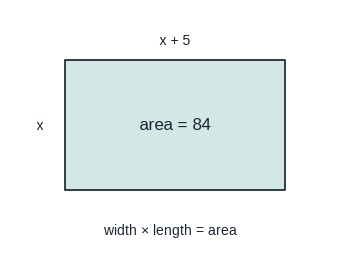
The diagram shows the rectangle from the introduction. Its equation is . Writing the relationship first makes the expansion easier.
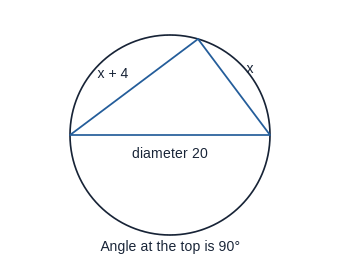
A right triangle with legs and has hypotenuse . Pythagoras gives .
Expand and simplify: , so . Factor: . The positive length is and the other leg is . Check .
4.3 Solution of a Quadratic Equation by Factorisation
Factorisation reverses multiplication. It turns a quadratic expression into a product whose zeroes are easy to identify.
The zero-product rule applies only when that product equals zero. The quadratic formula provides another route when suitable factors are hard to spot.
Write the three coefficients first, including their signs. Calculate the discriminant separately, then substitute into the formula.
The plus and minus signs describe two calculations, so carry out both.
Put zero on one side. Factor the other side into brackets. Then set each bracket equal to zero.
This uses the zero-product rule: if two real numbers multiply to zero, at least one of them is zero. You cannot use this rule while the other side is nonzero.
Solve . We need two integers whose sum is and product is . They are and , since and . Thus , giving or . The rectangle in the introduction has width and length .
For , split the middle term as . Then , so . Its roots are and . Substitution into the original equation verifies both.
The formula also comes from making a square. Start with and divide every term by . Move the constant term to the right.
Add to both sides. The left side becomes a perfect square:
Take both square-root signs, then subtract . We get Use it for real roots when .
For , completing the square gives , so . Both signs are needed.
Use the quadratic formula to solve , keeping the answers exact.
- Identify , and . The constant is negative, so keep brackets around it when evaluating the discriminant.
- Calculate . It is positive, so there are two real roots.
- The denominator is . Substitute to obtain .
- Write both roots: and . The root symbol applies to 41 alone; the division by four applies to the entire numerator.
Use the formula to solve exactly.
Answers
- Here , , . Discriminant . The formula gives . Since , the roots are and .
A rectangular panel is 4 cm longer than it is wide. Its area is 77 square centimetres. Find its dimensions.
- Let the width be cm. The length is cm. Area gives , so .
- Find two integers whose product is minus 77 and whose sum is four. They are eleven and minus seven. Therefore .
- The zero-product rule gives or . Both solve the algebraic equation, but a width must be positive.
- Choose width cm. The length is cm. Check the area: square centimetres.
A panel is 3 cm longer than its width and has area 70 square centimetres. Find its dimensions.
Answers
- Write . Rearranging and factoring gives . Positive width is cm, and length is cm. The product checks the area.
4.4 Nature of Roots
The discriminant tells you about real roots before you calculate them. A positive discriminant gives two square-root signs with different results.
A zero discriminant makes those results coincide. A negative discriminant has no real square root.
This classification is about real solutions to the equation. It does not tell you which solution fits a particular length, time or count problem.
The discriminant is . It is the number under the square root in the quadratic formula.
If , there are two different real roots. If , both roots are equal. If , there are no real roots. We cannot take the real square root of a negative number.
| Equation | Discriminant | Real roots |
|---|---|---|
| Two distinct | ||
| Equal | ||
| None |
For to have equal roots, . Therefore and the repeated root is .
History note: quadratic problems were studied in ancient Babylonian and Greek mathematics. Later mathematicians, including Brahmagupta and al-Khwarizmi, developed systematic ways to solve them. Modern symbols compress those methods into a general formula.
Solve . First identify , , . Keep the minus signs.
Find the discriminant: .
Substitute into the formula: . Since , the exact roots are .
An exact answer keeps the square root. A decimal is only an approximation. Substitute either exact root into the original equation to check it.
Exercise 4.1 — Form equations
Exercise 4.2 — Solve
Exercise 4.3 — Discriminants
4.5 Summary
- Reduce an equation to standard form before choosing a method.
- Factorisation uses the zero-product rule; completing the square leads to the quadratic formula.
- The discriminant classifies the real roots.
- Reject a root in an application only after stating the contextual restriction.