5. Arithmetic Progressions
5. About this chapter
Big idea: A constant change makes a long sequence predictable.
Read one small part at a time. Try each example on paper. Then cover the answers and do the practice. Use the diagrams to explain your thinking.
| Word | Meaning |
|---|---|
| Term | One number in a sequence. |
| Index | A term’s position in the list. |
| Common difference | The amount added at each step of an AP. |
5.1 Introduction
A list can look regular without being an arithmetic progression. Compare consecutive differences rather than guessing from its appearance.
You need a fixed change at every step. The sign of that change matters: decreasing terms have a negative common difference.
A real situation may end after a fixed number of terms even when its mathematical rule could continue.
A sequence is a list in a fixed order. Some sequences add the same amount each time. Others multiply, or follow a different rule.
Subtract each term from the next one. Check whether these differences stay the same.
A training schedule starts at minutes and increases by minutes each session. The times are . The constant increase lets us find a distant term without listing every session.
5.2 Arithmetic Progressions
A term is a value in the sequence. Its position tells you where it occurs.
The first term occupies the first position before any common difference has been added. Each move to the next position adds the common difference once.
A value can be negative even though its position must be a positive integer. Do not reject a negative term merely because a negative position would be impossible.
An arithmetic progression, or AP, adds the same number at every step. That number is the common difference . If the first term is , the terms start .
The difference can be positive, negative or zero. A negative difference makes the terms decrease.
The sequence has . A decreasing AP is still an AP. The constant sequence has . The sequence is not an AP because its differences change.
A finite AP has a last term. For example, stops. An infinite AP keeps going, such as . We can sum the first terms of either kind. The formula does not give the sum of an endless list.
If are consecutive AP terms, then . Rearrange to get , so . This middle value is the arithmetic mean of the two outer values.
Between and , the arithmetic mean is . Thus is an AP.
5.3 nth Term of an AP
Sometimes the position is known and you need a term. Sometimes a term is known and you need its position.
In the second case, solve the same formula for the position and check that the result is a positive integer. A fractional result means the proposed value falls between terms, rather than being a member of the AP.
Substituting back into the term formula is a direct check.
The first term needs no extra step. The second needs one step. The nth term needs steps.
So . Here is the position in the list, starting at one. A position must be a positive integer.
For the training schedule, minutes. To ask which session lasts minutes, solve : .
If and , subtract from . Then , so and .
Session length rises by 4 minutes each time. Only integer session numbers are terms of the AP.
Read a finite AP backwards. Its first term is now the old last term , and its difference is . So the kth term from the end is .
For , the seventh term from the end is .
There are terms. The seventh from the end is the fifteenth from the start. Check .
5.4 Sum of First n Terms of an AP
The nth term is one entry. The sum of the first n terms adds every entry up to that position.
Read a problem for words describing a single stage or an accumulated quantity. The sum formula pairs entries equally far from the ends.
That pairing explains the average of the first and last terms in the formula. When solving a sum equation, check every positive integer solution against the original sequence and its context.
Write the AP forwards. Under it, write the same terms backwards. Add each pair. Every pair has the same total: first term plus last term.
There are pairs, and we have counted the sum twice. So , giving . Since , we can also use .
For the first training sessions, minutes. This is the total time, whereas the eighteenth term is only one session’s time.
To sum multiples of from through , first count terms: . Then the sum is .
For the AP , suppose the sum is . Put into the sum formula: .
So , or . Only a positive integer can count terms. Hence .
Take the AP . Its first four terms sum to . Its first seven terms also sum to . The extra terms cancel.
The formula gives . Set it to : . Both and are valid. Always test both positive integer answers.
Check: and .
A familiar story about young Gauss describes pairing the first and last terms of a long sum. Each pair has the same total. Whether you start with ten terms or a hundred, the pairing idea explains the AP sum formula.
Stack rows contain 9, 8, 7, 6 and 5 blocks. Each new row has one fewer block.
The row counts form an AP with , , . Total blocks .
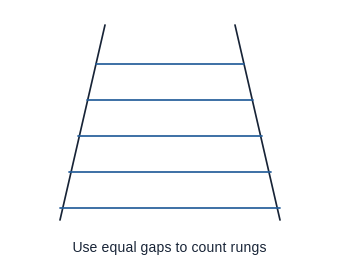
A ladder has equal gaps between its first and last rungs. There are rungs, because both end rungs count. If rung lengths go from cm to cm, total rung length is cm.
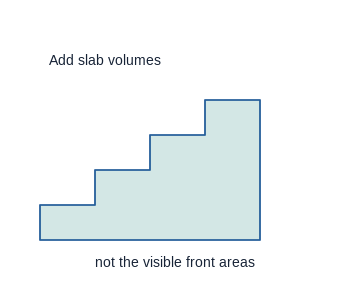
For equal-width slabs, let the heights be m. Each slab is m long and m deep. Add heights first: m. Multiply by m² to get volume m³.
Three semicircles have radii 1, 2 and 3. Their lengths are π, 2π and 3π.
A semicircle has arc length . For radii , total arc length is . The radii form an AP, so their arc lengths do too.
A collector starts at a base. Objects are m from it. The collector returns after each object. Add the one-way distances and double: m. This is different from one walk past every object.
A display has 12 rows. The first row has 8 lights, and each later row has 3 more lights. Find the last-row count and total count.
- The fixed increase makes an AP with , and . The last row is one term; the full display requires a sum.
- There are increases. The last row has lights.
- Pair the end terms. Their sum is . The total is lights.
- Check using the other sum form: . Both calculations count the same rows.
Use 10 rows with 6 lights first and an increase of 4. Find the last row and total.
Answers
- The last row has lights. The total is . The factor nine counts the changes between ten rows.
Exercise 5.1 — Identify patterns
Exercise 5.2 — Terms
Exercise 5.3 — Sums
Exercise 5.4 — Optional challenge
5.5 Summary
- An AP has a constant consecutive difference.
- The nth term is a + (n−1)d; the index must be a positive integer.
- The sum is n times the average of the first and last terms.
- Use S(n) − S(n−1) to recover a term from a sum formula.