3. Plant Kingdom
Introduction
This chapter uses original explanations and practice tasks. Learn the biological terms, then use them to explain an observation.
- Compare algae, bryophytes, pteridophytes, gymnosperms and angiosperms using body plan and reproduction.
- Trace haploid and diploid stages, and keep spores separate from gametes.
- Explain how pollen and seeds reduce the need for a film of water between plants.
Early plant lists often used a few visible traits, such as flower number. Natural systems compared many characters together. Phylogenetic systems try to reflect ancestry. Numerical taxonomy codes many traits for comparison. Cytotaxonomy uses chromosome evidence. Chemotaxonomy uses chemical features. Each method adds evidence. None replaces careful looking at the living plant.
This chapter is a comparison map, not a catalogue of every species. Each group is named by a few reliable traits. You will reuse those traits in later chapters on flowers, seeds and photosynthesis.
Keep one question in view: how does the plant complete its life cycle on land? Water, sperm, pollen, spores and seeds are the tools. Groups differ in which tools they use.
When a name is new, read the plain-language definition first. Then keep the exam word. Both are required. A definition without the term will not match a mark scheme. A term without meaning will not explain an example.
3.1 ALGAE
A green film on a pond and a large brown seaweed both capture light. They do not belong in one narrow box.
Algae is a broad school grouping of simple photosynthetic organisms. It is not one modern family tree. Many algae live in water. Some live on damp soil, bark or stone.
The body is usually a thallus. A thallus has no true roots, stems or leaves. True organs belong to vascular land plants with specialised tissues.
Algae may be one cell, a colony, a filament or a large sheet. Size alone does not name the class. Pigments, stored food and reproduction do more work.
Highlight Name an alga by pigment, reserve food and reproductive features together, not by colour alone.
Vegetative reproduction can be simple. A filament may break. Each piece grows. That is fragmentation.
Asexual reproduction often uses spores. A zoospore is a motile spore. Some spores do not swim.
Sexual reproduction joins gametes. There are school patterns.
Isogamous fusion joins similar gametes. The gametes look alike. They may still swim.
Anisogamous fusion joins gametes that differ in size. Both may still be motile.
Oogamous fusion joins a large non-motile egg with a smaller male gamete. The egg stays in place. The male gamete travels.
Similar colour does not mean similar sex. Two green algae can use different sexual patterns. Read the species, not only the class name.
Chlorophyceae are the green algae of this chapter. They contain chlorophyll a and chlorophyll b. Those pigments also occur in land plants. That is one reason green algae are compared with plants.
The usual stored food is starch. Many walls contain cellulose. A pyrenoid is a dense region in many chloroplasts. It is linked to carbon fixation and starch storage.
Chlamydomonas is unicellular and motile. Volvox is a colony of many cells. Ulothrix and Spirogyra form filaments. Ulva forms a sheet. One class, many body plans.
Green algae live mainly in fresh water. Some are marine. Some grow on moist surfaces. Habitat is a clue, not a proof.
Spirogyra is a filament with spiral chloroplasts. Sexual fusion of similar filaments is a common school picture of isogamy. Chlamydomonas can show more than one sexual pattern in different accounts. Do not force every green alga into oogamy.
Unicellular green algae can still be important in water. A bloom is a dense population. Colour of water is not a species name. You still need pigments and structure.
Phaeophyceae are the brown algae. Most are marine. Most are multicellular. Some form large kelp bodies.
Chlorophyll a and chlorophyll c occur. Fucoxanthin is an accessory pigment. It helps give the brown colour. The stored food is often laminarin and mannitol. Wall material may include alginates.
A holdfast anchors the body. A stipe is a stalk. Blades spread surface to light. These parts are not true roots, stems and leaves. They lack the organ plan of a fern or a seed plant.
How to read the figure. Start at the top blade. That is the light-catching sheet. Follow the stipe down. End at the holdfast. Conclude this: the holdfast keeps the plant in place. It does not take up soil minerals like a true root.
Laminaria, Fucus, Sargassum and Ectocarpus are syllabus examples. Motile stages, when present, often have two unequal lateral flagella. That is a school identification clue, not a sketch you must draw from memory.
Rhodophyceae are the red algae. Chlorophyll a is present. Phycoerythrin is a red accessory pigment. School tables also list chlorophyll d. The stored food is floridean starch.
Most red algae are marine. Some live in deeper water, where the light mix differs from the surface. Some occur in fresh water. Depth is a habitat note, not a definition.
Reproductive cells of red algae lack flagella. They do not swim. Porphyra, Gelidium and Gracilaria are examples. Several red algae are used as food or as sources of gelling materials.
How to read the figure. Read one column at a time. Green stores starch and uses chlorophyll a and b. Brown adds fucoxanthin and stores laminarin. Red uses phycoerythrin and stores floridean starch. If colour and storage disagree, re-check the specimen.
| Group | Useful pigments | Characteristic reserve | Flagella in sex cells? |
|---|---|---|---|
| Chlorophyceae | Chlorophyll a and b | Starch | Often present in motile stages |
| Phaeophyceae | Chlorophyll a and c; fucoxanthin | Laminarin and mannitol | Present in many motile stages |
| Rhodophyceae | Chlorophyll a; phycoerythrin | Floridean starch | Absent |
How to read the table. The pigment column is the first filter. The reserve column is the second. The flagella column separates red algae from many green and brown forms. Use all three before you name a class.
Algae add oxygen to water and air through photosynthesis. They also form the base of many aquatic food webs. Large seaweeds can shelter other organisms.
People harvest some algae as food. Others supply hydrocolloids: gel-forming wall materials. Algin comes from brown algae. Carrageenan and agar come from red algae such as Gelidium and Gracilaria. Agar is used to grow microbes in laboratories.
Some unicellular green algae have been studied as compact photosynthetic systems. Treat those notes as uses, not as extra classes.
Algae also cycle minerals in water. When they die, other organisms feed on the remains. A sudden die-off can change oxygen levels. That is ecology built on the same pigments you use for classification.
Do not treat “seaweed” as a class. Seaweed is a size word. A large green sheet, a kelp and a red blade can all be called seaweed in everyday speech. The class still comes from pigment and storage.
A marine thallus is brown. It stores laminarin. It has a holdfast and blades. Which class fits, and which extra check would you still make?
Goal. Place the specimen in one of the three school classes.
Rule. Combine colour, reserve food and body plan. Do not stop at colour.
Reserve. Laminarin points to Phaeophyceae, not to starch or floridean starch.
Body. Holdfast and blades match a large brown alga, not a unicellular green cell.
Extra check. Confirm chlorophyll a and c, and fucoxanthin, if the question supplies pigment data.
Result: Phaeophyceae (brown algae); confirm pigments if possible.
Cover the answers. Write a full sentence for each. Then check.
3.2 BRYOPHYTES
A moss on a wall looks like a small leafy plant. Its sperm still need a film of water. That fact places bryophytes among the first land plants in this chapter, not among seed plants.
Bryophytes are non-vascular land plants. They lack true xylem and phloem. Rhizoids attach the body. Rhizoids are not true roots.
The familiar green body is the haploid gametophyte. Haploid means it has one set of chromosomes, written n. The gametophyte makes sex organs.
Male organs are antheridia. They produce sperm. Female organs are archegonia. Each holds an egg. Sperm swim through water to the egg. No water film, no fertilisation in this group.
Fertilisation makes a diploid zygote. Diploid means two chromosome sets, written . The zygote grows into a sporophyte that stays attached to the gametophyte. The sporophyte depends on the gametophyte for food.
Meiosis in the capsule makes haploid spores. Spores grow into new gametophytes. Changing from n to needs fertilisation. Changing from to n needs meiosis.
Highlight In bryophytes the green plant you notice is haploid; the capsule-bearing stalk is diploid and dependent.
Many liverworts have a flattened thallus. Others are leafy. Marchantia is the usual school example.
Vegetative reproduction can use fragmentation. It can also use gemmae. A gemma is a small multicellular body. Gemmae form in gemma cups on the thallus. A gemma grows into a new gametophyte. No fertilisation is needed.
The liverwort sporophyte has a foot, a seta and a capsule. The foot attaches to the gametophyte. The seta is a stalk. The capsule makes spores.
A moss spore germinates into a green protonema. The protonema is a branched filament. Buds on it grow into leafy shoots called gametophores. Those leafy shoots bear the sex organs.
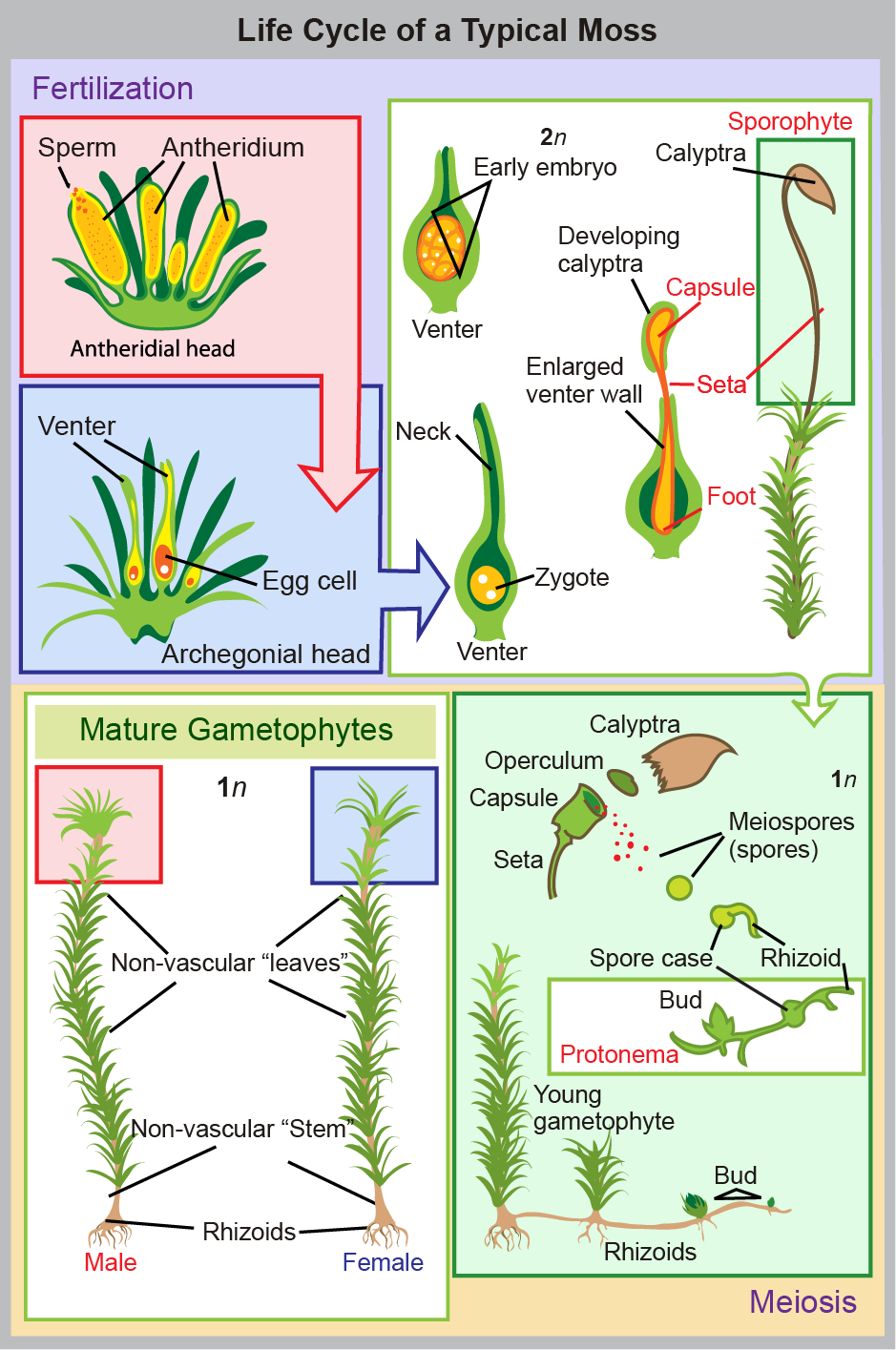
How to read the plate. Find the leafy green gametophyte first. That is the independent plant. Then find the sporophyte growing from its tip, with a stalk and a capsule. Spores leave the capsule. They do not sit inside a seed.
Moss sporophytes also have a foot, seta and capsule. The capsule releases spores. Funaria, Polytrichum and Sphagnum are syllabus mosses. Sphagnum can form peat in waterlogged places. Peat stores partly decayed plant matter.
How to read the figure. Look left. A liverwort is a flat thallus with gemma cups. Look right. A moss starts as protonema, then a leafy shoot, then a small capsule. Conclude this: both are bryophytes, but only the moss path begins with protonema in the school account.
Bryophytes hold moisture on surfaces. They can prepare a thin living layer for other organisms. They add organic matter as they die. These are ecological notes, not extra classification ranks.
Teachers sometimes call bryophytes the “amphibians of the plant kingdom”. The phrase is an analogy. It points to land bodies with water-dependent fertilisation. It is not an animal name.
Antheridia and archegonia are not flowers. They are sex organs of the gametophyte. No ovary forms. No fruit follows. The zygote stays on the parent gametophyte.
Sphagnum leaves can hold much water. That is why peatlands stay wet. Peat is not a seed bank. It is packed gametophyte remains. Do not call it wood from a tree.
Liverworts and mosses share the same life-cycle plan. They differ in the shape of the gametophyte and in extra vegetative tricks. Learn the shared plan first. Then add gemmae or protonema.
A leafy green shoot bears a small capsule on a thin stalk. The leafy shoot is haploid. Name the dominant generation, the generation that makes spores, and the process that makes those spores.
Goal. Place each part on the life-cycle loop.
Leafy shoot. Haploid and independent, so it is the gametophyte. In bryophytes this generation is dominant.
Capsule on a stalk. That is the sporophyte. It is diploid and attached.
Spores. Meiosis in the capsule produces haploid spores. Mitosis would keep the same ploidy.
Check. The capsule is not a fruit. There is no seed.
Result: Dominant gametophyte n; dependent sporophyte 2n makes spores by meiosis.
Try these on paper first. Uncover the answers only after you finish.
3.3 PTERIDOPHYTES
A fern has true roots, a stem and leaves. It still makes no seeds. That combination is the school idea of a pteridophyte.
Pteridophytes are seedless vascular plants. Vascular tissue means xylem and phloem. These tissues move water, minerals and sugars. They also support a larger body on land.
The dominant plant is a diploid sporophyte. It is independent. It is not a small capsule sitting on a moss. Some leaves are small microphylls. Ferns typically have larger megaphylls.
Sporangia form spores by meiosis. Sporangia may sit on specialised leaves called sporophylls. In some plants, sporophylls stack into cones or strobili. In many ferns, clusters of sporangia called sori sit on the underside of fronds.
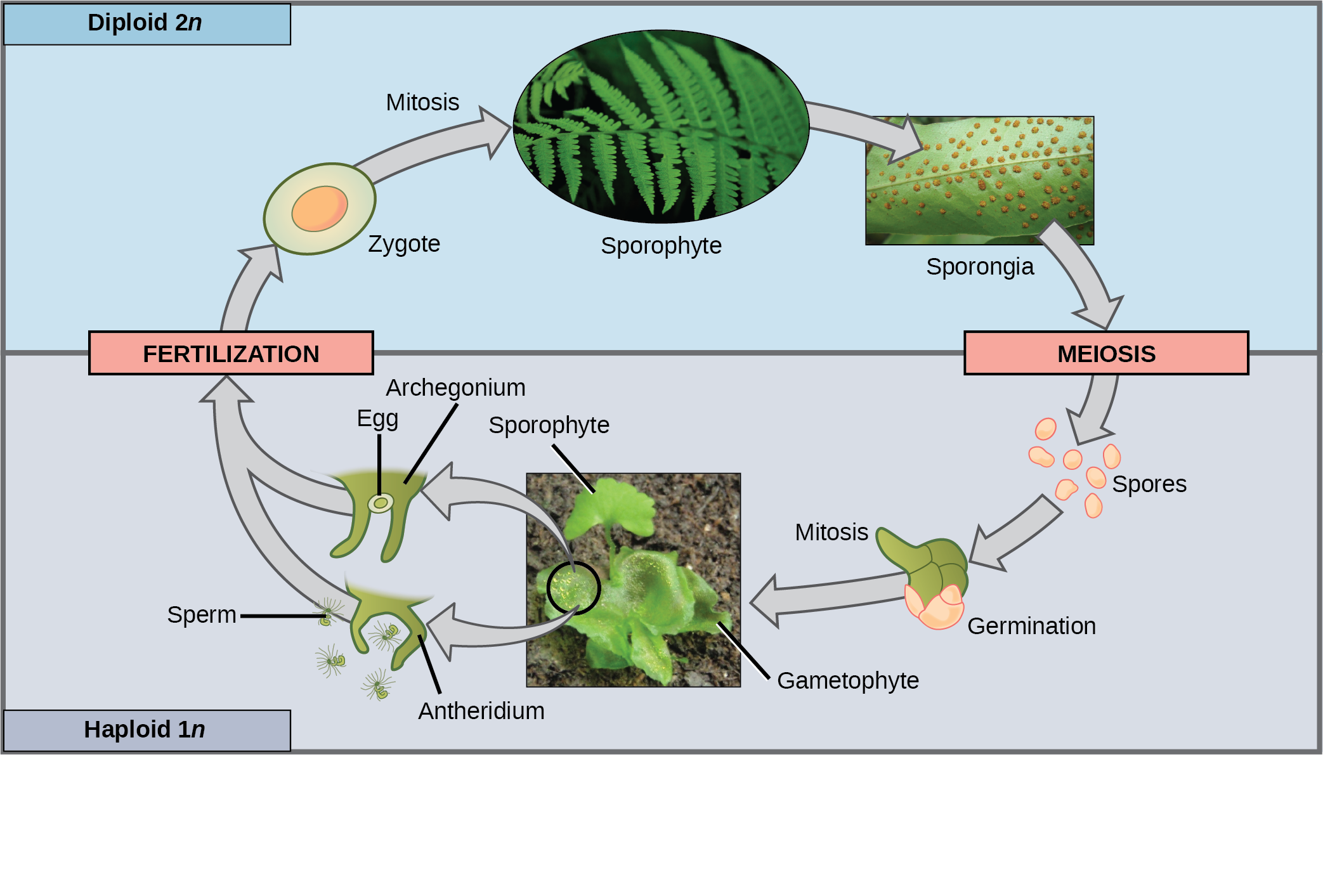
How to read the plate. Start with the large leafy fern. That is the sporophyte. Find sori or sporangia. Spores leave those cases. Then find the small heart-shaped gametophyte, the prothallus. Sperm still need water. The new fern grows from a zygote on that tiny plant.
A spore grows into a small gametophyte, often called a prothallus. It usually bears antheridia and archegonia. Sperm still swim. Vascular tissue does not remove the water need for sperm.
How to read the figure. Read top to bottom as one loop, then return. Meiosis is on the large plant. The prothallus is the small sexual plant. Fertilisation needs water. The zygote rebuilds the large fern. Do not draw seeds on this loop.
Highlight The fern you pick up is diploid; the small prothallus is haploid; water still carries sperm.
Homosporous plants make one kind of spore. That spore grows into a gametophyte. The gametophyte may bear both sex organs. The school point is one spore type, not two.
Heterosporous plants make two kinds of spore. Small microspores grow into male gametophytes. Larger megaspores grow into female gametophytes. Selaginella and Salvinia are syllabus examples of heterospory.
Heterospory matters because it specialises male and female sides. The female gametophyte may be retained and fed. Those steps sit on the path toward seeds. Pteridophytes still do not make true seeds.
Lycopodium, Equisetum and familiar ferns such as Dryopteris are further examples. Some of these bear strobili: compact stacks of sporophylls. A strobilus is still a spore cone, not a seed cone.
The old bundle called “pteridophytes” is a school comparison group. It is not one modern branch. Use the shared seedless vascular condition. Then add that caution if the question asks about phylogeny.
A young fern leaf is often coiled. That coil is a useful field clue. It does not replace life-cycle labels. You still must say sporophyte, spore, prothallus and zygote in the right order.
Compare the life-cycle role of a fern frond with that of a moss leafy shoot. Then say which plant still needs water for sperm.
Goal. Name the dominant generation in each plant, then the water step.
Fern frond. It is a leaf of the diploid sporophyte. The sporophyte is large and independent.
Moss leafy shoot. It is the haploid gametophyte. The sporophyte is the small capsule on top.
Shared step. In both groups, sperm swim to an egg. Both still need a water film for that step.
Check. Both make spores. Spores are not seeds.
Result: Frond = diploid sporophyte; moss shoot = haploid gametophyte; both still need water for sperm.
Answer without looking down. Then match your wording to the key.
3.4 GYMNOSPERMS
A conifer carries seeds on cone scales. The seeds are not hidden inside a fruit. That arrangement is the school meaning of gymnosperm.
Gymnosperms have ovules that are not enclosed in an ovary. “Naked seed” names that geometry. It does not mean the seed has no coat. A seed coat can still be present.
The dominant plant is a sporophyte with roots, stems and leaves. Many conifers have needle-like leaves and a thick cuticle. Those traits reduce water loss. They are adaptations, not a definition of the whole group.
Pinus roots often live with mycorrhizal fungi. The partnership helps mineral uptake. Cycas can have coralloid roots that contain nitrogen-fixing cyanobacteria. These are useful examples. They are not required of every gymnosperm.
Gymnosperms are heterosporous. Microsporangia make microspores. Microspores become pollen grains, the reduced male gametophytes. A megaspore grows into a female gametophyte inside an ovule.
Male cones and female cones may look similar from far away. They are not interchangeable. Male cones shed pollen. Female cones bear ovules. Mixing them breaks the life-cycle story.
Pollination moves pollen to the ovule region. Pollen does not need a free water path between two plants. In most seed plants a pollen tube later delivers male gametes. Cycas and Ginkgo still have motile sperm inside that reproductive system.
After fertilisation, the zygote becomes an embryo and the ovule becomes a seed. The food tissue in the usual gymnosperm comparison is the haploid female gametophyte. It formed before fertilisation. It is not the typical triploid endosperm of flowering plants.
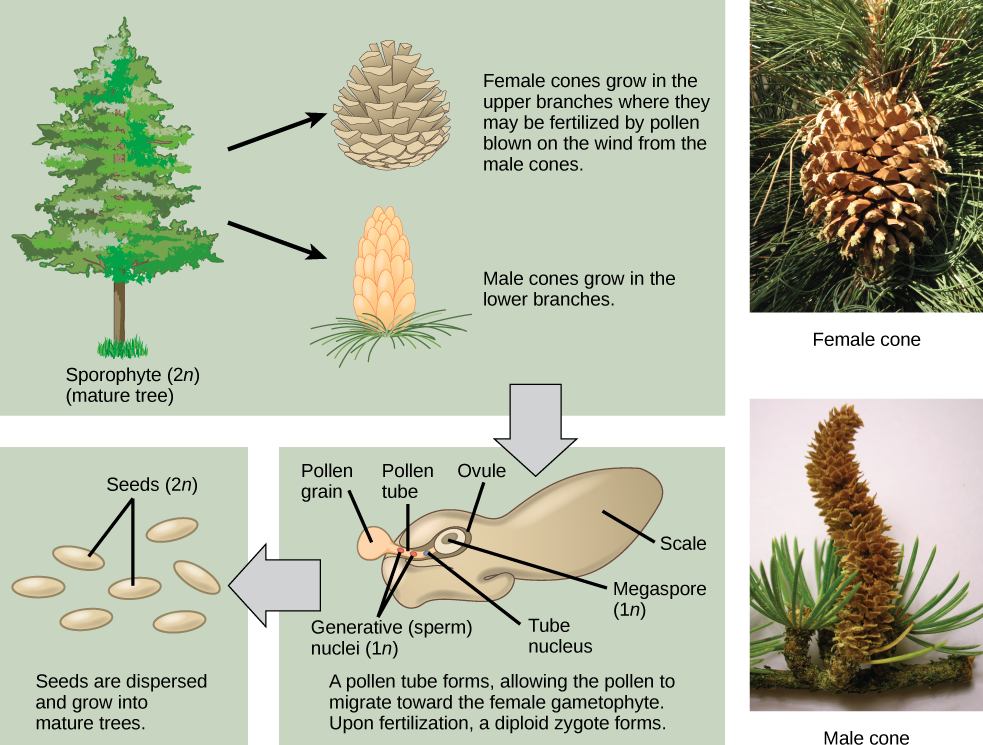
How to read the plate. Find male cones that release pollen. Follow pollen to female cones that bear ovules. The seed develops on the scale. There is no fruit wall around it. The large tree is the sporophyte.
Pollen is not a sperm cell on the wind. It is a tiny gametophyte. It later releases male gametes. Seed plants then need no water trail between two free plants.
Cones may occur on one plant or on separate plants, depending on the species.
Highlight A seed coat does not make a plant an angiosperm; ask whether the ovule sat in an ovary.
How to read the figure. The left panel is a gymnosperm seed on a scale. Food tissue is n. The right panel is a flowering-plant seed inside a fruit. Typical endosperm is . The splitting question is enclosure of the ovule, not presence of a coat.
A woody plant has seeds on cone scales and needle leaves. A classmate calls the brown covering a fruit. Correct the identification and name the food tissue inside the seed in the school comparison.
Goal. Separate seed, seed coat and fruit.
Rule. A fruit develops from an ovary. Gymnosperm ovules are not in an ovary.
Coat. A seed can have a coat and still be gymnosperm.
Food tissue. In the usual gymnosperm story the food is haploid female gametophyte tissue, not endosperm.
Check. Needles help identification of many conifers, but cones plus exposed ovules decide the group.
Result: Gymnosperm seed, not a fruit; food tissue is haploid female gametophyte.
Work these four items as a mini test. Check only after all four.
3.5 ANGIOSPERMS
A flower is not only decoration. It is the reproductive shoot that lets ovules sit inside an ovary. That enclosure defines the last group in this chapter.
Angiosperms are flowering plants. Ovules are enclosed in an ovary. After fertilisation the ovary commonly becomes a fruit. Ovules become seeds. The pollen grain and the embryo sac are highly reduced gametophytes.
The typical embryo sac in school biology is -celled and -nucleate. It includes one egg, two synergids, three antipodal cells and a central cell with two polar nuclei. You do not need a drawing of every wall to use those counts.
Angiosperms show double fertilisation. One male gamete fuses with the egg. That fusion makes a diploid zygote. The other male gamete fuses with the polar nuclei of the central cell. That fusion makes the primary endosperm nucleus, usually triploid ().
The zygote becomes the embryo. Endosperm nourishes it. Two fusions, two products. A single fusion is not the flowering-plant pattern.
Highlight Double fertilisation makes a diploid embryo and, typically, triploid endosperm in one event pair.
A cotyledon is a seed leaf. Traditional school splits use cotyledon for monocotyledons and cotyledons for dicotyledons.
A fruit can be dry or fleshy. The texture does not decide the group. A dry fruit is still a fruit if it came from an ovary. A gymnosperm seed on a cone is still not a fruit.
Other clues travel with that split. Many monocots have parallel venation and scattered vascular bundles. Many dicots have reticulate venation and a ring of bundles. Flowers often follow threes in monocots and fours or fives in dicots. Treat these as a bundle of clues, not as one magic trait.
Modern systems note that the old “dicot” pile is not one natural clade. Eudicots form a major lineage within it. School papers may still ask monocot versus dicot. Answer with the structural table, then add the caution if the question allows.
| Feature | Monocotyledon | Dicotyledon |
|---|---|---|
| Cotyledons | One | Two |
| Leaf venation | Usually parallel | Usually reticulate |
| Stem bundles | Often scattered | Often in a ring |
| Root | Often fibrous | Often a tap root |
| Flower parts | Often in threes | Often in fours or fives |
How to read the table. Start with cotyledon number if a seed is present. If you have only a leaf, venation is the next clue. One mismatch is weak evidence. Two or three matching rows are stronger.
A life cycle tracks haploid and diploid stages. Three school labels are used.
A haplontic cycle has a mainly haploid body. The diploid stage is the zygote. Many algae follow this pattern. Meiosis of the zygote returns the haploid plant.
A diplontic cycle has a mainly diploid body. Haploid stages are reduced to gametes, or to tiny gametophytes inside cones and flowers. Gymnosperms and angiosperms are diplontic in the school sense. Some algae, such as Fucus, are also described that way.
A haplodiplontic cycle has a multicellular haploid generation and a multicellular diploid generation. Bryophytes and pteridophytes show this alternation of generations. The two generations take turns. They are not two unrelated plants.
How to read the figure. Start at gametophyte n. Fertilisation makes a zygote . The sporophyte grows. Meiosis makes spores n. Spores grow into the gametophyte again. If a label skips meiosis or fertilisation, the ploidy will be wrong.
Land plants alternate generations. They differ in which generation you notice. Moss: gametophyte obvious. Fern: sporophyte obvious. Seed plant: sporophyte is the tree or crop. Gametophytes hide in pollen and ovules.
Many green algae are haplontic. The plant you see is n. Only the zygote is . That is not the moss pattern. Mosses have a multicellular capsule as well as a multicellular n body.
If a question gives only “dominant diploid plant”, you still have two school groups: pteridophytes and seed plants. Ask next whether seeds are present. Then ask whether ovules were enclosed.
Spores are cells that grow without fusing. Gametes fuse. Meiosis in land plants typically makes spores, not gametes directly. Gametes come later by mitosis in the gametophyte. Mixing those words is the most expensive error in this chapter.
Place these four events in life-cycle order. Mark haploid or diploid after each: spore formation, gametophyte growth, gamete fusion, embryo growth.
Goal. Walk one full loop without skipping a ploidy change.
Start after meiosis. Spore formation by meiosis yields haploid spores (n).
Next. A spore grows into a gametophyte (n).
Fusion. Gametes fuse. The zygote is .
Embryo. The embryo is tissue of the new sporophyte.
Check. Do not put embryo growth before fusion. Do not call the spore .
Result: Spores n, then gametophyte n, then fusion, then diploid embryo.
Write each answer as one or two short sentences. Then uncover the key.
SUMMARY
Use these links between ideas to check your understanding.
- Algae in this chapter form 3 classes that differ in pigments, stored food and motile stages. A thallus is not a vascular plant body.
- Bryophytes have a dominant gametophyte and a dependent sporophyte. Sperm need a water film. Gemmae are vegetative, not sexual.
- Pteridophytes have a dominant vascular sporophyte but still need water for sperm. Sori release spores. Heterospory is a step toward seeds, not a seed.
- Gymnosperms have exposed ovules and seeds without fruits. Pollen reduces the need for a water path between plants. Food tissue is usually n female gametophyte.
- Angiosperms enclose ovules in an ovary. Double fertilisation (2 fusions) makes a zygote and typically endosperm. Fruits come from ovaries.
- Life cycles are haplontic, diplontic or haplodiplontic. Alternation of generations swaps multicellular n and stages. Meiosis makes spores; fertilisation restores .
EXERCISES
Try these questions without looking at the answers. Write your answer in full sentences first, then compare.
3.1 A marine specimen is olive-brown and stores laminarin, but a student files it as Chlorophyceae because it photosynthesises. What error was made?
3.2 A marine alga stores floridean starch and has no flagellate gametes. Which class fits?
3.3 Why is a holdfast a poor synonym for a root in a marking scheme?
3.4 A leafy body bears a small attached capsule. The leafy body is haploid. Identify the dominant generation and the process that makes spores.
3.5 A liverwort thallus bears cups of gemmae, while a moss spore first makes a protonema. What does each structure produce?
3.6 On which plant does meiosis occur in a moss, and on which plant does it occur in a fern?
3.7 Why is a conifer seed neither a spore nor a fruit?
3.8 A plant produces microspores and megaspores but no seeds. Does heterospory prove it is a gymnosperm?
3.9 Place these events in order: embryo growth, spore formation, gamete fusion, gametophyte growth.
3.10 Explain why pollen permits reproduction on dry land more effectively than free-swimming sperm between separate gametophytes.
3.11 Name the two products of double fertilisation and their usual ploidy.
3.12 A plant has two cotyledons, reticulate venation and floral parts in fives. Which traditional group fits, and what caution should you add?
3.13 Is Fucus described as haplontic in the school scheme? What label is used, and why?
3.14 A student writes that bryophytes are amphibians. Repair the sentence for a biology paper.
3.15 Why can a fern be tall yet still fail to set seed in a dry season?
3.16 Match reserve food to group: starch, laminarin, floridean starch.
3.17 An ovary wall thickens around seeds after fertilisation. Name the structure and the group.
3.18 In alternation of generations, which process halves chromosome number, and which product does it make in land plants?
3.19 Why is calling red algae “deep-sea plants with no chlorophyll” unsafe?
3.20 A classmate says endosperm is the baby plant. Correct the claim using both fusions.
Answers
3.1 Photosynthesis is shared. Laminarin and brown accessory pigment point to Phaeophyceae. Chlorophyceae store starch and use chlorophyll b.
3.2 Rhodophyceae, the red algae.
3.3 A holdfast anchors a thallus. It does not have the anatomy or mineral-uptake role of a true root.
3.4 The gametophyte is dominant. Meiosis in the diploid sporophyte produces spores.
3.5 A gemma grows into another gametophyte without fertilisation. A moss spore grows into protonema, which then buds leafy gametophytes.
3.6 In a moss, meiosis is in the small attached sporophyte capsule. In a fern, meiosis is in sporangia on the large independent sporophyte.
3.7 It contains an embryo and seed tissues, so it is not one spore cell. It does not develop inside an ovary, so it is not a fruit.
3.8 No. Some seedless vascular plants are heterosporous.
3.9 Spore formation, gametophyte growth, gamete fusion, embryo growth. The sporophyte then continues the loop.
3.10 Pollen carries and protects the reduced male gametophyte. Fertilisation occurs at the ovule, not along an external water film between two free plants.
3.11 A diploid zygote (embryo line) and a typically triploid primary endosperm nucleus that forms endosperm.
3.12 A dicotyledon in the school table. The old dicot grouping is not one modern clade, so the structural match is not a full phylogeny.
3.13 It is treated as diplontic. The visible body is diploid and the haploid phase is reduced, unlike a mainly haploid green-algal plant.
3.14 Bryophytes are land plants whose fertilisation still needs water. The amphibian phrase is only a teaching analogy.
3.15 Height comes from a vascular sporophyte. Seed set is not part of its cycle. Sperm still need moisture, so dry conditions block fertilisation on the prothallus.
3.16 Starch — Chlorophyceae. Laminarin — Phaeophyceae. Floridean starch — Rhodophyceae.
3.17 A fruit in an angiosperm. Gymnosperms do not form fruits from ovaries.
3.18 Meiosis halves the number. It makes spores, not gametes, in the land-plant scheme of this chapter.
3.19 Red algae contain chlorophyll a. Phycoerythrin adds colour and can help in some light conditions. Depth is a habitat trend, not a definition, and they are thalloid algae, not vascular plants.
3.20 The embryo grows from the zygote. That zygote is egg plus one male gamete. Endosperm comes from the second fusion. It feeds the embryo. It is not the embryo.