7. Structural Organisation in Animals
Introduction
This chapter uses original explanations and practice tasks. Learn the biological terms, then use them to explain an observation.
- Connect cell, tissue, organ and organ-system levels.
- Describe a frog externally and trace its main organ systems.
- Relate amphibian structure to life in water and on land.
The frog has been a school animal for more than a century because it is large enough to dissect, and because it lives in two worlds. Treat the standard drawing as a typical amphibian pattern, not as every frog on Earth.
- Morphology: outside form. Anatomy: organs inside.
- Tissue: similar cells with one shared job.
- Organ: several tissues in a working pattern.
- Organ system: organs that share a broad job.
- Cloaca: shared terminal chamber, not a second stomach.
- Metamorphosis: hormone-timed rebuild of several systems.
Use the list as a glossary, not as the lesson. Each word needs a job in a sentence.
Read one level at a time. Then name a frog organ at that level.
Keep a six-row systems page. Add one organ and one job per row.
After each system, trace one molecule or signal through it.
The licensed plate is a model. Match names to it. Do not invent extra chambers.
Morphology named the outside of a plant in the last two chapters. Here the same word names the outside of an animal, and anatomy names the organs inside.
A single muscle cell can contract. It cannot pump blood around a body. Pumping needs an organ: several tissues arranged so they can work together.
highlight An organ is several tissues in a working pattern, not a large cell and not one tissue type.==
How to read the figure. Start at the top. Each box is a new level of cooperation. A function that is impossible at one level becomes possible at the next. Absorption needs an epithelium; moving food needs muscle as well.
The syllabus climbs 5 levels: cell → tissue → organ → organ system → organism.
The frog in this chapter is the school example historically named Rana tigrina, now generally Hoplobatrachus tigerinus. Species vary. Distinguish a typical frog from a rule about every amphibian.
Plant anatomy in the last chapter was a section through a root or stem. Animal organisation is a map of organs in a body that moves. The skill is the same: name the part, then say what must pass through it.
Keep a page of systems as you read: digestive, respiratory, circulatory, excretory, nervous, reproductive. For each, write one organ and one job. That page is the chapter in miniature.
Amphibian means “both lives”: a life that starts in water and continues, in the adult, on land that is still moist. The structures you will name all serve that double life.
Do not rush to the labelled heart. First be able to say why an organ is more than a tissue. The frog makes sense only after that idea is solid.
A dissection, a model and a textbook figure are three views of one pattern. The licensed plate is a model. The gut path is a schematic. Neither is a photograph of a living jump.
A cell is the working unit. A tissue is a team of similar cells. An organ is several teams with a shared product. A system is several organs on one job. The organism is the frog that must keep all six systems supplied.
If you skip a level, explanations snap. “The heart is muscle” skips lining, valves and nerves. “The frog is skin” skips lungs, kidneys and gut.
This chapter is a map, not a mammal chapter. Chamber counts, waste type and fertilisation site are amphibian facts. Do not paste human anatomy onto the frog.
Why study a frog rather than listing every animal tissue in the kingdom?
Goal. Give a reason that is not “it is in the syllabus”.
One body, many systems. A frog lets you trace food, air, blood and wastes through one animal.
Two habitats. The same body must work in water and on land, so the structures have a story.
A warning. The drawing is typical, not universal.
Result: A frog is a worked example of organ systems in one amphibious body.
A student points at the heart on a model and says “that is muscle tissue”. Repair the claim using levels.
Goal. Place the heart on the correct level.
Tissue. Cardiac muscle is one tissue class inside the wall.
Organ. The heart also has lining, connective tissue and nerves.
System. The heart belongs to the circulatory system with vessels and lymph.
Check. One word, “heart”, is an organ. It is not a tissue name.
Result: The heart is an organ in the circulatory system, not a single tissue.
Answer in a sentence, then check the wording.
7.1 ORGAN AND ORGAN SYSTEM
One muscle cell can contract, but it cannot pump blood effectively by itself. In an organ, several tissues cooperate in a structured way.
The heart combines muscle, connective tissue, lining tissue and nervous inputs. Their arrangement permits coordinated pumping. Naming the heart does not name only cardiac muscle.
An organ system links organs with a shared broad function. The digestive system takes in food, breaks it down and absorbs nutrients. The circulatory system distributes those nutrients. The respiratory surfaces supply oxygen. No system acts in complete isolation.
New functions arise from interactions at each level. The small intestine needs absorptive epithelium, supporting connective tissue, smooth muscle and nerves. Cut any one of those away and absorption fails in a different way.
Epithelium covers and lines. Connective tissue supports and binds. Muscle moves. Nervous tissue signals. Those four animal tissue classes return in every organ you will name in the frog.
A tissue is a group of similar cells with a shared job. That definition is the animal twin of the plant tissues in the previous chapter. The names differ; the idea that cells cooperate does not.
Epithelium in the gut absorbs. Epithelium in the skin keeps the frog from drying too fast, and still lets gases through. Same tissue class, two addresses, two jobs.
Connective tissue is a wide class: blood is a connective tissue, bone is a connective tissue, the packing around organs is connective tissue. In the frog you will meet it as packing, as blood, and as the skeleton that the muscles pull on.
Smooth muscle in the gut wall is not under the frog’s “will”. Skeletal muscle in the hindlimb is. Cardiac muscle in the heart has its own rhythm, adjusted by nerves. Three muscle kinds, three controls.
Nervous tissue is not only the brain. A nerve to a hindlimb, a receptor in the skin, a patch of the spinal cord: all are nervous tissue. The jump begins at a receptor, not at the muscle.
An organ system is named by the job the organs share, not by a single organ inside it. The digestive system is not “the stomach”. It is the path from mouth to cloaca plus the glands that empty into it.
highlight Name the shared job first, then the organs that serve it.==
Systems overlap. The cloaca belongs to digestion, excretion and reproduction. Blood belongs to circulation and also carries hormones. Do not fight the overlap; name it.
The organism is not a fifth organ. It is the whole frog, with systems that keep one another supplied. A jump uses muscle, bone, nerve, blood and lungs together. That is the point of the last summary task.
School lists name 4 tissue classes: epithelial, connective, muscular, nervous.
They reappear inside 6 systems: digestive, respiratory, circulatory, excretory, nervous, reproductive.
A lining without muscle cannot mix gut contents. Muscle without a lining cannot absorb. Nerves without either cannot feed the frog. Levels are not decoration.
Blood is a tissue that travels. That is why circulation is a system: a moving tissue plus a pump plus vessels.
When two systems share an organ, write both jobs. The cloaca is the usual test of that habit.
Do not rank levels as “better”. A tissue is not a failed organ. It is the right grain for its job.
After a frog captures prey, how do several systems share the work of feeding?
Goal. Do not stop at the stomach.
Capture. Tongue and jaws, under nervous control, seize the prey.
Digestion. Enzymes in the gut release absorbable molecules.
Transport. Blood carries those molecules.
Use. Cells oxidise them, using oxygen from respiratory surfaces.
Check. Feeding is a chain of systems, not a single organ’s job.
Result: Capture, digestion, circulation and respiration all take part after the tongue flicks.
Place each item on one level: intestinal epithelium, small intestine, digestive system, whole frog.
Goal. Use one level name per item, then say why.
Epithelium. Similar lining cells: a tissue.
Small intestine. Lining plus muscle, connective tissue and nerves: an organ.
Digestive system. Mouth to cloaca plus glands: an organ system.
Whole frog. All systems together: the organism.
Check. If several tissue types sit in one structure, you have left the tissue level.
Result: Tissue, organ, organ system, organism — in that order.
Cover the answers. Name the level first, then the job.
7.2 Frogs
A frog illustrates how one body supports both aquatic and terrestrial activities. The syllabus commonly uses the frog historically named Rana tigrina, now generally placed in Hoplobatrachus tigerinus. Species vary, so distinguish a typical frog description from a rule about every amphibian.
The body has a head and trunk, with no distinct adult neck or tail. Moist glandular skin supports gas exchange and helps prevent drying.

Eyes have movable lids and a protective nictitating membrane. A tympanum receives sound. External nostrils connect to the buccal cavity.
Forelimbs support the body; long muscular hindlimbs power jumping and swimming. That is 2 pairs of limbs, with webbing on the hind feet to increase the surface that pushes water.
Males of the standard example have vocal sacs and nuptial pads, particularly evident in the breeding season.
Frogs are ectothermic: body temperature depends strongly on the surroundings. Seasonal inactivity can reduce exposure to cold or dry conditions. Skin colour and posture may help camouflage.
No neck in the adult means the head sits on the trunk. A tail is a tadpole feature that is resorbed. If you are shown an adult with a long tail, you are not looking at the standard frog pattern.
Webbing is a fold of skin between digits. It is a swimming fan, not a gill. Do not confuse a larger pushing surface with a gas-exchange surface.
Vocal sacs are loose skin pouches in males of the standard example. Air from the lungs fills them and the call grows louder. They are a reproductive signal, not a spare pair of lungs.
Nuptial pads are rough patches on the male’s first fingers. They help grip the female during amplexus, the breeding clasp. Again, a seasonal structure, not a year-round extra limb.
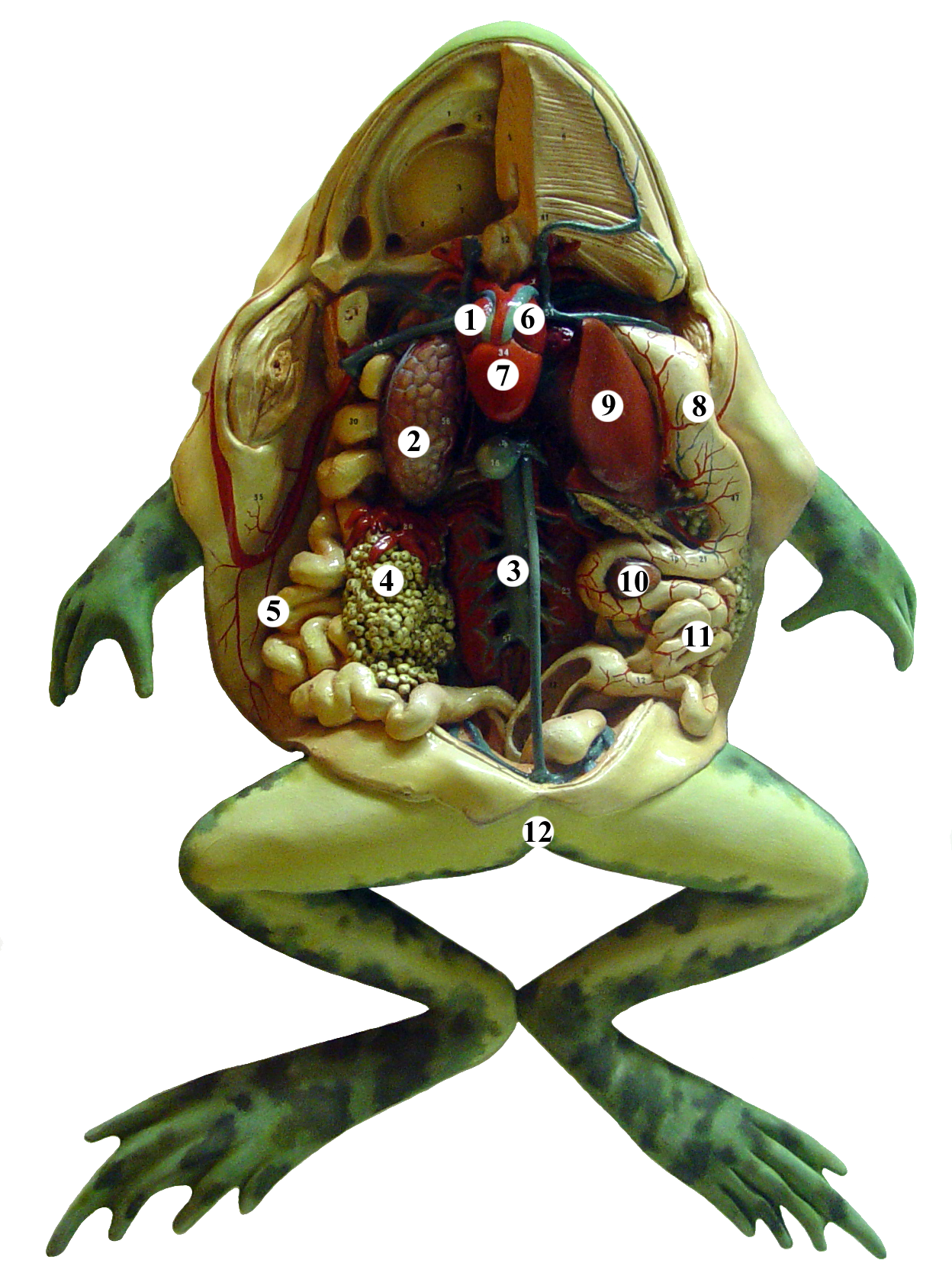
How to read the licensed plate. The numbered model that follows is a female frog opened to show internal organs. Use the key in the caption: atria and ventricle, lungs, liver, stomach, intestine, ovary, oviduct, cloaca. The model does not prove the species of the syllabus frog. It shows the organ layout you are about to trace.
Head landmarks matter in a viva. Find nostril, eye, tympanum, then the mouth. Then move to the trunk and the limb pairs.
Moist skin is morphology and physiology together. Glands keep it wet. Wet skin can exchange gases. Dry skin fails both jobs.
Do not call webbing a gill. Area for a push is not area for diffusion unless the text says so.
Prey enters the mouth and buccal cavity. A sticky, protrusible tongue helps capture it. Small teeth mainly hold prey rather than chew it.
Food passes through the oesophagus to the stomach, then small intestine, large intestine and cloaca. The liver supplies bile. The pancreas supplies digestive secretions.
Digestion releases small molecules that are absorbed through the intestinal wall. The cloaca is a shared terminal chamber for digestive, excretory and reproductive ducts. It is not another name for the stomach.
The tongue is attached at the front of the floor of the mouth in the typical frog, so it can flick out. Stickiness holds the prey. This is capture, not chewing.
Teeth are small and on the upper jaw in the standard example. They stop prey slipping out. A frog does not grind. Swallowing is the next step, helped by the eyes pushing down on the buccal cavity in many descriptions.
Bile from the liver emulsifies fats. Pancreatic juice supplies enzymes for several food classes. The intestine is where most absorption happens. The stomach is a holding and acid chamber, not the whole digestive system.
The liver is also a storage and processing organ for absorbed food. In the licensed plate it is a large, obvious organ. Size matches job: many tasks besides bile.
How to read the figure. Follow the boxes in order from mouth to cloaca. Liver and pancreas are side boxes: they add secretions, they are not a second gut. The last box is shared with urine and gametes.
The school path has 6 named stops: mouth, oesophagus, stomach, small intestine, large intestine, cloaca.
Glands join the path. They are not extra stomachs. Bile and pancreatic juice meet food mainly in the intestine.
Absorption needs a thin lining and a blood supply. That is why digestion never ends at “broken into bits”. The bits must enter blood.
A short adult gut fits a predator’s meals. A long tadpole gut fits a bulkier plant diet. Same species, different organ geometry.
Trace one swallowed meal through the frog gut. Name each main secretion on the way.
Goal. List the path and the juices, not only “stomach”.
Mouth. Tongue and teeth hold prey. Little chewing. Swallowing starts.
Oesophagus. A tube to the stomach. No extra school secretion here.
Stomach. Acid and enzymes begin breakdown. Food is stored and mixed.
Intestine. Bile from the liver meets fat. Pancreatic juice adds enzymes.
Absorption. Small molecules cross the intestinal wall into blood.
Large intestine and cloaca. Water is adjusted. Undigested remains leave via the shared chamber.
Check. Liver and pancreas never sit on the food path as extra boxes of gut.
Result: Mouth → oesophagus → stomach → intestine (bile and pancreatic juice) → cloaca.
In water, oxygen and carbon dioxide can diffuse through moist skin. On land, lungs and the buccopharyngeal lining also contribute, with skin continuing to function. Larvae commonly have gills.
Gas exchange needs a moist surface and a concentration difference. Skin is not merely a protective wrapper. A dry frog cannot use its skin as a lung.
Buccopharyngeal respiration is gas exchange across the moist lining of the mouth cavity. The frog can sit with the mouth closed and still pump air over that lining. It is a third surface, not a rumour.
A tadpole’s gills are the larval answer to the same need: a large moist surface in water. Metamorphosis replaces them with lungs and a heavier use of skin. The need does not change. The organ does.
On a hot dry day a frog hides. Behaviour is part of respiratory anatomy: the skin must stay wet, so the animal chooses wet places. Structure and habit belong together.
An adult has 3 school surfaces: skin, lungs and buccopharyngeal lining.
Diffusion needs a wet film and a gradient. Name both, or the answer is incomplete.
Lungs need air. Under water they are a poor surface. Skin can still work if water holds dissolved gases.
On land, lungs and the mouth lining take more of the load. Skin still helps if it stays moist. Hide, then breathe, is not laziness. It is keeping the surface wet.
How to read the figure. Pick the habitat first. Then tick every surface that is wet and open to that gas. Gills are a larval box.
Predict which respiratory surface works under water, and which works in dry air on land.
Goal. Match surface to habitat. State the wet-film rule.
Under water. Lungs have little air. Moist skin can still exchange with water.
On land. Lungs and the buccopharyngeal lining meet air.
Skin on land. Only if it stays moist. Dry skin fails.
Gills. Larval, in water. Not the adult land answer.
Check. Habitat plus moisture, not “frogs have lungs” as a slogan.
Result: Under water: moist skin. On land: lungs and mouth lining, plus moist skin.
The frog has a closed circulation and a heart with 3 chambers: two atria and one ventricle, plus associated inflow and outflow regions.
The two atria receive different streams, but the single ventricle means separation is less complete than in birds or mammals. Internal folds reduce mixing; they do not create a fourth chamber.
How to read the figure. Two atria sit above one ventricle. Blood enters left and right, and leaves from the single lower chamber. Do not draw a mammal’s four chambers onto this frog.
Paired kidneys filter and modify body fluids. Adult frogs excrete much nitrogen as urea. Ureters lead toward the cloaca. A urinary bladder stores urine. In males, the ducts also participate in reproductive transport. The kidney is not a bag in which urine merely collects.
A tadpole in water can afford to excrete ammonia, which needs a lot of water to dilute. The adult, spending time on land, switches toward urea. The waste matches the habitat of that life stage.
Closed circulation means blood stays in vessels. Lymph is the extra fluid that has left capillaries; it returns by lymph vessels. The spleen in the licensed plate is a lymphoid organ, not a second heart.
Incomplete separation in the ventricle is not chaos. Timing and internal folds send more oxygen-rich blood toward the body and more oxygen-poor blood toward the lungs and skin. “Three chambers” is not “no plan”.
Count chambers as 2 atria plus 1 ventricle. That sum is 3.
Right atrium takes blood from the body. Left atrium takes blood from lungs and skin. Both empty into the same ventricle.
The ventricle is one room with internal routing. It is not two hidden mammal ventricles. Do not invent a septum that the syllabus frog does not have.
How to read the figure. Two coloured inflows. One lower chamber. Two kinds of outflow: body, and lungs plus skin. Mixing is reduced, not abolished.
Kidneys sit as a pair. They adjust water and ions, then form urine. Ureters are pipes. The bladder is a store. The cloaca is the shared door.
Urine is not “made in the bladder”. The bladder waits. The kidney works.
| Life stage | Usual habitat cue | Main nitrogen waste | Why that waste fits |
|---|---|---|---|
| Tadpole | water around the body | ammonia | toxic, but water can dilute it |
| Adult | moist land and water | urea | less toxic, needs less flushing water |
How to read the table. Match life stage to habitat, then to waste. Ammonia is the water story. Urea is the moist-land story.
Route a drop of blood through the two atria and the one ventricle. Say what each chamber receives.
Goal. Name inflows, the shared ventricle, and why mixing is limited.
Right atrium. Receives blood from the body. That blood is lower in oxygen.
Left atrium. Receives blood from lungs and skin. That blood is richer in oxygen.
Ventricle. Both atria empty here. One chamber, two streams.
Routing. Folds and timing reduce mixing. They do not add a fourth chamber.
Out. Blood leaves toward the body and toward lungs and skin.
Check. Two in, one pump chamber, organised exit. Not a bag.
Result: Body → right atrium; lungs/skin → left atrium; both → one ventricle → body and gas surfaces.
Why does a tadpole often excrete ammonia, while the adult frog excretes much urea?
Goal. Link nitrogen waste to habitat, not to a new species.
Tadpole. Water all around. Ammonia can be diluted as it leaves.
Adult. Time on land. Water is more precious. Urea is less toxic.
Kidney job. Filter and adjust. Then send urine toward ureters, bladder and cloaca.
Check. Waste type is a life-stage match to water, not a random label.
Result: Ammonia fits a watery larva; urea fits a moist-land adult.
The central nervous system includes brain and spinal cord. Peripheral nerves connect them to receptors and muscles. Endocrine glands provide chemical coordination.
Sense organs include eyes and the tympanum-associated auditory apparatus. A response has a receptor, an integrating centre and an effector. Those are different parts, not three names for the brain.
A jump starts at a receptor: a moving shadow, a touch. Nerves carry that inward. The brain and spinal cord decide. Other nerves carry a command to hindlimb muscles. Blood has already brought those muscles oxygen. Lungs and skin have already loaded the blood. One action, five systems.
The spinal cord is not a spare brain. It is the highway and, for some reflexes, a local decision centre. Cutting the story at “the brain does everything” misses the cord and the muscle.
Endocrine glands secrete into blood. The message is slower than a nerve, and it can reach many organs at once. Metamorphosis is that kind of message: thyroid hormone in the blood, many organs changing together.
Eyes with lids can work in air. A nictitating membrane can sweep across the eye in water or for protection. The same organ is built for both habitats, which is the chapter’s theme in one socket.
A receptor is a detector. An integrator is brain or cord. An effector is muscle or gland. Keep the three names on three structures.
Chemical messages do not replace nerves. They cover a different time scale. A jump is neural. A rebuild of the gut is hormonal.
| Receptor or organ | What it detects | What happens next |
|---|---|---|
| Eye, with lids and nictitating membrane | light and movement | nerves to brain; muscle can jump or hide |
| Tympanum | sound in air | auditory path to the brain |
| Skin receptors | touch, temperature, some chemicals | local or central nervous decisions |
| Tongue (sticky, front-hinged) | contact with prey | capture, then swallowing, not chewing |
| Nostrils to buccal cavity | air path, not a lung | air can reach lungs and mouth lining |
How to read the table. Left column is the detector. Middle is the stimulus. Right is the next step. The tongue row is capture, not a “taste only” slogan.
A shadow moves. Trace the jump from receptor to hindlimb, then name two systems that already supplied the muscle.
Goal. Receptor, integrator, effector, then support systems.
Receptor. Eye detects the moving shadow.
Integrator. Brain and spinal cord decide.
Effector. Hindlimb skeletal muscle contracts.
Support. Respiratory surfaces loaded the blood. Circulation delivered oxygen.
Check. The muscle is last, not first. Detection starts the story.
Result: Eye → central nervous system → hindlimb muscle, already supplied by lungs/skin and blood.
Sexes are separate. Testes produce sperm, ovaries produce eggs, and ducts carry the gametes. Fertilisation is generally external in water in the standard frog example.
Eggs develop through an embryo into a tadpole, followed by metamorphosis. The transition involves coordinated changes in limbs, tail, respiratory surfaces, gut and other systems. Thyroid hormones are central regulators. A tadpole is a larval stage, not a separate species.
The tadpole’s long gut suits a more plant-based diet. The adult’s shorter gut suits a predator’s diet. Metamorphosis rebuilds the intestine, not only the legs. That is why “diet change” is a development question, not a species question.
External fertilisation needs water so that sperm can swim to eggs. The adult may sit on land, but the next generation still starts in a pond. Amphibian life is not a clean break from water.
If thyroid function fails, metamorphosis stalls. A chapter on organs therefore includes endocrine control. Hormones are how one gland talks to many organs at once.
How to read the figure. Read down. Water holds the egg and the tadpole. Hormones, not a sudden wish, rebuild the body. The adult still needs moisture; metamorphosis does not make a desert animal.
How to read the timing diagram. Left to right is age, not rank. Hormones sit in the middle because they time the switch. The last box is still moist.
Male and female ducts both reach the cloaca in the school story. That is another shared-chamber fact, not a second gut.
Amplexus is a clasp, not fertilisation. Fertilisation is sperm meeting eggs in water after the clasp.
Frogs participate in food webs as predators and prey. Permeable skin and a life tied to water can make them sensitive to habitat and water-quality changes. Claims about environmental health still need local evidence.
| System | Main organs in the frog | Job | Needs from other systems |
|---|---|---|---|
| Digestive | mouth, stomach, intestines, liver, pancreas, cloaca | break down food and absorb molecules | oxygen from respiratory surfaces; blood to carry products |
| Respiratory | skin, buccopharyngeal lining, lungs (gills in larva) | exchange gases | moist skin; blood to move O2 and CO2 |
| Circulatory | heart, vessels, lymph | carry gases, food and wastes | a pumping organ; respiratory loading of the blood |
| Excretory | kidneys, ureters, bladder, cloaca | regulate water and ions, remove urea | blood bringing wastes; water matching the habitat |
| Nervous | brain, spinal cord, nerves, sense organs | detect, decide, command muscles | effectors such as muscle; blood for long chemical messages |
| Reproductive | testes or ovaries and their ducts | produce and carry gametes | water for typical external fertilisation; cloaca as a shared exit |
How to read the table. One row is one system. The middle columns are organs and the shared job. The last column is the supply the row cannot provide alone. A cloaca appears in more than one row because it is a shared chamber.
highlight Skin, lungs and the mouth lining all exchange gases only while they stay moist.==
A frog remains submerged for a time. Which respiratory surface can still work, and what must stay true of that surface?
Goal. Name the surface and its condition.
Lungs. Little use under water; they need air.
Skin. Moist skin can exchange gases with surrounding water.
Condition. The skin must stay moist, and a diffusion gradient must remain.
Check. Skin is a respiratory organ here, not only a covering.
Result: Moist skin, provided gases can still diffuse across it.
Why must typical frog fertilisation happen in water even if the adult sits on damp land?
Goal. Separate adult habitat from the site of fertilisation.
Gametes. Sperm need a liquid path to eggs.
Site. External fertilisation in water in the standard example.
Adult. Moist land is possible, but the next generation still starts in water.
Check. Amphibian means both lives, including the egg.
Result: Sperm swim to eggs in water; land life does not move fertilisation onto dry ground.
Try these as if a labelled frog were on the bench.
SUMMARY
Use these links between ideas to check your understanding.
- Tissues cooperate in organs, and organs cooperate in systems.
- The hierarchy is cell, tissue, organ, organ system, organism.
- Frog limbs, skin and sense organs support an amphibious lifestyle.
- Digestion, circulation and gas exchange supply cells with materials for metabolism.
- Kidneys regulate fluid composition as well as removing wastes.
- A three-chambered heart has two atria and one ventricle; mixing is reduced, not abolished.
- External fertilisation and larval development connect the typical frog life cycle to water.
- Metamorphosis reorganises several systems under thyroid-hormone control; a tadpole is not another species.
- Adult gas exchange uses skin, lungs and the mouth lining while those surfaces stay moist.
- Ammonia suits a watery larva; urea suits a partly terrestrial adult.
- A receptor, an integrator and an effector are three parts of one response.
- The cloaca is a shared exit, not a second stomach and not a missing bladder.
Rebuild the six-row systems page from memory. Then uncover the table and mend one gap.
For the jump task, start at a receptor. End at hindlimb muscle. Insert blood and gas surfaces in between.
If a question names only lungs, add skin and the mouth lining before you stop.
EXERCISES
Try these questions without looking at the answers. Write your answer in full sentences first, then compare.
7.1 Why is “the frog stomach consists of digestive tissue” an incomplete description?
7.2 A frog remains submerged for a time. Which respiratory surface can still exchange gases with surrounding water?
7.3 Explain why webbed hind feet help swimming but are not respiratory organs.
7.4 Distinguish kidney, ureter, urinary bladder and cloaca.
7.5 Why is metamorphosis more than the growth of legs?
7.6 Explain why an adult frog and a tadpole can have different diets yet belong to the same species.
7.7 List the five organisation levels and give one frog example of an organ.
7.8 What is a nictitating membrane, and what does a tympanum do?
7.9 Why are frogs described as ectothermic?
7.10 Name two respiratory surfaces of an adult frog on land.
7.11 How does a frog heart differ from a mammal heart in chamber number?
7.12 What nitrogenous waste do adult frogs mainly excrete, and why is that linked to water?
7.13 Where does fertilisation usually occur in the standard frog example?
7.14 Why do male frogs of the standard example have vocal sacs?
7.15 A student says the cloaca proves the frog has no urinary bladder. Correct the claim.
7.16 How do thyroid hormones belong in a chapter on organs?
7.17 Trace bile and pancreatic juice to the meal they meet. Where do those secretions join the gut path?
7.18 Which atrium receives oxygen-rich blood from lungs and skin?
7.19 Why is buccopharyngeal lining listed with lungs and skin?
7.20 Give one reason a dry adult cannot rely on skin for gas exchange.
7.21 Name the receptor, integrator and effector in a jump away from a moving shadow.
7.22 Why does amplexus not replace fertilisation in water?
Answers
7.1 An organ combines epithelial, muscular, connective and nervous tissues with different roles.
7.2 Its moist skin, provided adequate diffusion gradients are maintained.
7.3 They increase the surface pushing against water. Their main role in this comparison is propulsion, not gas exchange.
7.4 Kidneys form urine, ureters carry it, the bladder stores it, and the cloaca is a shared terminal chamber.
7.5 It reorganises several systems, including tail, respiratory surfaces and digestion, under hormonal control.
7.6 They are different life stages of one developmental cycle. Feeding structures and physiology change during development.
7.7 Cell, tissue, organ, organ system, organism. The heart, stomach or kidney is an organ example.
7.8 A nictitating membrane is a protective extra eyelid. A tympanum receives sound.
7.9 Their body temperature depends strongly on the surrounding temperature, rather than being held constant by internal heat.
7.10 Lungs and moist skin; the buccopharyngeal lining also contributes.
7.11 The frog has three chambers, two atria and one ventricle. A mammal has four.
7.12 Urea. It is less toxic than ammonia and needs less water to flush, suiting a partly terrestrial adult that still stays moist.
7.13 Externally, in water.
7.14 They amplify the call that attracts females in the breeding season.
7.15 The bladder stores urine. The cloaca is the shared exit that the bladder, gut and reproductive ducts open into.
7.16 They drive metamorphosis, which rebuilds several organ systems together, so chemical coordination is part of structural organisation.
7.17 They join at the intestine. They are gland products, not extra lengths of gut.
7.18 The left atrium.
7.19 It is a moist mouth-cavity surface that can exchange gases in air, a third adult surface.
7.20 Gases must dissolve in a moist film; dry skin blocks that step.
7.21 Eye as receptor, brain and spinal cord as integrator, hindlimb muscle as effector.
7.22 Amplexus is the breeding clasp. Sperm still meet eggs in water afterwards.