5. Morphology of Flowering Plants
Introduction
This chapter uses original explanations and practice tasks. Learn the biological terms, then use them to explain an observation.
- Name roots, stems, leaves and their modified forms from position and development.
- Describe inflorescences and flowers using symmetry, fusion, ovary position and placentation.
- Trace ovary to fruit and ovule to seed, and read the parts of a seed.
- Write a semi-technical description with a floral formula, and know three exam families.
Katherine Esau, a twentieth-century botanist, showed how much a plant reveals through its structure. Her studies connected a plant’s form with its development and even with disease. Her method is this chapter’s model: look closely, name precisely, then explain. Historical source.
Morphology is the study of the external form of an organism. Plant morphology describes roots, stems, leaves, flowers, fruits and seeds, and gives each part a precise name.
Precise names matter because plants trick the eye: a swollen underground part may be root or stem, a flat green blade may be leaf or flattened stem. Shape alone cannot decide.
Highlight Position and development name a plant part; shape and use come after.==
How to read the figure. Work down the boxes in order. Where does the part sit? Which embryonic part or bud produced it? Which surface clues — hairs, buds, nodes, veins — can you see? Only then describe shape and use. In an exam, this checklist walks you past the guess.
A swollen underground part is dug up. It has no leaves. How would you start identifying it?
Goal. Decide which checklist questions apply.
Position. It grew below the soil, at the base of the shoot.
Development. Unknown yet; it must be checked against the seedling.
Surface clues. Look for nodes, buds or scale leaves. Roots never carry them.
Check. “Swollen” and “stores food” fit roots, stems and leaves alike.
Result: Begin with surface clues: nodes or buds point to a stem; their absence points to a root.
Answer each question in a full sentence before you look.
5.1 THE ROOT
Carefully pull up two young plants. One has a main root with side roots. The other has a tuft of similar roots. Both anchor the plant and absorb water and minerals, but their histories differ.
The first root of a seedling grows from the radicle, the embryonic root inside the seed.
A tap root system keeps one main root grown from the radicle, with side roots branching from it. Dicots, the two-seed-leaf plants, usually form this system.
A fibrous root system has no dominant main root. Many roots of similar size grow from the base of the stem, as in monocots. Adventitious roots grow from any place other than the radicle: from stems, leaves or older roots.
How to read the figure. Read the panels left to right; a line marks the soil surface in each. Left: one thick main axis with side roots. Middle: many similar roots from the shoot base. Right: roots leaving a stem, adventitious by origin. The words name where roots came from, not how thick they are.
Each job at a root tip has its own region.
The root cap is a thimble of cells protecting the very tip as it pushes through soil. Behind it lies the region of cell division, full of meristematic cells that divide to make new cells. Then comes the region of elongation, where new cells stretch and the root grows longer. Farther back lies the region of maturation, where cells finish specialising.
In the maturation region grow the root hairs. Root hairs are individual extensions of single surface cells, not tiny roots of their own. Together they greatly increase the absorbing surface.
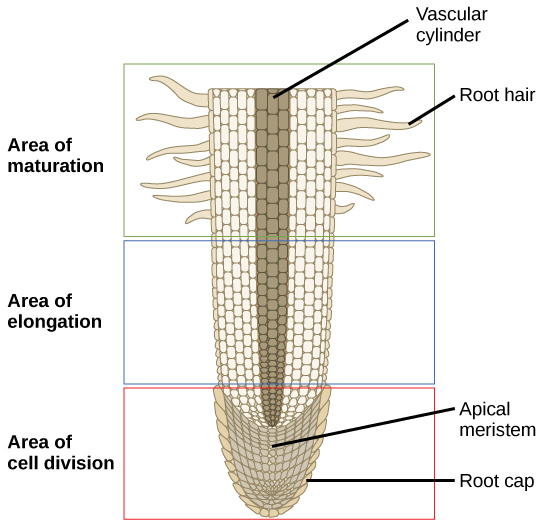
How to read the plate. The licensed plate shows a real root tip lengthwise. Start at the tip and move upward: the rounded cap, the dividing region, the elongation region, then the maturation region with its hairy fringe — the same order as the schematic.
Roots do more than anchor and absorb. Some swell with food, some prop up branches, some breathe in mud.
| Modified root | What it does | What to look for | Example |
|---|---|---|---|
| Conical tap root | stores food | tapering main root | carrot |
| Fusiform tap root | stores food | spindle-shaped, middle thick | radish |
| Napiform tap root | stores food | swollen top, narrow tail | turnip |
| Prop roots | supports branches | roots drop from branches | banyan |
| Stilt roots | supports the stem | roots from lower nodes | maize, sugarcane |
| Pneumatophores | breathes in mud | upright roots stand out of mud | mangrove |
| Storage adventitious | stores food | swollen side roots | sweet potato |
How to read the table. One row at a time: the second column gives the job, the third the visible clue, the last a plant you may know. Storage forms grow from tap roots; support and breathing forms are usually adventitious.
A large tree has rope-like parts hanging from its branches. They reach the soil and thicken. Name the structure and the root type.
Goal. Name the structure using origin, not shape.
Origin. They grow from branches, above the soil, not from the radicle: adventitious.
Job. They grow down to the soil and support the spreading branches.
Name. Supporting roots that drop from branches are prop roots.
Check. They thicken like stems but develop as roots, and bear no nodes or buds.
Result: Prop roots: adventitious roots that support heavy branches.
Cover the answers. Write a full sentence for each. Then check.
5.2 THE STEM
A stem is the plant’s central axis, holding leaves toward the light and flowers where pollinators find them. Its landmarks work above ground and below.
Nodes are the points where leaves attach to a stem. Internodes are the stretches between nodes, so a stem looks jointed.
The terminal bud at the very tip extends the stem. An axillary bud sits in the angle between a leaf and the stem and can grow into a branch or a flower.
How to read the figure. Find the vertical axis first. Two swellings mark the nodes, each carrying a leaf. Between them lies one internode. At the top, the terminal bud continues growth; in each leaf angle sits a small axillary bud. These positions, not thickness or colour, define the stem.
Stems support leaves, flowers and fruits, and carry water and food between roots and leaves. Young green stems can photosynthesise, some store food, and some spread the plant into new ground.
A modified stem is still a stem: it keeps nodes and buds, sometimes as tiny “eyes” or scale leaves. It may grow below soil, along soil, or climb in air.
| Where | Modified stem | What to look for | Example |
|---|---|---|---|
| Underground | Rhizome | horizontal, nodes with scale leaves | ginger |
| Underground | Tuber | swollen stem tip; the “eyes” are buds | potato |
| Underground | Bulb | short stem, fleshy leaf bases | onion |
| Near soil | Runner | slender stem rooting at nodes | lawn grass |
| Near soil | Offset | short rosette stem on water | water hyacinth |
| Near soil | Sucker | shoot from the stem base below soil | banana |
| Aerial | Tendril | leafless coiling branch that grips | pumpkin |
| Aerial | Thorn | sharp woody point; guards the plant | citrus |
| Aerial | Phylloclade | flat green stem doing photosynthesis | Opuntia |
How to read the table. Group the rows by the first column: underground forms store food, near-soil forms spread the plant, aerial forms climb or protect. The third column is the evidence for an exam answer. The “eyes” of a potato are its buds — the giveaway that a tuber is a stem.
An onion bulb is cut across. It shows a very short stem at the base with fleshy leaf bases attached. Is the storage organ the stem or the leaves?
Goal. Separate the stem axis from the leaves sitting on it.
Axis. The flat base plate is the stem: short, but bearing nodes.
Leaves. The thick fleshy parts are leaf bases attached at those nodes.
Storage. Most stored food sits in the fleshy leaf bases, not the stem itself.
Check. Naming only “stem” or only “leaf” misses half the story.
Result: A bulb is a short modified stem bearing fleshy storage leaves.
Try these on your own before you uncover the answers.
5.3 THE LEAF
A leaf is built to catch light: flat, thin, joined to the stem at a node. Every whole leaf carries a marker — a bud in its angle with the stem.
A typical leaf has three parts. The leaf base attaches it to the stem, the petiole is the stalk, and the lamina is the flat green blade. Small stipules may flank the leaf base. A leaf without a petiole is sessile.
How to read the figure. Start at the blade on the left, with its midrib and side veins. Follow the petiole right to where the leaf meets the stem. There sit the leaf base, two stipules, and the round axillary bud of this whole leaf — the leaf’s signature.
Veins carry transport tissue and stiffen the blade; their arrangement is the venation.
Reticulate venation makes a network of branching, rejoining veins. Parallel venation runs the main veins side by side, like rails. Reticulate patterns are common in dicots and parallel patterns in many monocots, but exceptions exist, so treat venation as one clue among several.
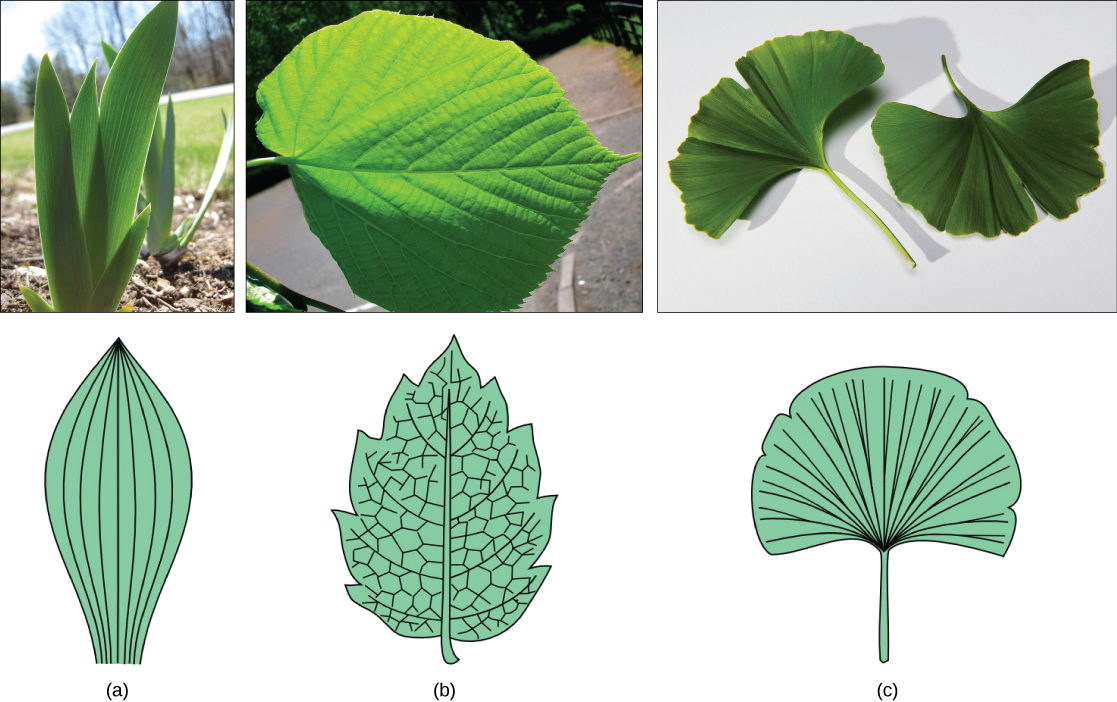
How to read the plate. The licensed plate shows real leaves with three vein patterns. Compare branches rejoining into a net with strands running side by side, then match each leaf to reticulate or parallel before reading labels.
In a simple leaf the blade is one piece. Its edge may carry lobes, but the cuts never reach the midrib.
In a compound leaf the blade is divided into separate leaflets, the cuts running to the main stalk. Leaflets in a row along a middle stalk make a pinnately compound leaf; leaflets fanning from one point make a palmately compound leaf.
Use the axillary-bud test to tell a leaflet from a leaf: a bud sits at the base of a whole leaf, in its angle with the stem; a leaflet has none.
A stalk carries six small blades. Only one small bud exists, right where the stalk meets the stem. How many leaves are present?
Goal. Count leaves, not blades.
Rule. An axillary bud marks the base of one whole leaf.
Observation. One bud, at the very base of the whole stalk.
Inference. The six blades are leaflets of one compound leaf.
Check. No leaflet has a bud at its base, so they are not six simple leaves.
Result: One compound leaf with six leaflets.
Phyllotaxy is the arrangement of leaves on the stem. Alternate puts one leaf at each node, opposite puts two facing each other, whorled puts three or more at one node.
How to read the figure. Look at one node in each panel. Left: one leaf per node, swapping sides as you move up. Middle: a pair per node. Right: a ring of three at one node. Count leaves at a single node, or leaflets get confused with leaves.
Leaves modify too. A pea’s climbing tendril is a modified leaf or leaflet. A cactus spine is a leaf turned protective. The fleshy scales of an onion bulb are storage leaves. Each is still a leaf by position: at a node, with a bud at its base.
Sketch if it helps, then compare with the explained answers.
5.4 THE INFLORESCENCE
Some flowers open alone on a stem. Most plants show off instead: flowers in spikes, clusters or heads. The arrangement of flowers on a floral axis is the inflorescence.
Two growth patterns cover the school list; one question decides: what does the main axis tip do?
In a racemose inflorescence the main axis keeps growing at its tip and never ends in a flower. Flowers sit on side stalks along it, oldest near the base, youngest near the tip: acropetal succession. In a flattened head the youngest sit toward the centre.
In a cymose inflorescence the main axis ends in a flower, so it cannot grow on. New flowers appear on side branches below. The terminal flower opens first, the sequence running tip to base: basipetal succession.
How to read the figure. Left panel: follow the arrow at the axis tip. The tip grows on, so this is racemose, with numbers 1, 2, 3 giving the opening order from the bottom. Right panel: the axis tip is flower 1, which opened first; flowers 2 and 3 sit on side branches. Growth continues only sideways, the cymose habit.
How to read the figure. This flow is the decision itself. Find the main axis, ask the one question in the second box, and the third or fourth box names the pattern. Cluster length appears nowhere: it decides nothing.
In a flower cluster, the oldest flower sits at the centre and the youngest at the outer edge. Which pattern fits?
Goal. Map flower positions onto the two patterns.
Observation. Youngest flowers outside; oldest in the centre.
Rule. A flat racemose head keeps opening outward, so its youngest flowers sit at the edge.
Conclusion. The cluster is racemose, with young flowers produced outward from the centre.
Check. A cymose cluster opens its first flower terminally; it does not leave young flowers outside.
Result: Racemose pattern; the flattened axis keeps producing flowers outward.
Answer in words first. Then read each explanation.
5.5 THE FLOWER
A flower is a reproductive shoot: modified leaves set in tight rings. Learn the rings and any flower becomes readable.
The flower’s stalk is the pedicel; its swollen tip, the thalamus, carries the flower parts. A leaf-like bract may sit where the stalk begins: the flower is bracteate, and ebracteate without one.
A complete flower carries 4 rings, from outside in: calyx of sepals, corolla of petals, androecium of stamens, gynoecium of carpels. A flower missing a whorl is incomplete.
A flower with both stamens and carpels is bisexual. A unisexual flower carries one only: staminate if stamens, pistillate if carpels.
An actinomorphic flower can be cut through its centre in many planes and still give matching halves. A zygomorphic flower matches in one plane only, like a pea flower. An asymmetric flower matches in none.
Parts come in fixed counts: trimerous in threes, tetramerous in fours, pentamerous in fives. Monocots are typically trimerous; dicots tetramerous or pentamerous.
The calyx consists of sepals, usually green, protecting the bud. Separate sepals make it polysepalous; joined sepals make it gamosepalous.
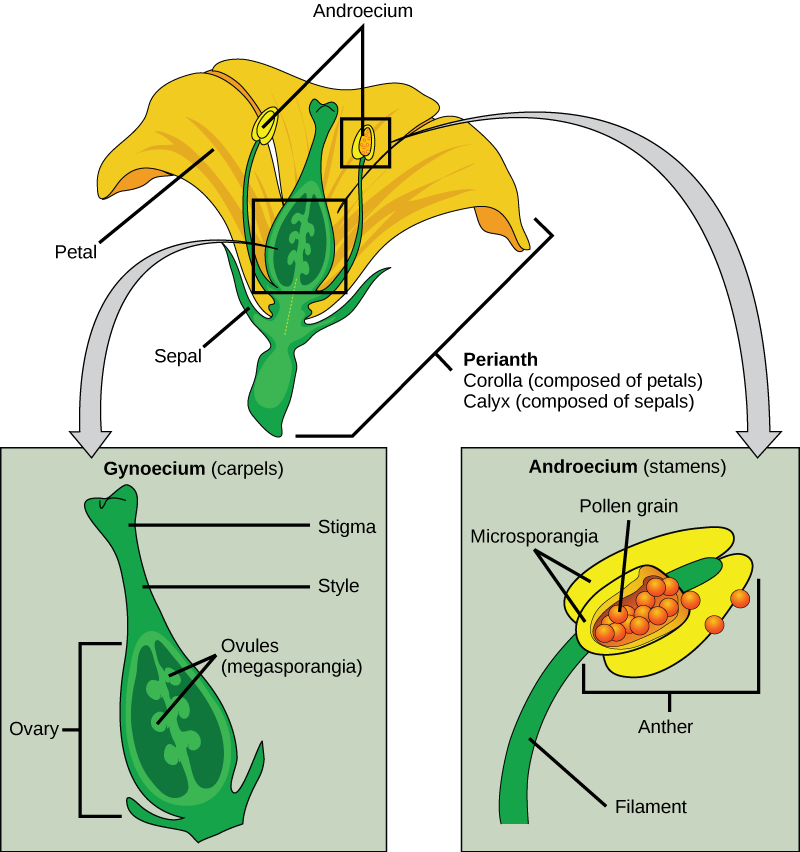
The corolla consists of petals, usually the ring that guides pollinators. Separate petals are polypetalous; joined petals are gamopetalous. When sepals and petals look alike, the ring is a perianth and its parts are tepals.
How to read the plate. The licensed plate cuts a flower lengthwise so the rings show from outside in. Find the green sepals, then the petals, then the thin stamens, then the central bottle-shaped gynoecium, all carried by the thalamus at the base.
Aestivation is how sepals or petals overlap each other in an unopened bud. It is judged in the bud, never in the open flower.
The school list has 4 types. Valvate: margins just touch, no overlap. Twisted: each overlaps the next in one direction. Imbricate: overlaps are irregular. Vexillary: a large standard petal overlaps two wings, which overlap two keel petals — the pea-flower arrangement.
How to read the figure. Treat each panel as a bud cut across. Valvate: edges meet like closed hands. Twisted: each petal lies over its neighbour like tiles laid one way. Imbricate: no single direction rules. Vexillary: name standard, wings, keel from outside in.
A stamen has a stalk, the filament, and a pollen-bearing tip, the anther. Epipetalous stamens grow from the petals; epiphyllous stamens grow from the perianth.
Stamens may fuse among themselves: polyandrous stamens are free, monadelphous are joined in one bundle, diadelphous in two, polyadelphous in many.
Attachment to petals is not fusion among stamens. They are different observations and need different words.
A carpel has 3 parts: the stigma that catches pollen, the style that raises it, and the ovary that holds the ovules. Free carpels make the gynoecium apocarpous; joined carpels make it syncarpous.
The ovary’s height has its own names. In a hypogynous flower the ovary sits above the other whorls: it is superior. In a perigynous flower a cup-shaped thalamus surrounds the ovary, the other whorls on its rim. In an epigynous flower the ovary lies below, fused with surrounding tissue: it is inferior.
How to read the figure. In each panel find the ovary first, then the small marks for the other whorls. Left: whorls below the ovary, so superior. Middle: whorls on the rim of a cup around the ovary. Right: whorls above a sunken ovary, so inferior. The names compare ovary height with whorl attachment.
Inside the ovary, ovules grow from a tissue called the placenta. Placentation is the arrangement of ovules on that placenta.
The school list has 5 types. Marginal: ovules in a line along the carpel’s joined edge. Axile: ovules on a central column, walls dividing the ovary into chambers. Parietal: ovules on the inner ovary wall, no column. Free-central: ovules on a central column, no walls. Basal: a single ovule at the base of the ovary.
How to read the figure. Each circle is an ovary cut across; the dots are ovules. Where do the dots sit? On an edge: marginal. At a centre with walls: axile. On the wall, no column: parietal. On a column, no walls: free-central. One at the bottom: basal, seen lengthwise.
A cut ovary shows ovules on a central column, and no walls divide the ovary into chambers. Name the placentation and the look-alike you must exclude.
Goal. Separate two central-attachment patterns.
Observation. Ovules on a central column; chambers absent.
Rule. A central column with walls is axile; without walls, free-central.
Conclusion. No walls, so the placentation is free-central.
Check. With septa present, the same column would make it axile. The walls decide.
Result: Free-central placentation; axile needs dividing walls.
Work each item, then compare with the explained answers.
5.6 THE FRUIT
A fruit is the ovary’s next act. After fertilisation the ovary swells and ripens, its wall thickens, and its seeds mature. The fruit protects the seeds and often helps spread them.
A fruit is a ripened ovary, usually formed after fertilisation. Its wall is the pericarp.
In a fleshy fruit the pericarp has 3 layers, named from outside in. The epicarp is the skin, the mesocarp the thick middle, and the endocarp the inner layer, stony in a mango around the seed.
How to read the figure. Read the rings from outside in: skin, flesh, stone, seed. Each layer is part of one pericarp; they differ in texture, not origin. The seed sits inside only because it grew from an ovule inside the ovary.
A true fruit grows from the ovary wall alone; most fruits are true fruits. An accessory fruit, often called a false fruit, has other floral parts join in: in an apple the thalamus grows into the flesh while the ovary becomes the core. The fruit is real — “false” only names the extra origin.
A parthenocarpic fruit develops without fertilisation and is usually seedless, as in the market banana. Seedlessness can arise in other ways, so the two words are not synonyms.
How to read the figure. Follow the four boxes as the usual route: fertilisation inside an ovule, the ovary wall becoming pericarp, each fertilised ovule becoming a seed, the mature ovary being the fruit. Two side routes sit in the text above: accessory fruits add other floral parts; parthenocarpic fruits skip fertilisation.
A sliced fruit shows a fleshy wall around several hard units, each with an embryo inside. Separate the fruit parts from the seed parts.
Goal. Sort wall from seeds.
Wall. The fleshy layer around everything is the pericarp, from the ovary wall.
Units. Each hard unit is a seed, grown from one ovule, with its embryo inside.
Count. Seed number records how many ovules matured, not how many existed at flowering.
Check. An unfertilised ovule leaves no seed, so seeds can be fewer than ovules.
Result: Pericarp from the ovary wall; seeds from ovules; seed count is matured ovules only.
Say each answer aloud in a full sentence. Then check yourself.
5.7 THE SEED
A seed is a parcel: a baby plant, a food store and a coat, built to outlast the seasons.
A seed contains an embryo, a food store and a protective coat. The coat forms from the ovule’s coverings, the integuments. The hilum is the scar where the seed hung from the ovary. The micropyle is the pore, left from the ovule, that lets water in when the seed wakes.
Soak and open a pea or bean seed. The embryo has 2 thick cotyledons, seed leaves packed with food, flanking a small axis.
Above the cotyledon attachment lies the epicotyl, ending in the plumule, the embryonic shoot. Below lies the hypocotyl, ending in the radicle, the embryonic root, which pokes out of the seed coat first on germination.
How to read the figure. Left: the whole seed, with hilum scar and micropyle pore. Right: cut open, two cotyledons fill most of the space; between them the axis runs from plumule to radicle. On germination the radicle end leads.
A cereal grain, such as maize, is a different parcel. Its 1 cotyledon, the scutellum, is a shield pressed against the food store. Most of the grain is endosperm, stored food outside the embryo.
A thin protein-rich layer around the endosperm is the aleurone layer. The plumule wears a sheath, the coleoptile; the radicle wears its own, the coleorhiza. Fruit wall and seed coat are fused into one covering, so a maize grain is a fruit as well as a seed.
How to read the figure. Work outside in: fused outer wall, aleurone layer, large endosperm. The embryo sits to one side — scutellum as the shield, plumule in its coleoptile above, radicle in its coleorhiza below. The scutellum absorbs food from the endosperm for the growing embryo.
Albuminous seeds keep their endosperm at maturity, as maize and castor do. Exalbuminous seeds have used most of it up, storing food in the cotyledons instead, as pea and bean do.
A few seeds also keep a residue of the ovule’s nutritive tissue, the nucellus. That persistent tissue is perisperm, inside the seed; the pericarp is the fruit wall outside it.
Match each seed part with the ovule part it came from: seed coat, seed, embryo.
Goal. Link seed vocabulary to ovule vocabulary.
Seed coat. The integuments of the ovule harden into the seed coat.
Seed. The whole ovule becomes the seed.
Embryo. The zygote, formed after fertilisation, grows into the embryo.
Check. The pericarp is not on this list: it comes from the ovary wall, outside the ovule.
Result: Integuments → seed coat; ovule → seed; zygote → embryo.
Write your answer, then read the explanation for any step you missed.
5.8 SEMI-TECHNICAL DESCRIPTION OF A TYPICAL FLOWERING PLANT
Botanists describe thousands of plants. They need a language short enough for one line, yet exact enough to rebuild the plant in a reader’s mind.
A semi-technical description records a plant in a fixed order: habit (herb, shrub or tree), root, stem, leaves with arrangement, type and venation, inflorescence and flower — moving inward through calyx, corolla, androecium and gynoecium — then fruit and seed. The order lets readers compare descriptions line by line.
A floral formula compresses the flower into symbols. The letter names the whorl: K for calyx, C for corolla, P for perianth, A for androecium, G for gynoecium. The number counts its parts. Brackets mean the parts of that whorl are joined to each other.
Symbols in front add the rest: a circled plus sign, ⊕, marks actinomorphic symmetry; a percent sign, %, marks zygomorphic; a small mark or word records the sex; Br marks bracteate and Ebr ebracteate.
The gynoecium carries an extra stroke: a line under G means a superior ovary, and a line above G means an inferior ovary.
How to read the figure. Read the five boxes left to right as one formula: ⊕ K(5) C(5) A5 G(2), with a line under the G. Translate each box with the words below it. Actinomorphic flower; five joined sepals; five joined petals; five free stamens; two joined carpels, superior — a whole description in one line.
A floral diagram draws the flower from above, all whorls together, with the mother axis at the top and a bract, if present, at the bottom. It shows positions a formula cannot. Formula and diagram must agree; if they differ, the flower itself decides.
Write the formula for: an actinomorphic, bisexual flower with five joined sepals, five joined petals, five stamens attached to the petals, and a superior ovary of two joined carpels.
Goal. Turn each observation into its symbol.
Symmetry and sex. Actinomorphic and bisexual: ⊕ with the bisexual mark.
Calyx and corolla. Five joined sepals, then five joined petals: K(5) C(5).
Androecium. Five stamens, free among themselves: A5, no brackets. Their attachment to petals is stated in words as epipetalous.
Gynoecium. Two joined carpels, superior ovary: G(2) with a line under it.
Result: ⊕ K(5) C(5) A5 G(2), with G underlined and “epipetalous” noted in words.
Close the book. Answer from memory, then check.
5.9 SOLANACEAE
Everything in this chapter now points at one plant family, recognised by a combination of features, never one alone. Meet Solanaceae.
Members are usually herbs or shrubs, with simple, alternate, exstipulate leaves and reticulate venation. The inflorescence is often cymose, or flowers stand solitary.
The flower is bisexual, actinomorphic and pentamerous. The calyx has 5 united sepals, gamosepalous, and often stays on the fruit. The corolla has 5 united petals, gamopetalous. The 5 stamens are epipetalous, alternating with the petals.
The gynoecium has 2 joined carpels: bicarpellary and syncarpous. The ovary is superior, usually two-chambered, with axile placentation on a swollen placenta.
Put together, the formula reads ⊕ K(5) C(5) A5 G(2) with the line under G — the formula taken apart in the previous section.
The fruit is a berry, as in tomato, or a capsule, as in Datura; the seeds are many and endospermic. Familiar members include tomato, potato, aubergine, chilli and Petunia; some members yield medicines.
Some Solanaceae plants make strong toxins. An edible fruit on one member does not make the family, or even the whole plant, safe. Family membership is not a safety test.
An unknown flower is bisexual and actinomorphic, with five united petals, five epipetalous stamens and a superior syncarpous ovary with axile placentation. The plant is a herb with simple, alternate, exstipulate leaves. Argue the family.
Goal. Combine features into a family-level argument.
Floral set. Pentamerous, gamopetalous, epipetalous stamens, bicarpellary syncarpous superior ovary, axile placentation: this combination matches Solanaceae.
Vegetative set. A herb with simple, alternate, exstipulate, reticulate leaves also matches.
Caution. Five fused petals alone would be weak evidence.
Check. Confirm with the fruit, a berry or capsule, before finalising on a real specimen.
Result: The combined floral and vegetative evidence supports Solanaceae.
The syllabus compares 3 families: Fabaceae, Solanaceae, Liliaceae. Solanaceae sits between a pea-like and a lily-like family, and the comparison sharpens each.
| Feature | Fabaceae | Solanaceae | Liliaceae |
|---|---|---|---|
| Habit | herbs, shrubs, trees | herbs, shrubs | herbs with bulbs or rhizomes |
| Leaves | compound, stipulate | simple, exstipulate | often basal, parallel veins |
| Symmetry | zygomorphic | actinomorphic | actinomorphic |
| Outer whorls | 5 petals, papilionaceous | 5 united sepals, 5 united petals | 6 tepals, 3+3 |
| Androecium | 10 stamens, diadelphous (9+1) | 5 stamens, epipetalous | 6 stamens, 3+3 |
| Gynoecium | 1 carpel, marginal placentation | 2 carpels, axile placentation | 3 carpels, axile placentation |
| Ovary | superior | superior | superior |
| Fruit | pod | berry or capsule | capsule |
| Examples | pea, bean | tomato, potato | lily, onion |
How to read the table. Compare one row at a time. Symmetry separates Fabaceae, the only zygomorphic one. The outer-whorls row separates Liliaceae, with its 6 tepals instead of sepals and petals. The androecium row contrasts 10 stamens in two bundles, 5 attached to petals, and 6 in two sets of three. All three keep a superior ovary, which identifies none of them alone.
Test yourself as if this were the exam. Then read the answers.
SUMMARY
Use these links between ideas to check your understanding.
- Position and development name a plant part; shape and use only describe it.
- Roots are tap, fibrous or adventitious by origin, with a cap and three growing zones behind the tip.
- Stems are marked by nodes, internodes and buds, and modify underground, near the soil and in the air.
- Leaves have base, petiole and lamina; venation, division and phyllotaxy describe three different properties.
- Inflorescences are racemose or cymose, decided by whether the main axis tip grows on or ends in a flower.
- Flower description combines whorls, symmetry, fusion, aestivation, ovary position and placentation.
- The ovary becomes the fruit wall and each ovule becomes a seed; embryos carry cotyledons on an axis ending in plumule and radicle.
- A floral formula compresses a description into symbols, and families such as Solanaceae are recognised by feature combinations.
EXERCISES
Try these questions without looking at the answers. Write your answer in full sentences first, then compare.
5.1 A swollen underground part develops from the radicle and bears side roots but no nodes or buds. Identify the organ and justify your answer.
5.2 Explain why a root hair is not called a root.
5.3 A ginger rhizome and a lawn-grass runner are both stems. State where each grows and one visible feature that identifies each.
5.4 To record phyllotaxy, what must you check before counting leaves at a node?
5.5 A pea tendril and a pumpkin tendril both coil. How do their origins differ?
5.6 In a spike-like cluster, flowers at the bottom opened first and the tip is still producing buds. Name the succession and the inflorescence pattern.
5.7 Define zygomorphic symmetry and name the exam family that shows it.
5.8 Describe the arrangement called vexillary aestivation.
5.9 What does epipetalous mean, and how is it recorded in a floral formula?
5.10 A flower’s other whorls arise above the ovary, which is fused with surrounding tissue. Name the flower type and the ovary position.
5.11 How does parietal placentation differ from axile placentation in a cut ovary?
5.12 Name the pericarp layers from outside inward, and match them to a mango.
5.13 In a seed, where does the plumule sit and what does it become?
5.14 A maize grain is called a fruit as well as a seed. Why?
5.15 Give one albuminous and one exalbuminous seed, and state the difference between the terms.
5.16 List four floral features that together support placing a flower in Solanaceae.
5.17 Why must a family identification never rest on a single feature?
Answers
5.1 A storage tap root. It grows from the radicle, which makes it a root, and roots never carry nodes or buds.
5.2 A root hair is an extension of a single surface cell, not a multicellular organ. A true root has tissues and can branch; a root hair cannot.
5.3 The rhizome grows horizontally under the soil and shows nodes with scale leaves. The runner creeps on or above the soil and roots at its nodes.
5.4 That each counted blade is a whole leaf, not a leaflet. The axillary bud test applies: only whole leaves have a bud at their base.
5.5 The pea tendril is a modified leaf or leaflet, sitting at a node of a leaf. The pumpkin tendril is a modified stem, a leafless branch arising where a leaf would stand.
5.6 Acropetal succession on a racemose inflorescence; the axis keeps growing, so new flowers appear toward the tip while the oldest sit at the base.
5.7 A zygomorphic flower can be divided into matching halves in one vertical plane only. Fabaceae is the zygomorphic family in this chapter’s comparison.
5.8 One large standard petal overlaps two lateral wing petals, and the wings overlap two inner keel petals, judged in the bud. It is the pea-flower arrangement.
5.9 The stamens are attached to the petals. The formula keeps A without brackets, since brackets would mean stamens joined to each other, and the attachment is stated in words.
5.10 An epigynous flower with an inferior ovary.
5.11 Parietal ovules sit on the inner ovary wall with no septa or central column. Axile ovules sit on a central column with septa dividing the ovary into chambers.
5.12 Epicarp, mesocarp, endocarp. In a mango the epicarp is the skin, the mesocarp is fleshy, and the endocarp is stony around the seed.
5.13 At the top of the embryonal axis, above the cotyledon attachment, as the tip of the epicotyl. It becomes the shoot of the seedling.
5.14 Its fruit wall and seed coat are fused into one covering, so the grain is the mature ovary enclosing the seed, which meets the definition of a fruit.
5.15 Maize is albuminous: it keeps a large endosperm at maturity. Pea is exalbuminous: the food was moved into the cotyledons during development.
5.16 Five united sepals, five united petals, five epipetalous stamens, and a bicarpellary syncarpous superior ovary with axile placentation.
5.17 Single features, such as five fused petals, are shared by several families. A family is a combination of vegetative and floral characters, and the combination is the identification.