12. Respiration in Plants
Introduction
This chapter uses original explanations and practice tasks. Learn the biological terms, then use them to explain an observation.
- Separate gas exchange from cellular respiration, and locate each major stage.
- Follow carbon, electrons and ATP through glycolysis, fermentation and aerobic routes.
- Add a school ATP balance sheet, then read RQ and amphibolic links without mixing those ideas.
Hans Krebs mapped the citric acid cycle in the 1930s. The work showed how acetyl groups are oxidised in a loop that remakes its acceptor. Krebs shared the 1953 Nobel Prize in Physiology or Medicine. Tracing intermediates can reveal a cycle that a single reaction list would hide. Earlier, work on yeast and muscle extracts had already shown that sugar breakdown does not need the whole cell. Historical source.
12.1 Do PLANTS BREATHE?
A plant has no lungs. It still uses oxygen in many of its living cells. It still releases carbon dioxide from those cells. The chemistry that unlocks food energy is cellular respiration.
Breathing in animals is bulk movement of air. Plants do not pump air in and out that way. They exchange gases by diffusion across wet surfaces. The two ideas meet, but they are not the same word.
Highlight Gas exchange moves O2 and CO2. Cellular respiration is the enzyme pathway that oxidises organic molecules and makes ATP.
Why respire at all, if leaves can photosynthesise? Photosynthesis stores energy in organic molecules. Respiration unlocks a usable fraction of that energy as ATP, the cell’s short-term energy currency. Every living cell needs ATP. Non-green tissues, roots, seeds and night-time leaves cannot wait for a chloroplast to hand them ATP directly.
Aerobic respiration also provides carbon skeletons. Those intermediates become amino acids, nucleotides and other cell parts. The pathway is therefore not only an “energy tap”. It is a hub. Later sections return to that amphibolic role.
How to read the figure. Start at the leaf box. Stomata are pores. Internal air spaces shorten the path to mesophyll cells. The stem box uses lenticels on woody surfaces. The root box takes gases from soil air. Every living cell still runs its own metabolism. Roots cannot wait for a leaf to “breathe for them”.
Diffusion works because plant organs expose large surfaces. Distances inside air spaces are short. Waterlogged soil fills those spaces with water. Oxygen then diffuses far more slowly. Root cells can become oxygen-limited even when water is plentiful.
Stomata are adjustable pores. Guard cells can close them to save water. Closed stomata also slow carbon dioxide entry and oxygen exit. That matters more for photosynthesis than for the oxygen a mitochondrion needs, because air is rich in oxygen. Roots still depend on soil spaces, not on stomata.
Respiration does not switch off in the light. A green leaf may show net carbon dioxide uptake because photosynthesis is faster. Mitochondria in that leaf are still working. Net gas change is a balance, not a proof that one process has stopped.
| Feature | Gas exchange | Cellular respiration | Photosynthesis |
|---|---|---|---|
| What it is | movement of O2 and CO2 | oxidation of organic molecules to make ATP | building organic carbon using light |
| Plant structures | stomata, lenticels, soil spaces | cytosol and mitochondria of living cells | chloroplasts of green cells |
| Oxygen | O2 may enter the organ | O2 can be the final electron acceptor | O2 is released from water |
| When it runs | whenever gases can diffuse | in living cells, light or dark | mainly in the light in green tissue |
How to read the table. Compare one row at a time. Gas exchange is transport. Respiration is chemistry that can use oxygen. Photosynthesis is a different chemistry that can release oxygen. A net reading on a leaf mixes the last two columns.
Three model curves of oxygen percent in a closed flask against time from 0 to 12 hours. Live aerated tissue falls from 21 percent toward about 9 percent by 8 hours. Waterlogged live tissue falls more slowly to about 15 percent. Killed tissue stays near 21 percent.
How to read the figure. The y-axis is oxygen remaining in a closed flask in a teaching model, not a lab trace. All three lines start near 21 percent. At 8 h the aerated live line has fallen to about 9.4 percent. The waterlogged live line is still about 15.2 percent. The killed line stays near 21 percent. Aerobic living tissue consumes oxygen. Killing the tissue stops that uptake. Waterlogging slows aerobic uptake.
A closed flask holds equal masses of living root tissue. Flask A is well aerated. Flask B is waterlogged. Flask C holds boiled tissue. Oxygen is measured after several hours.
Goal. Rank expected oxygen remaining and name the process being tested.
Rule. Aerobic respiration consumes oxygen. Diffusion through water is slow. Dead cells do not respire.
Prediction. Flask C stays near 21 percent. Flask A falls fastest. Flask B falls more slowly.
Check. The reading is oxygen uptake, not “breathing”. It does not by itself name the sugars used.
Result: Living aerated tissue takes up oxygen fastest; boiling stops uptake; waterlogging slows it.
Cover the answers. Write a full sentence for each. Then check.
12.2 GLYCOLYSIS
Respiration begins with a sugar that is already in the cell. The first shared pathway is glycolysis: the splitting of glucose in the cytosol, the fluid outside organelles.
Glycolysis does not need oxygen as a direct reactant. It still needs a supply of NAD+, a carrier that can accept electrons. If NAD+ stays trapped as NADH, later glycolytic steps stop.
How to read the figure. Read top to bottom. The first box spends ATP. The split turns one six-carbon sugar into two three-carbon pieces. The payoff box makes more ATP than was spent. The last box is the net: two pyruvate, net ATP, and NADH. Carbon dioxide is not a product of this pathway.
Glucose is phosphorylated and rearranged before the six-carbon intermediate splits. That investment uses ATP. Plants can feed the path from glucose, from sucrose, or from stored carbohydrate. The first committed sugar phosphate is trapped in the cell.
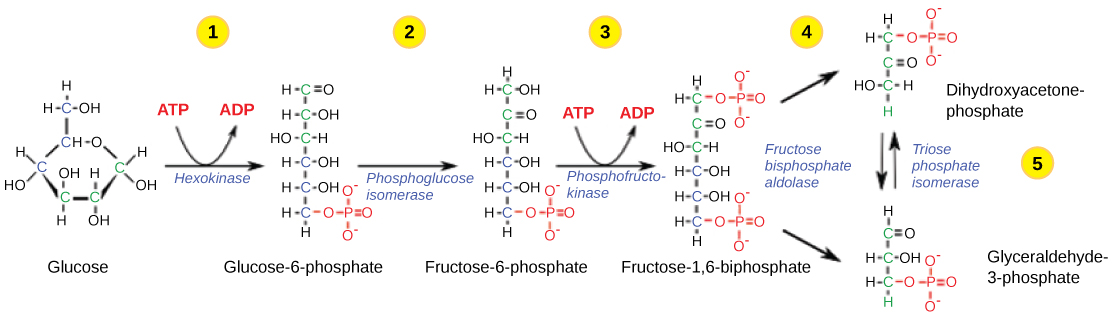
How to read the licensed plate. The first half of glycolysis is the investment phase. Find glucose receiving phosphate from ATP. Find the later split into two three-carbon molecules. Those phosphates also help keep the sugar from leaving the cell. The plate is a pathway map, not a photograph of cytosol.
Substrate-level phosphorylation makes ATP here. A phosphate group is transferred from a high-energy intermediate straight onto ADP. No membrane gradient is required for that step.
A second phosphorylation, still using ATP, makes a bisphosphate sugar. That molecule splits. The two triose phosphates are then processed in parallel. You therefore double the later ATP and NADH counts. Forgetting the doubling is a common arithmetic slip.
Oxidation of a triose phosphate reduces NAD+ to NADH. That is an electron transfer, not ATP synthesis. Keep the two products in separate columns. ATP comes later, when a phosphate is handed to ADP. NADH is a reduced carrier that will matter in fermentation or in the mitochondrion.
The standard net accounting is 2 pyruvate, 2 NADH and 2 ATP per glucose. Four ATP are made in the payoff phase. Two ATP were invested, so the net is 2. Carbon count: glucose has 6 carbons. Each pyruvate has 3 carbons, so 2 pyruvate keep all 6 carbons.
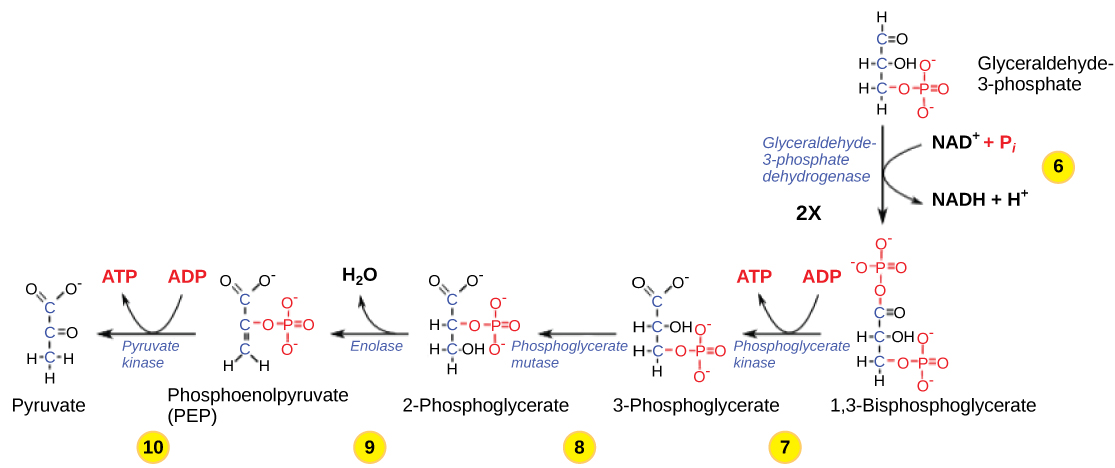
How to read the licensed plate. The second half is the payoff phase. Find NAD+ becoming NADH. Find the substrate-level steps that make ATP. Count four ATP formed in this half, then subtract the two already spent. Pyruvate is the three-carbon end of the map. Carbon dioxide is still absent.
Glycolysis is anaerobic in the strict sense that O2 is not a reactant. It is still used in aerobic cells. Aerobic just means that pyruvate and NADH can later be oxidised with help from oxygen. Do not write “glycolysis occurs only when oxygen is absent”.
Show every ATP step for one glucose in glycolysis, then state the net.
Goal. Find net ATP, pyruvate and NADH per glucose.
Investment. 2 ATP are used to phosphorylate the hexose.
Payoff. 4 ATP form by substrate-level phosphorylation (two per triose, two triose).
Net ATP. 4 − 2 = 2 ATP.
Carbon and carriers. 2 pyruvate and 2 NADH also form.
Check. No CO2 is listed. If a mark scheme asks for CO2 from glycolysis, the answer is none.
Result: Net 2 ATP, 2 pyruvate and 2 NADH per glucose.
Try these on paper first. Uncover the answers only after you finish.
12.3 FERMENTATION
Glycolysis will stall unless NAD+ returns. When the mitochondrial chain cannot reoxidise NADH, some cells use fermentation. Fermentation regenerates NAD+ from NADH. It does not use oxygen as the final electron acceptor.
The ATP of these fermentations is still the glycolytic net. The fermentation steps themselves add no extra ATP in the school alcohol and lactate paths. Much chemical energy remains in ethanol or lactate.
Think of NADH as a full electron taxi. Glycolysis filled it. Fermentation empties it back to NAD+ by handing electrons to an organic molecule. The taxi can then collect another passenger in glycolysis. Oxygen is not that passenger here.
How to read the figure. Both columns start from pyruvate. The left column is alcoholic fermentation: pyruvate loses carbon dioxide to form acetaldehyde, then NADH reduces acetaldehyde to ethanol. The right column is lactic fermentation: pyruvate is reduced to lactate and no CO2 is released in that step. The bottom bar is the shared point: NAD+ goes back to glycolysis.
Yeast and some plant tissues can form ethanol. Many animal muscle cells form lactate. Some microbes use other organic end products. Name the organism when you name the product. Do not claim that every plant cell always ferments.
Per glucose, fermentation still nets 2 ATP. Complete aerobic oxidation in the school 38-ATP account would give 38 ATP. The difference is 36 ATP left behind in the organic end product and unused carriers.
Oxygen-limited roots may ferment for a time. That keeps a trickle of ATP. It cannot match aerobic yield. Ethanol can also become toxic if it accumulates. Flooded tissues are under stress, not running a preferred high-yield path.
If oxygen returns, many cells switch pyruvate toward mitochondria again. NADH can then be reoxidised by the ETS instead of by ethanol or lactate formation. That is why aeration of a culture or a soil can raise ATP yield without inventing a new glycolytic enzyme.
Do not call fermentation “anaerobic respiration” in this chapter unless a mark scheme uses that older phrase. School language here keeps respiration for pathways that use an electron-transport chain. Fermentation is the NAD+ recycle without that chain.
A culture has no oxygen. Glucose is still being consumed and ethanol is appearing. A student says “fermentation enzymes must be making lots of extra ATP”. Correct the claim.
Goal. Separate NAD+ recycling from ATP yield.
Rule. Alcoholic fermentation restores NAD+. Net ATP remains the glycolytic 2 per glucose.
Correction. Extra ethanol does not mean extra substrate-level ATP beyond that net.
Check. Aerobic respiration can add up to 36 more ATP per glucose in the 38-ATP school model, because pyruvate is fully oxidised.
Result: Fermentation keeps glycolysis running; it does not add ATP beyond net 2 per glucose in this path.
Answer each question, then read the explanation for the step you missed.
12.4 AEROBIC RESPIRATION
When oxygen can serve as the final electron acceptor, pyruvate is oxidised much further. In a eukaryotic cell that work sits in the mitochondrion.
How to read the figure. The outer oval is the outer membrane. The folded line is the inner membrane, site of the electron-transport system (ETS). The innermost space is the matrix. Between the membranes is the intermembrane space (IMS). Glycolysis stays in the cytosol. Pyruvate must enter. Krebs-cycle enzymes sit in the matrix.
Each pyruvate is oxidatively decarboxylated to acetyl-CoA. Carbon dioxide is released. NAD+ is reduced to NADH. The two-carbon acetyl group is now attached to coenzyme A. Per glucose there are 2 pyruvate, so this step happens 2 times. It yields 2 CO2 and 2 NADH.
This link is the first CO2 from the original glucose carbons. Glycolysis had not released any. If a question asks “where is the first CO2 in aerobic respiration of glucose?”, the school answer is this oxidative decarboxylation of pyruvate, not glycolysis.
A two-carbon acetyl group combines with four-carbon oxaloacetate to form six-carbon citrate. That is why the path is called the citric acid cycle, the tricarboxylic acid cycle, or the Krebs cycle.
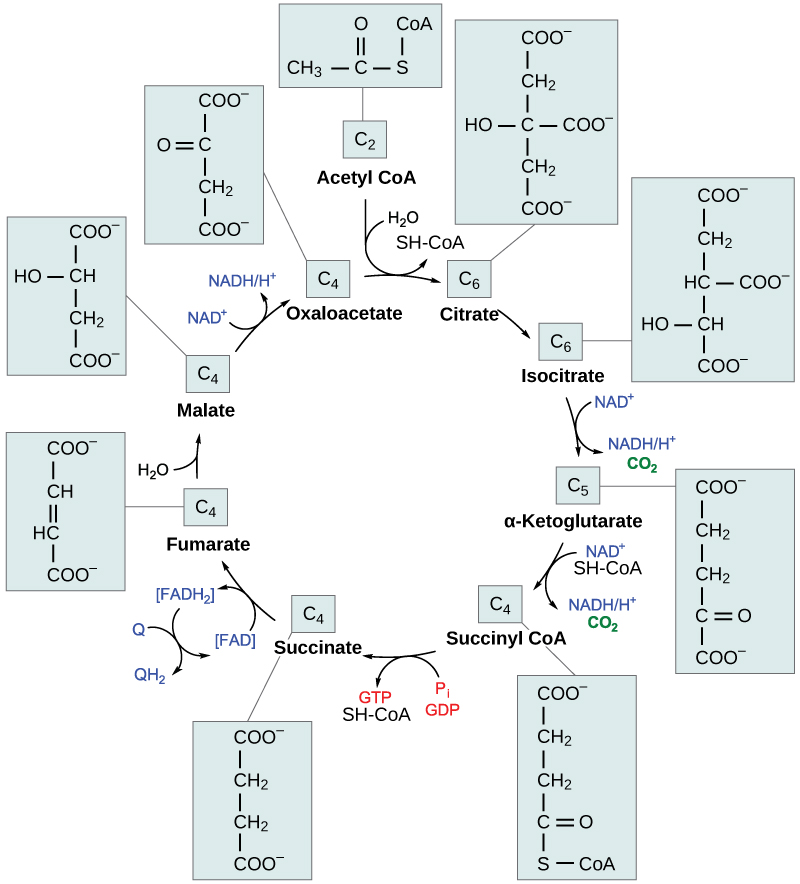
How to read the licensed plate. Find the 2C acetyl unit joining the 4C acceptor. Walk around the loop until the 4C compound is back. Count two CO2 leaving per turn. Count the NADH, FADH2 and ATP (or GTP) symbols on one turn, then double them for one glucose.
How to read the figure. Start at acetyl-CoA. Joining oxaloacetate makes citrate. Follow the right-hand boxes: carbon dioxide and NADH leave, then FADH2 and a substrate-level ATP (or GTP) form. The last box is oxaloacetate again. If that 4C acceptor is not remade, the cycle stops even if acetyl-CoA is waiting.
Per acetyl-CoA the school count is 2 CO2, 3 NADH, 1 FADH2 and 1 ATP equivalent. Glucose supplies 2 acetyl groups, so double those numbers: 4 CO2, 6 NADH, 2 FADH2 and 2 ATP. Link plus cycle together release 6 CO2, matching the six carbons of glucose.
The cycle does not use O2 as a reactant in those named steps. It still depends on the ETS to reoxidise NADH and FADH2. Without that, the cycle fills with reduced carriers and slows.
NADH and FADH2 transfer electrons to inner-membrane carriers. Electron flow powers proton pumping from matrix to IMS. Oxygen is the final electron acceptor and is reduced to water. Protons return through ATP synthase toward the matrix. That ATP synthesis is oxidative phosphorylation, driven by chemiosmosis.
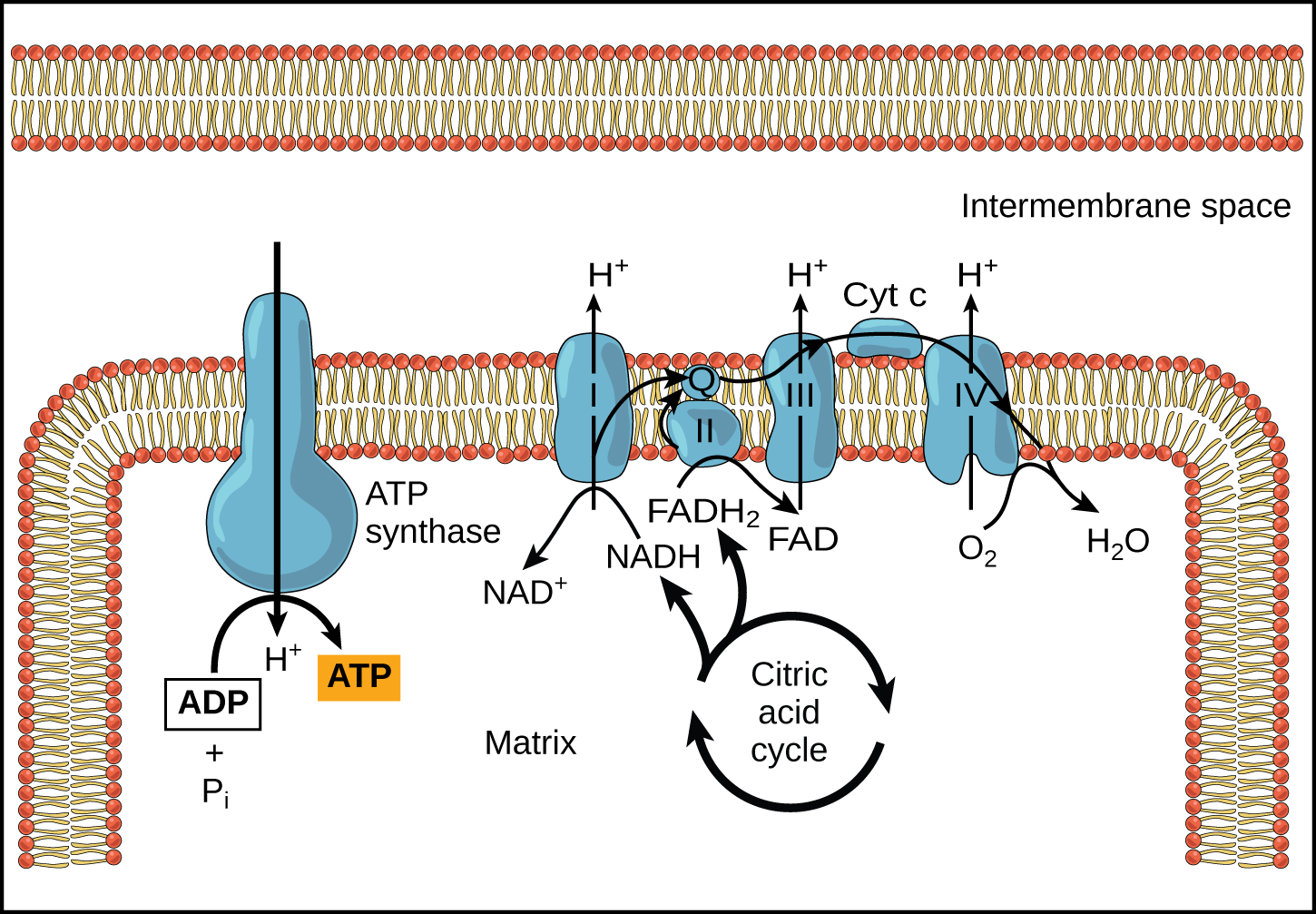
How to read the licensed plate. The inner membrane is the barrier. Complexes in that membrane pass electrons and pump protons into the IMS. Find O2 at the end of the chain, forming water. Find ATP synthase as a separate channel for protons returning to the matrix. Electron flow and proton flow are two coupled stories on one picture.
If a poison blocks electron transfer to oxygen, carriers behind the block stay reduced. Upstream NADH cannot unload. The Krebs cycle then lacks NAD+ and FAD. Chemiosmotic ATP falls because pumping slows. A different poison that only lets protons leak leaves electron flow possible for a time but still cuts ATP synthesis. The two faults are not the same.
How to read the figure. Electrons move first. Proton pumping is the middle event. Oxygen and water are the end of the electron path. ATP synthase is a later, separate protein that uses the proton return. FADH2 donates after the first pump in the simplified school chain, so it is worth fewer ATP than matrix NADH.
Oxygen is removed from an otherwise intact mitochondrion that still has pyruvate. Predict NADH, the Krebs cycle, and ATP synthase activity.
Goal. Link the final acceptor to upstream pathways.
Rule. Without O2, the ETS cannot pass electrons on. Carriers stay reduced.
Prediction. NADH remains high. NAD+ falls. The Krebs cycle and link reaction slow.
ATP synthase. The proton gradient is not maintained, so oxidative phosphorylation falls.
Check. Substrate-level ATP from glycolysis could continue if fermentation restores NAD+.
Result: No oxygen means the chain backs up, so aerobic NADH oxidation and chemiosmotic ATP both fall.
Close the page. Write your own sentence, then compare.
12.5 THE RESPIRATORY BALANCE SHEET
A respiratory balance sheet adds substrate-level ATP to the ATP counted from reduced carriers. It is a school model. It is not a measured yield for every living cell.
This chapter uses the older school equivalents: 3 ATP per NADH and 2 ATP per FADH2. State that convention before you add. Mixing it with modern ~2.5 / ~1.5 values in one sum is a common error.
| Source per glucose | NADH | FADH2 | Substrate-level ATP | ATP if NADH = 3, FADH2 = 2 |
|---|---|---|---|---|
| Glycolysis (net) | 2 | 0 | 2 | 2 + (2 × 3 or 2) |
| Link reaction | 2 | 0 | 0 | 2 × 3 |
| Krebs cycle | 6 | 2 | 2 | carriers + 2 |
| Totals | 10 | 2 | 4 | 38 or 36 |
How to read the table. Add down the NADH column to 10. Add FADH2 to 2. Substrate-level ATP is 4. Carrier ATP depends on the NADH rule you chose. The last row is the two school totals, not two different glucose molecules.
38-ATP convention. Count every NADH, including cytosolic ones, as 3 ATP: 10 × 3 = 30. FADH2: 2 × 2 = 4. Substrate-level: 4. Sum: 30 + 4 + 4 = 38.
36-ATP convention. Cytosolic NADH is counted as 2 ATP each, because a shuttle into mitochondria costs energy or skips a pump: 2 × 2 = 4. Matrix NADH: 8 × 3 = 24. FADH2 still 4. Substrate-level still 4. Sum: 4 + 24 + 4 + 4 = 36. The gap is 2 ATP.
Highlight 36 and 38 are school bookkeeping totals. Real eukaryotic yields are often nearer 30–32 ATP and vary with shuttles, leaks and alternative oxidases.
Plant mitochondria can use an alternative oxidase that accepts electrons with less proton pumping. That route still uses oxygen. It makes less ATP. Heat and stress physiology use it. Do not fold it into the 36/38 table as if it were the default school sum.
Modern textbook estimates often use about 2.5 ATP per NADH and 1.5 ATP per FADH2. Those decimals give totals near 30–32 ATP in eukaryotes. They are still models. Proton leak, transport of phosphate and pyruvate, and diverted intermediates all change the real yield. In an exam, use the convention named in the question.
Fermentation’s 2 ATP versus aerobic 38 or 36 is the teaching contrast. It explains why oxygen-limited tissues cannot match aerobic growth on the same sugar. It does not mean a flooded root “makes 36 ATP of ethanol”.
Build both school totals for one glucose. Show every multiplication.
Carriers. 10 NADH and 2 FADH2. Substrate-level ATP = 4.
38 path. NADH ATP = 10 × 3 = 30. FADH2 ATP = 2 × 2 = 4. Total = 30 + 4 + 4 = 38.
36 path. Cytosolic NADH ATP = 2 × 2 = 4. Matrix NADH ATP = 8 × 3 = 24. Total = 4 + 24 + 4 + 4 = 36.
Check. 38 − 36 = 2, which is the cytosolic-NADH difference (2 × 1).
Result: School totals are 38 ATP or 36 ATP per glucose, depending on cytosolic NADH.
Work these without the table. Then check one line at a time.
12.6 AMPHIBOLIC PATHWAY
Respiratory paths break molecules down. They also feed building reactions. A path that serves both breakdown and synthesis is amphibolic.
Catabolism is breakdown that can yield ATP and reduced carriers. Anabolism is building of new cell material. The Krebs cycle and glycolysis sit in the middle. Carbon can leave toward amino acids, fatty acids and other compounds. Carbon can also enter from those families.
How to read the figure. Each box is an entry, not a complete diet. Carbohydrate is the school default fuel. Fat does not have to become glucose first. Amino acids join after their nitrogen is removed or transferred. If you draw arrows only toward CO2, you hide biosynthesis.
When cycle intermediates are withdrawn, anaplerotic reactions refill the cycle. Oxaloacetate is a common refill point. A growing cell may oxidise some carbon for ATP and divert other carbon into new proteins or lipids. The balance sheet then overstates ATP, because not every acetyl group completes oxidation.
School links worth naming: acetyl-CoA can build fatty acids. α-Ketoglutarate can lead toward glutamate and other amino acids. Oxaloacetate can lead toward aspartate. None of those exits “breaks” respiration. They use it as a factory as well as a furnace.
The reverse also happens. After deamination, an amino-acid carbon skeleton may become pyruvate, acetyl-CoA or a cycle acid. That is why protein can be a respiratory fuel in starvation or in germinating seeds, even though the chapter’s default fuel is carbohydrate.
| Fuel family | Typical entry | What that means for ATP |
|---|---|---|
| Carbohydrate | glycolysis, then pyruvate | can be fully oxidised if the cell does not divert carbon |
| Fat (glycerol) | a three-carbon glycolytic intermediate | joins the sugar path after glycerol processing |
| Fat (fatty acids) | acetyl-CoA | skips glycolysis; no extra cytosolic NADH from that acetyl |
| Protein (after deamination) | pyruvate, acetyl-CoA or cycle acids | entry point depends on the amino-acid skeleton |
How to read the table. Match the fuel to the entry, then ask whether glycolysis NADH still appears. Fatty-acid acetyl-CoA does not recreate the glycolytic 2 ATP net. That is one reason a fat balance sheet is not a glucose balance sheet.
A seedling is rapidly making new membranes. Acetyl-CoA is being used to build fatty acids as well as to enter the Krebs cycle. What happens to the ATP total compared with the ideal glucose sheet?
Goal. Apply the amphibolic idea to a number.
Rule. ATP from the school sheet assumes each acetyl group is fully oxidised.
Prediction. Diverted acetyl-CoA does not yield Krebs NADH, FADH2 or substrate-level ATP.
Check. The cell still needs ATP. It may oxidise other fuel, but the ideal 36/38 number does not apply to every glucose-equivalent.
Result: Biosynthetic withdrawal of intermediates lowers ATP below the ideal complete-oxidation total.
Predict first, then match the answer.
12.7 RESPIRATORY QUOTIENT
The respiratory quotient (RQ) is carbon dioxide released divided by oxygen consumed. Use matching units: both moles, or both volumes under the same conditions.
Complete carbohydrate oxidation has RQ near 1. The school glucose equation uses 6 CO2 and 6 O2. Fat oxidation needs relatively more oxygen, so RQ is below 1. A palmitic-acid model releases 16 CO2 for 23 O2, so RQ = 0.7. Protein values are often near 0.9. Some organic acids give RQ above 1.
| Substrate (school model) | CO2 | O2 | RQ | How to read it |
|---|---|---|---|---|
| Carbohydrate (glucose) | 6 | 6 | 1 | equal gas volumes; RQ near 1 |
| Fat (palmitic acid) | 16 | 23 | 0.7 | more O2 than CO2; RQ below 1 |
| Organic acid example | 4 | 3 | 1.33 | more CO2 than O2; RQ above 1 |
| Protein (typical textbook) | varies | varies | about 0.9 | depends on the amino acids and nitrogen fate |
How to read the table. RQ is a ratio, not an ATP count. A value near 1 suggests carbohydrate, but mixed fuels blur the signal. An illuminated leaf also photosynthesises, so its net gases are not a pure respiratory RQ.
If oxygen uptake is zero, the denominator is zero. You cannot report a finite aerobic RQ. Fermentation that releases CO2 without taking O2 is not this ratio. Name fermentation instead of forcing an RQ.
Germinating seeds are a classic RQ comparison. A starchy seed, oxidising carbohydrate, tends toward RQ near 1 in the dark. A seed using stored oil tends toward a value below 1, closer to the fat model 0.7. Measure in the dark so photosynthesis does not rewrite the gases.
RQ can change with time as the preferred fuel changes. A single snapshot is not a lifetime label for the organism. Always state the conditions: dark or light, aerobic, and which organ was enclosed.
A dark tissue sample releases 8 volume units of CO2 and consumes 8 matching units of O2. A fat model uses 16 CO2 and 23 O2. Calculate both RQ values.
Goal. Apply RQ = CO2 / O2 with comparable units.
Sample. RQ = 8 / 8 = 1.
Fat model. RQ = 16 / 23 = 0.7.
Meaning. The sample matches carbohydrate oxidation in this model. The fat model is below 1.
Check. Do not convert either ratio into ATP. Do not use a lit leaf without subtracting photosynthesis.
Result: Sample RQ = 1; palmitic model RQ = 0.7.
Use the RQ formula. Show the ratio, then read the answer.
SUMMARY
Use these links between ideas to check your understanding.
- Plants exchange gases by diffusion and respire in light and darkness; net leaf gases can hide that fact.
- Glycolysis in the cytosol nets 2 ATP, 2 pyruvate and 2 NADH per glucose, with no CO2.
- Fermentation restores NAD+ so glycolysis can continue; school alcohol and lactate paths still net only 2 ATP.
- Aerobic oxidation uses the link reaction, Krebs cycle and ETS; oxygen is the final electron acceptor.
- School ATP totals are 38 or 36 per glucose, depending on cytosolic NADH; real yields are often lower.
- Amphibolic paths feed biosynthesis as well as oxidation. RQ = CO2/O2 compares fuels, not ATP.
EXERCISES
Try these questions without looking at the answers. Write your answer in full sentences first, then compare.
12.1 Why can roots suffer when soil is flooded even though shoots remain in air?
12.2 Glycolysis invests 2 ATP and later makes 4 ATP per glucose. What is the net gain, and how many pyruvate form?
12.3 Why does blocking NADH oxidation eventually stop glycolysis even if glucose is still present?
12.4 Explain how the citric acid cycle can depend on oxygen without using O2 in each named cycle reaction.
12.5 An experiment gives 8 units of CO2 and 8 units of O2 in the dark. Calculate RQ and state one limit of the interpretation.
12.6 Why should a growing seedling not be expected to deliver the ideal maximum ATP from every glucose?
12.7 Name the compartment for each: glycolysis, Krebs cycle, mitochondrial ETS.
12.8 Alcoholic fermentation releases CO2. Lactic fermentation in the school path does not. Which step explains the difference?
12.9 Using 3 ATP per NADH and 2 per FADH2, show the 38-ATP addition from 10 NADH, 2 FADH2 and 4 substrate-level ATP.
12.10 How does the 36-ATP school total treat the 2 cytosolic NADH?
12.11 Protons are allowed to leak freely across the inner mitochondrial membrane. Predict oxidative phosphorylation.
12.12 A dark sample releases 14 units of CO2 and uses 20 units of O2. Calculate RQ and name the closer school fuel class.
12.13 Fatty-acid carbon enters as acetyl-CoA. Why is that not the same ATP sheet as glucose?
12.14 A leaf in bright light shows net oxygen release. Has mitochondrial respiration stopped? Explain.
12.15 Why is fermentation described as low-yield compared with aerobic respiration?
12.16 If oxaloacetate is withdrawn to make an amino acid, what happens to citrate formation from acetyl-CoA unless the cycle is refilled?
12.17 FADH2 usually yields fewer school ATP than matrix NADH. Give the simplified reason.
12.18 Why can an RQ above 1 appear when organic acids are oxidised in the school examples?
Answers
12.1 Water fills soil air spaces, so oxygen diffuses too slowly. Root aerobic respiration is limited even if leaves still exchange gases.
12.2 Net 2 ATP and 2 pyruvate. Subtract the investment from the gross ATP.
12.3 NAD+ is not regenerated. The glycolytic step that must reduce NAD+ has no electron acceptor.
12.4 The ETS uses oxygen to reoxidise NADH and FADH2. Without that, the cycle lacks NAD+ and FAD and cannot continue at a normal rate.
12.5 RQ = 1. Equal gases suggest carbohydrate, but mixed metabolism can still hide other fuels.
12.6 Intermediates are used for growth, transport costs energy, and coupling is not perfectly efficient.
12.7 Glycolysis in the cytosol; Krebs cycle in the matrix; ETS in the inner mitochondrial membrane.
12.8 Pyruvate decarboxylation to acetaldehyde releases CO2 in the alcohol path. Lactate is made by reducing pyruvate, without that decarboxylation.
12.9 NADH: 30. FADH2: 4. Substrate-level: 4. Total 38.
12.10 Each is counted as 2 ATP rather than 3, giving 4 instead of 6, so the grand total is 36.
12.11 The proton gradient collapses, so ATP synthase cannot use chemiosmosis. Electron flow might continue for a time, but coupled ATP synthesis falls.
12.12 RQ = 14 / 20 = 0.7, below 1, closer to the fat model (0.7) than to carbohydrate (1).
12.13 It skips glycolysis, so the glycolytic net ATP and cytosolic NADH of glucose are not produced from that acetyl group.
12.14 No. Photosynthetic oxygen release can exceed respiratory uptake. Mitochondria can still oxidise substrates.
12.15 Only the glycolytic net ATP is obtained, and reduced organic end products still hold much of the original chemical energy.
12.16 The 4C acceptor becomes scarce, so acetyl-CoA cannot form citrate at the normal rate until anaplerotic reactions restore oxaloacetate.
12.17 FADH2 donates electrons after an earlier proton-pumping complex, so fewer protons are pumped per electron pair.
12.18 Those substrates already contain relatively more oxygen, so less O2 is consumed per CO2 released, and the ratio exceeds 1.