1. Real Numbers
1. About this chapter
Big idea: Prime factors reveal the structure hidden inside whole numbers.
Read one small part at a time. Try each example on paper. Then cover the answers and do the practice. Use the diagrams to explain your thinking.
| Word | Meaning |
|---|---|
| Factor | A whole number that divides another number exactly. |
| Coprime | Having no shared positive factor except one. |
| Prime factorisation | Writing a number as a product of primes. |
1.1 Introduction
A decimal display is only one way to describe a number. A fraction is another.
Before classifying a number, ask whether its exact value can be written as a ratio of integers. A rounded display cannot answer that question.
A square root symbol also does not settle it: the root of a perfect square is an integer. Read the number first, then choose the category.
Real numbers are the numbers we place on a number line. They include integers, fractions and irrational numbers.
A rational number can be written as . Here and are integers, and . An irrational number cannot be written this way. An integer is a whole number, its negative, or zero.
A terminating decimal ends. For example, . A repeating decimal goes on with a fixed pattern. Both kinds are rational.
To turn into a fraction, let . Then . Subtract to get . So . An endless decimal is not always irrational.
Euclid’s method finds the highest common factor, or HCF. Divide the larger number by the smaller one. Next, divide the old divisor by the remainder. Keep going. The last nonzero remainder is the HCF.
Why does it work? If , a number dividing both and also divides . A number dividing both and also divides . The common factors stay the same at each step.
For and : , , , and . Their HCF is .
1.2 The Fundamental Theorem of Arithmetic
Imagine cutting several lengths into equal pieces without waste. The piece length must divide each original length.
You need a common factor, and the largest possible piece uses the HCF. Now imagine events repeating at different intervals.
A shared event time must be a multiple of each interval. The first positive shared time uses the LCM.
Decide what the answer must do before starting a factor tree.
A prime number is an integer greater than one. Its only positive factors are one and itself. Every integer greater than one can be broken into prime factors.
There is only one set of prime factors for each number. You may change their order, but not the primes or how often they occur. This is the Fundamental Theorem of Arithmetic.
Break a composite factor down until only primes remain: . Multiplying the factors gives . Starting with must lead to the same prime factors.
Two repeating indicators flash every and seconds. Write and . The HCF takes the smaller exponent of each shared prime: . The least common multiple, or LCM, takes every prime at its larger exponent: . If they flash together now, they next flash together after that many seconds.
For two positive integers, HCF multiplied by LCM equals their product. Here both products equal . For each prime, the smaller and larger exponents add to the total exponent in the product.
A useful consequence: if a prime divides a product, it divides at least one factor. In particular, if a prime divides , it divides . Unique prime factorisation explains why.
A factor tree breaks a number into smaller factors. Keep splitting until every leaf is prime. Different trees can lead to the same prime factors.
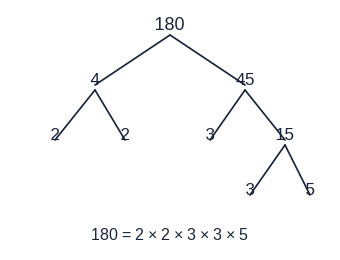
Multiply the leaves to check: . Every leaf must be prime. Do not stop at or .
The prime-factor method works for three numbers too. For the HCF, use only primes shared by all three. Take the smallest powers. For the LCM, use every prime that appears. Take the largest powers.
| Number | Prime factors |
|---|---|
The HCF is . The LCM is .
For three numbers, do not use “HCF times LCM equals their product”. Here the left side is , while the product is .
Let be the HCF of positive integers . Then
For our numbers, the pair HCFs are . So .
The matching identity is You can still use prime factors instead. These identities are an extra tool.
Here the pair LCMs are . Substitution gives for the HCF.
Two strips measure 96 cm and 144 cm. Cut them into the longest equal pieces without waste. Find the piece length and total number of pieces.
- The piece length must divide both strip lengths. Choose the HCF, because the question asks for the greatest common divisor.
- Prime factorisation gives and . A shared factor cannot use more copies of a prime than either strip provides.
- Take the smaller prime powers: HCF cm.
- The first strip gives pieces. The second gives pieces. Altogether there are pieces.
What changes if the strips measure 80 cm and 120 cm?
Answers
- The shared prime powers give HCF cm. The counts are and , giving pieces. Use HCF again because the required pieces must divide both lengths.
1.3 Revisiting Irrational Numbers
Trying several fractions cannot prove that no fraction works. A contradiction proof starts with an arbitrary fraction in lowest terms, so it covers every proposed rational representation.
Each later statement must follow from that assumption. When both numerator and denominator are forced to share a factor, the problem is with the original assumption.
The square root still exists on the number line; it simply has no fractional representation.
A proof gives a reason that works in every case it covers. In a contradiction proof, we start by assuming the opposite of our claim. We then show that this assumption cannot be true.
For an irrational square root, start by assuming it is a fraction in lowest terms. “Lowest terms” means the top and bottom have no common factor greater than one. The maths will force a shared prime factor. That is our contradiction.
Assume , with integers and . Choose the fraction in lowest terms. Squaring gives .
The prime divides , so it also divides . Write . Then , which gives .
Now also divides . The top and bottom share a factor of . But we chose lowest terms. This contradiction proves that is irrational.
A rational number plus an irrational number is irrational. If the sum were rational, subtracting the rational part would leave a rational number. But that would make the irrational part rational.
Also, a nonzero rational number times an irrational number is irrational. Divide by the rational factor to see why. The word nonzero matters: multiplying by zero gives zero.
History note: Euclid’s Elements organised number and geometry results into chains of reasoning. Prime factorisation remains useful today because it turns divisibility questions into questions about prime exponents.
If is prime, then is irrational. In the proof for , replace by . The key step still works: if a prime divides a square, it divides the number being squared.
Euclid collected results about numbers and shapes around 300 BCE. Many centuries later, Carl Friedrich Gauss gave a careful account of prime factorisation in a book published in 1801. The key idea is that every number has its own prime-factor structure.
Prove that the square root of three is irrational. Then explain how the proof changes for the square roots of two and five.
- Assume , where are integers, is nonzero and the fraction is in lowest terms. This is the opposite of what we want to prove.
- Square both sides to obtain . Thus the prime three divides . Prime factorisation implies that three divides .
- Write for an integer . Substitution gives . Divide by three to obtain . Therefore three divides as well.
- Both numerator and denominator have a factor three. That contradicts the lowest-terms assumption. Reject the rational representation, so the square root of three is irrational.
Prove the corresponding statements for the square roots of two and five.
Answers
- For two, assume in lowest terms. Then and substitution yields . Both integers are divisible by two, a contradiction. For five, gives and then . Both are divisible by five, again a contradiction. Both square roots are irrational.
Exercise 1.1 — Prime factors and divisibility
Exercise 1.2 — Irrationality
1.4 Summary
- Every integer greater than one has a unique prime factorisation up to order.
- HCF uses common primes with minimum exponents; LCM uses all primes with maximum exponents.
- A contradiction proof must state the assumption and identify exactly why it is impossible.
- Rational numbers include both terminating and repeating decimals.