6. Triangles
6. About this chapter
Big idea: A change of scale preserves shape and creates useful ratios.
Read one small part at a time. Try each example on paper. Then cover the answers and do the practice. Use the diagrams to explain your thinking.
| Word | Meaning |
|---|---|
| Vertex | A corner. The plural is vertices. |
| Corresponding | Matching in the chosen order. |
| Proportional | Having the same ratio. |
6.1 Introduction
A triangle may be rotated, reflected or drawn at a different scale. Its position on the page gives no reliable correspondence.
Match equal angles first, then write the vertex order. Similarity keeps shape; congruence keeps both shape and size.
A drawing helps you see a claim, but measured-looking sides do not prove it. Proof needs given facts and valid consequences.
Enlarge a triangle without stretching it in one direction. Its shape stays the same. Its angles stay the same too, but its lengths change.
We call the old and new triangles similar. Similarity lets us use a known side to find an unknown side.
A vertex is a corner. Write matching corners in the same order. If , then matches , matches and matches .
So matches , matches , and matches . “Corresponding” is the maths word for matching.
6.2 Similar Figures
Similar figures preserve angle sizes and use a single length multiplier throughout. Either condition alone can fail for general polygons.
A useful counterexample shows exactly why a proposed rule is insufficient. When you compare two figures, choose corresponding sides in a consistent order.
Test each ratio in the same direction. Mixing enlargement and reduction ratios creates a false disagreement.
A polygon is a closed shape made of straight sides. Similar polygons need two things. Matching angles must be equal. Matching sides must all use the same scale factor.
Equal angles alone do not prove that two polygons are similar. A long thin rectangle and a square both have right angles. Their side ratios differ.
Triangles with sides and have the scale factor . A side of scales to . Scaling multiplies every length by the same factor; it does not add the same amount to each.
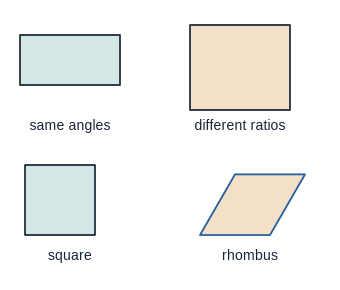
Equal angles alone do not make polygons similar. Equal corresponding side ratios alone do not either. You need both conditions for general polygons. Triangles have special shortcuts.
All circles are similar. All squares are similar. All equilateral triangles are similar, since each angle is . Not all rectangles or isosceles triangles are similar.
6.3 Similarity of Triangles
A line inside a triangle cuts each of two sides into two parts. BPT compares a near-vertex part with the remaining part on each side.
Label those four pieces before writing the proportion. Do not replace a remaining part by the whole side accidentally.
The parallel-line condition is essential for the forward theorem. In the converse, an equal ratio becomes evidence that the connecting line is parallel.
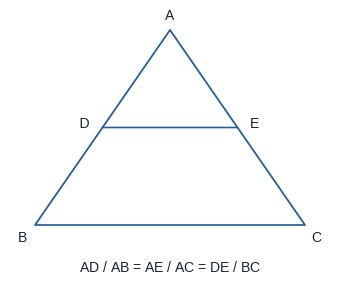
Parallel lines stay the same distance apart and never meet. Draw a line inside triangle , parallel to . Let lie on and lie on .
The two sides are cut in the same ratio: . This is the Basic Proportionality Theorem, or BPT.
In triangle ABC, DE is parallel to BC and divides both sides in the same ratio.
An altitude is a perpendicular height. Triangles and have bases and on the same line. They share the same height from . Their area ratio is .
Triangles and have bases on and the same height from . Their area ratio is .
Triangles and share base . Their heights are equal because is parallel to . Their areas are equal. So the two earlier ratios are equal.
A converse reverses an if–then rule. Here it says: if , then is parallel to .
To see why, draw through a line parallel to . Let it meet at . The forward BPT gives .
A fixed segment has only one interior point dividing it in a given ratio. So and must be the same point. The original line is therefore parallel to .
If , and , then . Hence and .
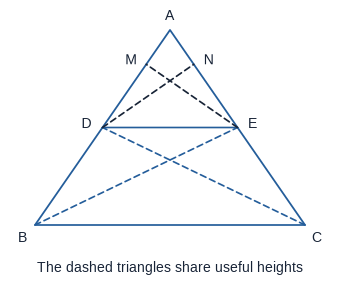
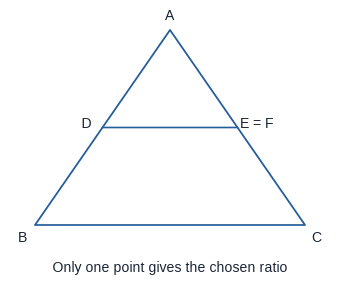
A midpoint cuts a side in ratio . BPT says a parallel through one midpoint reaches the other midpoint. Conversely, the segment joining two midpoints is parallel to the third side. Its length is half that side.
In triangle ABC, D lies on AB and E lies on AC. DE is parallel to BC. AD is 6 cm, DB is 4 cm and AE is 9 cm. Find EC.
- The parallel condition permits BPT. Use part-to-part ratios: .
- Let cm. Substitute to get . The denominator is the remaining segment EC, not the whole side AC.
- Cross-multiply: . Therefore cm.
- Check the ratios: and . They agree. Whole-side lengths are cm and cm.
Change AD to 8 cm, DB to 6 cm and AE to 12 cm. Find EC.
Answers
- BPT gives . Thus and cm. The check confirms the corresponding ratios.
6.4 Criteria for Similarity of Triangles
To prove triangles similar, first decide which criterion the given information supports. AA needs two matching angle pairs.
SSS needs three matching side ratios. SAS needs two matching side ratios and equality of the included angle.
Only after establishing similarity should you use an additional corresponding-side proportion. Explain angle equalities with reasons such as parallel lines, vertical angles or a shared angle.
A proof is a chain of justified statements.
A similarity criterion is a test that proves two triangles have the same shape. AAA means all three matching angles are equal. AA is enough: the third pair must match because angles in a triangle add to .
SSS means all three pairs of matching sides have the same ratio. SAS means two side pairs have the same ratio and the angle between them is equal. The angle must be between those two sides.
For the AA proof, start with and . Choose the names so . Mark on with . Draw parallel to , meeting at .
The small triangle has the same two angles and the matching side as . They are congruent by ASA, so and . Congruent means the same shape and size.
BPT gives . To include the third side, draw through a line parallel to , meeting at . Then is a parallelogram, so . BPT in triangle gives .
Subtract both fractions from one: . Since , all three side ratios match. Replace by . This proves similarity. If the scale factor is one, use ASA directly.
For SSS, let . Choose the smaller triangle so . Mark on with . Draw parallel to .
AA gives and . So and have three equal side pairs. They are congruent by SSS. Their angles match, which proves the original triangles are similar.
For SAS, use the same construction. It gives two equal side pairs and the given equal angle between them. Congruence by SAS then gives the angle matches needed for similarity.
Triangles with sides and are similar by SSS because every scale factor is . Two side ratios alone do not establish SAS: the equal angle must be the angle between those sides.
A small triangular frame has sides . A similar frame has shortest side . The scale factor is , so the other sides are and .
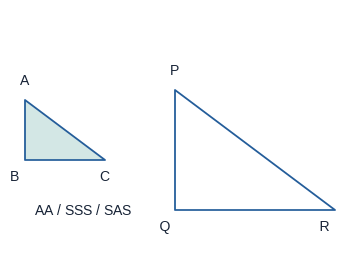
To turn or flip a triangle is not to change its shape. Use matching angles or side lengths to find the right corner order. Do not match corners just because they appear on the same side of the page.
RHS means right angle, hypotenuse and one side. Two right triangles are similar if their hypotenuses and one pair of matching legs have the same ratio. This is the RHS similarity test.
Why? Let the shorter triangle have hypotenuse and one leg . Its other leg is . If the larger triangle has matching lengths and , its other leg is for . All three side ratios are , so SSS proves similarity.
For a right triangle and a second right triangle with hypotenuse and matching leg , the ratio is . The other leg must be , twice .
Thales lived around the sixth century BCE. Stories link him with using shadows to compare heights. Similar triangles explain the idea: under the same sun angle, height and shadow length have one common ratio.
In trapezium ABCD, AB is parallel to DC. The diagonals form similar triangles AOB and COD.
At , the crossing angles are equal. The parallel sides give another pair of equal angles. So and are similar by AA. Write matching vertices carefully: .
For and , the scale factor between these triangles is . If , then .
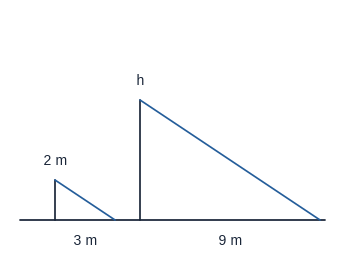
A m pole casts a m shadow. At the same time, another vertical object casts a m shadow. Equal sun angles give similar right triangles. So , giving m.
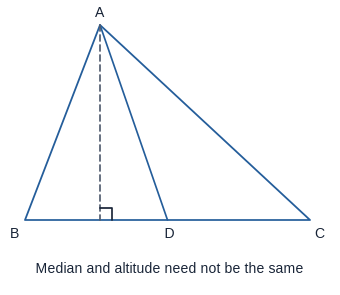
A median joins a vertex to the midpoint of the opposite side. An altitude is a perpendicular height. An angle bisector cuts an angle into two equal angles. These lines have different jobs.
In similar triangles, matching medians, altitudes and angle bisectors have the same scale factor as the sides. Here is the reason for medians.
If and are the midpoints of , then . Also . So by SAS. Their matching sides give .
For altitudes, the two small triangles have a right angle and a matching original angle. AA proves similarity. For angle bisectors, use the matching half-angle and another matching original angle. AA again gives the same scale factor.
If the side scale factor is and the smaller median is , the larger median is . The same rule applies to matching heights and bisectors.
A lamp is m high. A person m tall stands m from its base. Let the shadow length be . The large triangle has base , not .
Similar right triangles give . Cross-multiply: . Thus , so m.
If the person walks farther away, the distance changes. Use the new distance in the same equation. The person’s shadow begins at their feet, not at the lamp.
Triangles ABC and PQR have matching sides in ratio 2:3, even though the second triangle is turned.
Match the right angles first: A matches P. Side AB of length four matches PQ of length six. So the scale factor is .
- AC is three, so PR is .
- BC is five, so QR is .
- Check all matching side ratios: .
Try it: A matching side in the smaller triangle is . What is its length in the larger one?
Answer: .
Exercise 6.1 — Similar figures
Exercise 6.2 — Parallel lines
Exercise 6.3 — Similar triangles
6.5 Summary
- Write the vertex correspondence before ratios.
- A parallel line divides triangle sides proportionally; the converse holds too.
- Use AA, SSS or SAS, with all required conditions.
- Similarity multiplies every matching length by one common factor.