1. Real Numbers
1. About this chapter
Big idea: Prime factors reveal the hidden mathematical blueprint inside every whole number.
Read one small part at a time. Try each example on paper. Then cover the answers and do the practice. Use the diagrams to explain your thinking.
| Word | Meaning |
|---|---|
| Factor | A whole number that divides another number exactly. |
| Coprime | Having no shared positive factor except one. |
| Prime factorisation | Writing a number as a product of primes. |
1.1 Introduction
A decimal display is only one way to describe a number. A fraction is another.
Before classifying a number, ask whether its exact value can be written as a ratio of integers. A rounded display cannot answer that question.
A square root symbol also does not settle it: the root of a perfect square is an integer. Read the number first, then choose the category.
Imagine a sweet shop owner in Jaipur packing gift boxes for Diwali. She has 420 Kaju Katlis and 130 Badam Barfis. She wants to stack them on serving trays so that every stack has the exact same number of sweets, mixing none, and using the minimum number of trays. What is the largest number of sweets she can place in each stack?
To solve this without guessing, we need the Highest Common Factor (HCF)—the greatest whole number that divides both quantities without leaving any remainder.
Every number we use in daily life belongs to the family of Real Numbers. A real number is either:
- Rational numbers: numbers that can be written as a fraction , where and are integers and . This includes whole numbers (), terminating decimals (), and repeating decimals ().
- Irrational numbers: numbers with non-terminating, non-repeating decimals that can never be written as a clean fraction of two integers (such as , , and ).
Long before calculators, the Greek mathematician Euclid noticed a simple rule: if you divide a larger number by a smaller positive number , you get a quotient and a remainder :
If you replace the pair with the pair , their common divisors do not change! Repeat this division until the remainder hits zero. The last nonzero divisor is your HCF.
- Divide by : (quotient is , remainder is ).
- Divide by : (quotient is , remainder is ).
- Divide by : (remainder is now zero!).
- The last nonzero divisor is 10. Therefore, .
The baker can put stacks of 10 sweets each. For two other numbers, say and : , then , then , and finally . Their HCF is .
Use Euclid’s division algorithm to find the HCF of 4052 and 12576. [CBSE Board Exam, 3 Marks]
1.2 The Fundamental Theorem of Arithmetic
Imagine cutting several lengths into equal pieces without waste. The piece length must divide each original length.
You need a common factor, and the largest possible piece uses the HCF. Now imagine events repeating at different intervals.
A shared event time must be a multiple of each interval. The first positive shared time uses the LCM.
Decide what the answer must do before starting a factor tree.
Think of prime numbers as the indestructible chemical elements of mathematics. Just as every drop of water or grain of sugar is built from atoms, every composite number is built from prime factors.
A prime number is a whole number greater than that has no positive divisors other than and itself (). Note that is neither prime nor composite.
The Fundamental Theorem of Arithmetic states: Every composite number can be expressed (factorised) as a product of primes, and this factorisation is unique, apart from the order in which the prime factors are written.
Take the number . We can factor it by splitting: .
No matter how you begin—whether or —you will always arrive at exactly three s, two s, and one ($2^3 \times 3^2 \times 5 = 360).
- HCF (Highest Common Factor): Multiply the smallest power of each common prime factor.
- LCM (Least Common Multiple): Multiply the greatest power of every prime factor involved in the numbers.
Two signal lights flash at intervals of 24 seconds and 90 seconds. If they flash together right now, after how many seconds will they flash together again?
- Step 1: Write the prime factorisation of each number:
- Step 2: To find when they flash together, find the LCM (the smallest common cycle):
- Take the highest power of each prime: seconds.
- Step 3: Find the HCF (the largest shared unit measure):
- Take the lowest power of shared primes: .
Answer: The lights flash together every seconds (which is minutes).
For any two positive integers and :
Let us verify with our numbers and : . And . Both products match perfectly!
There is a circular path around a sports field. Sonia takes 18 minutes to drive one round of the field, while Ravi takes 12 minutes for the same. Suppose they both start at the same point and at the same time, and go in the same direction. After how many minutes will they meet again at the starting point? [CBSE 2019, 2022, 3 Marks]
A factor tree breaks a number into smaller factors. Keep splitting until every leaf is prime. Different trees can lead to the same prime factors.
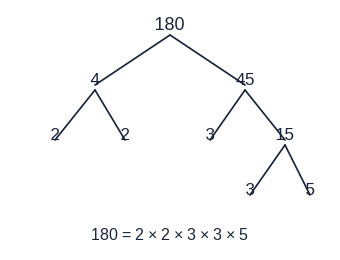
Multiply the leaves to check: . Every leaf must be prime. Do not stop at or .
The prime-factor method works for three numbers too. For the HCF, use only primes shared by all three. Take the smallest powers. For the LCM, use every prime that appears. Take the largest powers.
| Number | Prime factors |
|---|---|
The HCF is . The LCM is .
For three numbers, do not use “HCF times LCM equals their product”. Here the left side is , while the product is .
Let be the HCF of positive integers . Then
For our numbers, the pair HCFs are . So .
The matching identity is You can still use prime factors instead. These identities are an extra tool.
Here the pair LCMs are . Substitution gives for the HCF.
Two strips measure 96 cm and 144 cm. Cut them into the longest equal pieces without waste. Find the piece length and total number of pieces.
- The piece length must divide both strip lengths. Choose the HCF, because the question asks for the greatest common divisor.
- Prime factorisation gives and . A shared factor cannot use more copies of a prime than either strip provides.
- Take the smaller prime powers: HCF cm.
- The first strip gives pieces. The second gives pieces. Altogether there are pieces.
What changes if the strips measure 80 cm and 120 cm?
Answers
- The shared prime powers give HCF cm. The counts are and , giving pieces. Use HCF again because the required pieces must divide both lengths.
1.3 Revisiting Irrational Numbers
Trying several fractions cannot prove that no fraction works. A contradiction proof starts with an arbitrary fraction in lowest terms, so it covers every proposed rational representation.
Each later statement must follow from that assumption. When both numerator and denominator are forced to share a factor, the problem is with the original assumption.
The square root still exists on the number line; it simply has no fractional representation.
In ancient Greece, followers of Pythagoras believed that the whole universe was made of neat whole numbers and clean fractions. Then, a mathematician examined a simple square floor tile of side metre.
By Pythagoras’ theorem, the diagonal satisfies , so . When they tried to write as a fraction, they discovered it was completely impossible. The decimal never ends and never repeats: . Legend says they threw the mathematician overboard into the sea to protect their secret!
Let the prime factorisation of be . When you square , you get .
Notice that the prime factors of are the exact same primes as in , just doubled in exponent! So if a prime divides , it must already be one of the prime factors of .
To prove is irrational, we use the method of contradiction: we assume the exact opposite, and show that this assumption leads to an impossible logical contradiction.
- Step 1: Assume to the contrary that is rational. Then we can write , where and are coprime integers (they share no common factor other than ), and .
- Step 2: Rearrange to isolate : . Squaring both sides gives .
- Step 3: Since divides , divides . By our theorem, since is prime, ** divides **.
- Step 4: Since divides , we can write for some integer . Substitute back into :
- .
- Step 5: This means divides , which implies ** divides ** as well!
- Step 6 (The Contradiction): We have shown that divides both and . But in Step 1, we defined and as coprime (having no common factor other than )! This contradiction arose because of our incorrect assumption that is rational.
- Conclusion: is an irrational number.
Prove that 3 + 2√5 is an irrational number, given that √5 is irrational. [CBSE Board 2018, 2020, 2023, 3 Marks]
If is prime, then is irrational. In the proof for , replace by . The key step still works: if a prime divides a square, it divides the number being squared.
Euclid collected results about numbers and shapes around 300 BCE. Many centuries later, Carl Friedrich Gauss gave a careful account of prime factorisation in a book published in 1801. The key idea is that every number has its own prime-factor structure.
Prove that the square root of three is irrational. Then explain how the proof changes for the square roots of two and five.
- Assume , where are integers, is nonzero and the fraction is in lowest terms. This is the opposite of what we want to prove.
- Square both sides to obtain . Thus the prime three divides . Prime factorisation implies that three divides .
- Write for an integer . Substitution gives . Divide by three to obtain . Therefore three divides as well.
- Both numerator and denominator have a factor three. That contradicts the lowest-terms assumption. Reject the rational representation, so the square root of three is irrational.
Prove the corresponding statements for the square roots of two and five.
Answers
- For two, assume in lowest terms. Then and substitution yields . Both integers are divisible by two, a contradiction. For five, gives and then . Both are divisible by five, again a contradiction. Both square roots are irrational.
Exercise 1.1 — Prime factors and divisibility
Exercise 1.2 — Irrationality
1.4 Summary
- Euclid’s Division Lemma: For given positive integers a and b, there exist unique integers q and r satisfying a = bq + r, with 0 ≤ r < b.
- The Fundamental Theorem of Arithmetic: Every composite number has a unique prime factorisation up to the order of factors.
- HCF takes the minimum power of common prime factors; LCM takes the maximum power of all prime factors.
- Product rule: For two positive integers a and b, HCF(a, b) × LCM(a, b) = a × b.
- A number whose square is divisible by a prime p must itself be divisible by p.
- Numbers like √2, √3, √5 and their sums/products with non-zero rationals are irrational.