12. Surface Areas and Volumes
12. About this chapter
Big idea: For joined solids, count exposed surfaces and occupied space separately.
Read one small part at a time. Try each example on paper. Then cover the answers and do the practice. Use the diagrams to explain your thinking.
| Word | Meaning |
|---|---|
| Solid | A three-dimensional shape. |
| Surface area | The total area of the exposed surfaces. |
| Volume | The space occupied or held. |
12.1 Introduction
Volume measures occupied space. Surface area measures the outside covering.
Capacity measures the usable inside space of a container. A diagram should show whether dimensions are internal or external.
Radius is half a diameter; slant height is different from perpendicular height. Before calculating, name the basic solids making up the object and list the measurements required for each one.
A solid takes up space. We can build one solid by joining simpler solids, such as a cylinder and a cone.
Surface area counts the exposed skin. Volume counts the space inside. When two solids join, their touching faces are hidden. Do not count those faces in the outer area.
| Solid | Curved or lateral area | Volume |
|---|---|---|
| Cylinder | ||
| Cone | , where | |
| Sphere | ||
| Hemisphere |
A cylinder with both flat ends exposed has total area . A cone with its base exposed has total area . A hemisphere including its flat base has total area . These distinctions matter more than memorising a single formula.
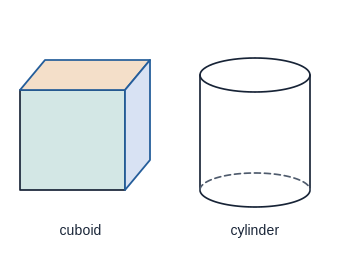
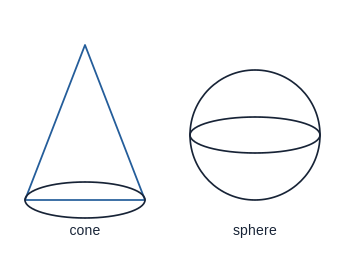
| Solid | Total area when all faces are exposed | Volume |
|---|---|---|
| Cuboid | ||
| Cube of side a | ||
| Closed cylinder | ||
| Cone with base | ||
| Hemisphere with flat base |
For a cuboid, mean length, breadth and height. A cube has all three lengths equal. For a cone, means slant height instead. The same letter can have different meanings in different formulas, so read its definition.
A hemisphere is half a sphere. Its curved area is . Its flat circular base adds if exposed. That makes total area .
12.2 Surface Area of a Combination of Solids
Joining solids can hide faces without changing the material in the solids. List the visible surfaces before substituting values.
A flat face glued completely to another face contributes nothing to the outside area. A partly covered face contributes only its uncovered region.
A cavity adds a new inside surface if that surface is exposed. A surface ledger is safer than guessing whether to add or subtract two complete total-area formulas.
A closed container has a cylinder of radius cm and height cm topped by a hemisphere of the same radius. The visible surface contains the cylinder’s curved surface, the hemisphere’s curved surface, and one bottom disc. The circular join is internal.
The area is cm². Adding the complete surface areas of both original solids would count the hidden join twice.
A cone of radius cm and height cm is attached to a cylinder of radius cm and height cm. The cone slant height is cm. With the cylinder bottom exposed, total outer area is cm².
A cavity changes which faces are exposed. A hemispherical hollow cut into a flat face replaces a flat circular patch with a curved interior surface. Subtract the removed patch and add the new curved surface. The interior surface is still exposed to the air inside the cavity.
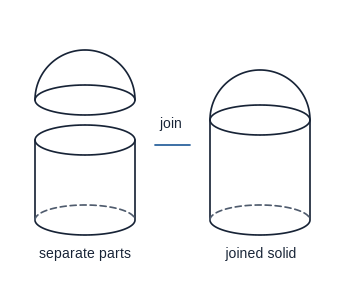
In the joined shape, the hemisphere’s flat base and the cylinder’s top disc are hidden. The outer surface has the cylinder’s curved side, the dome and the bottom disc.
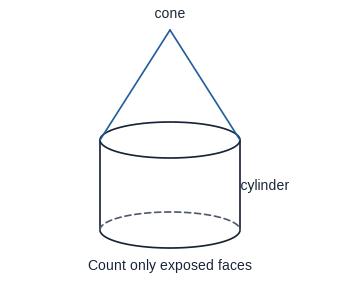
Now put a cone of base radius on a cylinder of radius . The cone is wider. A ring of the cone’s base remains exposed underneath. Its area is . Do not throw away the whole cone base.
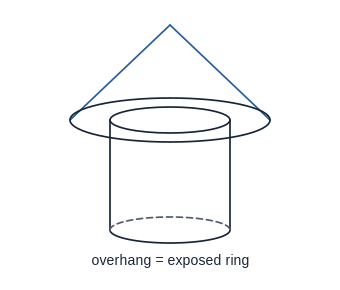
Let cone height be , so its slant height is . Let cylinder height be . Outer area is cone curved area , cylinder curved area , bottom and exposed ring . Total square units.
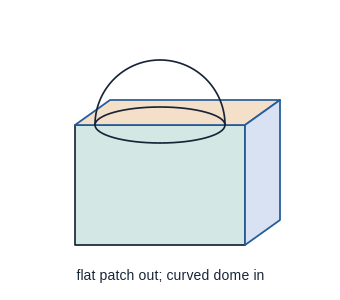
A cube of side has a hemisphere of radius on top. Cube area is . Remove the disc and add the dome . Outer area square units.
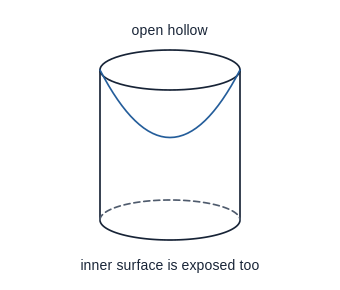
For a cylinder of radius and height with a hemispherical hollow of radius , count the cylinder side, bottom disc and hollow. Area . The hollow is not an extra volume of material.
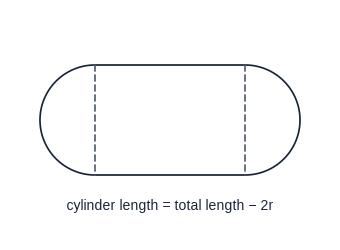
A capsule is cm long and has radius cm. The cylinder length is cm. Its outer area is cm². Its volume is cm³.
A tent has no floor. If it has cylindrical walls and a cone roof, count the curved cylinder and cone only. For radius , wall height and roof slant height , canvas area is square units.
A solid consists of a cylinder of radius 3 cm and height 8 cm, topped by a hemisphere of the same radius. The base is exposed. Find the external surface area in terms of pi.
- List visible surfaces: cylinder curved surface, hemisphere curved surface and cylinder bottom disk. The common joining disk is hidden.
- Cylinder curved area is square centimetres.
- Hemisphere curved area is . Base area is .
- Add the three exposed areas: square centimetres.
Keep the same radius but change the cylinder height to 5 cm. Find the exposed area.
Answers
- Cylinder curved area becomes . The hemisphere and base remain and . Total is square centimetres. Only the cylinder curved area depends on cylinder height.
12.3 Volume of a Combination of Solids
For non-overlapping solid pieces, add their volumes. For a cavity, subtract the removed volume from the original volume.
In recasting, the shape changes while the amount of material remains constant if none is lost. Calculate one small object volume before dividing the total material volume by it.
Decide whether a final fractional number is physically meaningful: whole manufactured objects may require rounding down and reporting unused material.
Add volumes when the parts do not overlap inside. Subtract the volume of a hole or hollow part.
If two parts overlap, adding both full volumes counts some space twice. Work out the shared space before adding.
For the radius-, height- cylinder with hemispherical top, The coefficient is approximately .
A solid cylinder of radius and height has a conical cavity with the same radius and height. Remaining volume is cubic units. The cavity removes space, regardless of how much new surface it creates.
When material is melted and recast with no loss, old volume equals total new volume. A sphere of radius becomes smaller spheres of radius . The number is . The radius ratio must be cubed, because volume scales with the cube of length.
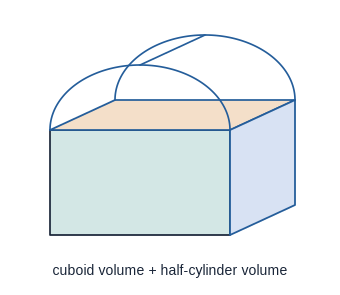
A room is m wide, m long and m high before the roof. A half-cylinder roof has radius m and length m.
Cuboid volume m³. Roof volume m³. Total m³.
If equipment fills m³, subtract it to estimate space left for air: m³. The roof radius is half the room’s width, not half its length.
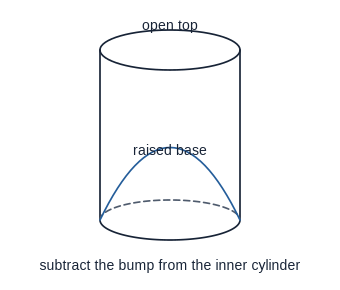
A cup has inner radius cm and height cm. Its cylindrical space would be cm³. A solid hemispherical bump of radius occupies cm³. Actual capacity is cm³.
A solid fully under water pushes aside its own volume of water. If the vessel starts full, that volume overflows. Assume no water is lost in another way.
A full cone has radius cm and height cm. Its volume is cm³. One-quarter overflows when small spheres are fully submerged. Overflow volume is cm³.
Each small sphere has radius cm and volume . The number is .
Suppose liquid fills percent of a capsule-shaped item. First find the whole volume, then multiply by .
For radius cm and total length cm, cylinder length is cm. Whole volume is cm³. The liquid portion is cm³.
Density means mass per unit volume. With density g/cm³ and volume cm³, mass is g. Keep the volume unit consistent with the density unit.
For a pole made of two cylinders, add their volumes first. If radii are and cm, and heights are and cm, volume is cm³. At density g/cm³, mass is g.
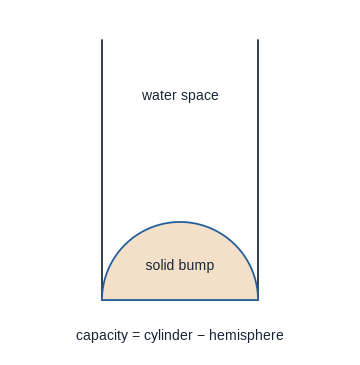
Use the cup example in this section: inner radius cm, total inner height cm.
- The full cylinder would hold cm³.
- The solid bump takes up cm³.
- The water capacity is cm³.
The height of the cylinder stays ten. Do not subtract three from the height and then use a shorter cylinder. The curved bump does not fill a flat layer.
Exercise 12.1 — Exposed surfaces
Exercise 12.2 — Volumes
12.4 Summary
- List the exposed faces before calculating surface area.
- Include cavity surfaces but remove hidden joins.
- Add volumes of non-overlapping pieces and subtract cavities.
- Volume is conserved in a loss-free recasting.
- Length, area and volume scale by k, k² and k³.