14. Probability
14. About this chapter
Big idea: Count outcomes fairly before comparing chances.
Read one small part at a time. Try each example on paper. Then cover the answers and do the practice. Use the diagrams to explain your thinking.
| Word | Meaning |
|---|---|
| Outcome | One possible result. |
| Event | A set of outcomes. |
| Complement | All outcomes outside an event. |
14.1 Probability — A Theoretical Approach
Probability begins with a clearly defined trial. List the possible outcomes, then define the event as a subset of that list.
The favourable-outcomes fraction applies when individual outcomes are equally likely. A category with many underlying outcomes is not necessarily as likely as another category.
For two dice, keep ordered pairs distinct. For a draw after removal, update the contents before calculating the next probability.
An experiment is a process whose result is not known in advance. The sample space is the full set of possible outcomes. An event is a group of outcomes we are interested in.
For a finite set of equally likely outcomes, Favourable means included in our event. It does not mean the outcome is good or desirable.
Equally likely means each outcome has the same chance. A fair die gives each face the same chance. A spinner with unequal regions may not.
Experimental probability uses results we have observed. Theoretical probability uses a model of what could happen. We will compare them later.
A bag contains green, blue and white tiles. One tile is selected so that every tile is equally likely. There are outcomes at the individual-tile level. Probability of blue is . Colours are not equally likely because their counts differ.
Probabilities lie between zero and one. An impossible event has probability zero; a sure event has probability one. The complementary event, “not E”, contains all outcomes outside . Since these two sets partition the sample space, .
Under an independent fair-toss model the ordered outcomes are , all equally likely. Exactly one head occurs in or , giving probability . At least one head is the complement of , so its probability is . The three labels “zero, one, two heads” are not equally likely outcomes.
Two independent fair dice produce equally likely ordered pairs. A sum of occurs in : five outcomes, so probability is . A sum of has only one outcome. Possible sums are not equally likely.
A standard deck has distinct cards, with four suits of thirteen cards. Each suit contains one ace, one king, one queen and one jack. In a uniform single draw, the probability of a king is , and the probability of a face card is . Specify the deck and the selection rule.
An elementary event contains exactly one outcome. For one die, “get a 4” is elementary. “Get an even number” is not: it contains three outcomes.
The probabilities of all elementary outcomes add to one. One of the possible outcomes must happen, and two different single outcomes cannot happen on the same trial.
| Die 1 / Die 2 | 1 | 2 | 3 | 4 | 5 | 6 |
|---|---|---|---|---|---|---|
| 1 | (1, 1) | (1, 2) | (1, 3) | (1, 4) | (1, 5) | (1, 6) |
| 2 | (2, 1) | (2, 2) | (2, 3) | (2, 4) | (2, 5) | (2, 6) |
| 3 | (3, 1) | (3, 2) | (3, 3) | (3, 4) | (3, 5) | (3, 6) |
| 4 | (4, 1) | (4, 2) | (4, 3) | (4, 4) | (4, 5) | (4, 6) |
| 5 | (5, 1) | (5, 2) | (5, 3) | (5, 4) | (5, 5) | (5, 6) |
| 6 | (6, 1) | (6, 2) | (6, 3) | (6, 4) | (6, 5) | (6, 6) |
Read a cell as (first die, second die). There are cells. Equal sums do not mean equal numbers of cells.
| Sum | 2 | 3 | 4 | 5 | 6 | 7 | 8 | 9 | 10 | 11 | 12 |
|---|---|---|---|---|---|---|---|---|---|---|---|
| Count | 1 | 2 | 3 | 4 | 5 | 6 | 5 | 4 | 3 | 2 | 1 |
| Probability | 1/36 | 2/36 | 3/36 | 4/36 | 5/36 | 6/36 | 5/36 | 4/36 | 3/36 | 2/36 | 1/36 |
Sum has the most cells: six. Sums and each have one. That is why the eleven possible sums are not equally likely.
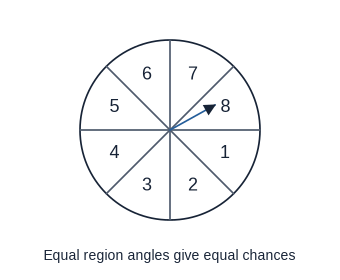
On this ideal fair spinner, even numbers occupy four of eight regions, so probability is . A fair lettered die with faces gives . Different letter labels are not equally likely if one appears twice.
| First toss H | First toss T |
|---|---|
| HHH | THH |
| HHT | THT |
| HTH | TTH |
| HTT | TTT |
For three independent fair tosses, all eight outcomes are equally likely. Exactly two heads occurs in . Probability . All three the same occurs in , giving .
A bag has red and blue counters. A blue counter is removed and not replaced. Now the bag has red and blue, with total . The next-draw red probability is , not .
The colour of the removed counter is known here. If it were unknown, we would need a different argument. State what information the problem gives.
On two independent fair die rolls, “no six” has choices on each roll. That gives out of pairs. So “at least one six” has probability .
Early probability work grew from questions about games of chance. Girolamo Cardano studied these questions in the sixteenth century.
Jacob Bernoulli and Abraham de Moivre developed the methods further in the seventeenth and eighteenth centuries. Pierre-Simon Laplace wrote an important account in 1812. Today probability also helps us study science and data.
Some models choose a point anywhere in a continuous interval or region. There are infinitely many points, so we cannot use a finite outcome count.
If every equal-length part of an interval has the same chance, use favourable length divided by total length. If every equal-area part of a region has the same chance, use favourable area divided by total area. These rules need a uniform model.
A time is chosen uniformly between 0 and 120 seconds. The highlighted first 30 seconds occupy one-quarter of the interval.
The probability of the first seconds is . This does not follow merely from “random”; we also assumed equal chance per unit time.
A point is chosen uniformly inside a 12 by 8 rectangle. The smaller 3 by 4 region has one-eighth of the total area.
Whole area . Target area . Probability .
A radius-1 circle lies inside a 6 by 4 rectangle. A uniform point lands in the circle with probability π/24.
Circle area is . Rectangle area is . Probability is , approximately . The source textbook marks this kind of extension as outside its examination focus.
A bag contains 5 blue counters, 3 green counters and 2 orange counters. Counters have the same size and shape and are well mixed. One is drawn. Find the probability of not drawing green.
- Count individual counters: total . Colour categories themselves are not equally likely.
- Not green includes blue and orange. These events do not overlap for a single counter, so their counts can be added.
- Favourable count . Probability is .
- Check with the complement. Green has probability , so not green has probability .
One blue counter is removed. Find the probability of green on a new draw from the remaining bag.
Answers
- There are still green counters but only counters in total. Probability is . Update the denominator because the bag has changed.
Exercise 14.1 — Theoretical probability
14.2 Summary
- Define the experiment, sample space and event.
- Use counting ratios only for equally likely outcomes.
- Probabilities range from zero to one.
- Complements add to one.
- Ordered outcomes matter for successive tosses or distinguishable dice.